
慢性髓性白血病中的免疫效应恢复与无治疗缓解
Immune Effector Recovery in Chronic Myeloid Leukemia and Treatment-Free Remission.
作者信息
Hughes Amy, Yong Agnes S M
机构信息
Department of Haematology, SA Pathology, Adelaide, SA, Australia.
Cancer Theme, South Australia Health and Medical Research Institute (SAHMRI), Adelaide, SA, Australia.
出版信息
Front Immunol. 2017 Apr 24;8:469. doi: 10.3389/fimmu.2017.00469. eCollection 2017.
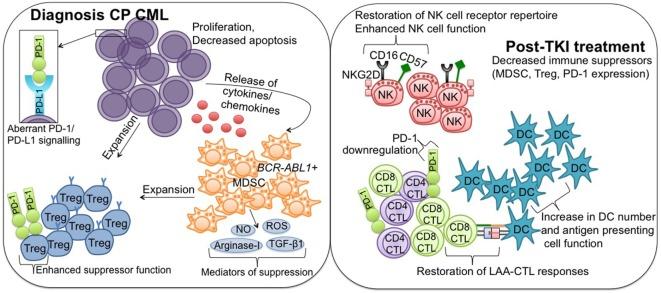
Chronic myeloid leukemia (CML) is a hematological cancer, characterized by a reciprocal chromosomal translocation between chromosomes 9 and 22 [t(9;22)], producing the Bcr-Abl oncogene. Tyrosine kinase inhibitors (TKIs) represent the standard of care for CML patients and exert a dual mode of action: direct oncokinase inhibition and restoration of effector-mediated immune surveillance, which is rendered dysfunctional in CML patients at diagnosis, prior to TKI therapy. TKIs such as imatinib, and more potent second-generation nilotinib and dasatinib induce a high rate of deep molecular response (DMR, ≤ 0.01%) in CML patients. As a result, the more recent goal of therapy in CML treatment is to induce a durable DMR as a prelude to successful treatment-free remission (TFR), which occurs in approximately half of all CML patients who cease TKI therapy. The lack of overt relapse in such patients has been attributed to immunological control of CML. In this review, we discuss an immunological timeline to successful TFR, focusing on the immunology of CML during TKI treatment; an initial period of immune suppression, limiting antitumor immune effector responses in newly diagnosed CML patients, linked to an expansion of immature myeloid-derived suppressor cells and regulatory T cells and aberrant expression of immune checkpoint signaling pathways, including programmed death-1/programmed death ligand-1. Commencement of TKI treatment is associated with immune system re-activation and restoration of effector-mediated [natural killer (NK) cell and T cell] immune surveillance in CML patients, albeit with differing frequencies in concert with differing levels of molecular response achieved on TKI. DMR is associated with maximal restoration of immune recovery in CML patients on TKI. Current data suggest a net balance between both the effector and suppressor arms of the immune system, at a minimum involving mature, cytotoxic CD56 NK cells may be important in mediating TFR success. However, a major goal remains in CML to identify the most effective pathways to target to maximize an advantageous immune response and promote TFR success.
慢性髓性白血病(CML)是一种血液系统癌症,其特征是9号和22号染色体之间发生相互易位[t(9;22)],产生Bcr-Abl癌基因。酪氨酸激酶抑制剂(TKIs)是CML患者的标准治疗药物,具有双重作用模式:直接抑制癌激酶和恢复效应器介导的免疫监视,在TKI治疗之前,CML患者在诊断时这种免疫监视功能失调。伊马替尼等TKIs以及更有效的第二代尼洛替尼和达沙替尼在CML患者中诱导出高比例的深度分子反应(DMR,≤0.01%)。因此,CML治疗中更近的治疗目标是诱导持久的DMR,作为成功的无治疗缓解(TFR)的前奏,约一半停止TKI治疗的CML患者会出现TFR。此类患者缺乏明显复发归因于CML的免疫控制。在本综述中,我们讨论了成功实现TFR的免疫时间线,重点关注TKI治疗期间CML的免疫学;免疫抑制的初始阶段,限制新诊断CML患者的抗肿瘤免疫效应反应,这与未成熟髓系来源抑制细胞和调节性T细胞的扩增以及免疫检查点信号通路的异常表达有关,包括程序性死亡-1/程序性死亡配体-1。TKI治疗的开始与CML患者免疫系统的重新激活和效应器介导的(自然杀伤(NK)细胞和T细胞)免疫监视的恢复相关,尽管频率不同,这与TKI治疗所达到的不同分子反应水平一致。DMR与接受TKI治疗的CML患者免疫恢复的最大程度恢复相关。目前的数据表明,免疫系统效应器和抑制器分支之间的净平衡,至少涉及成熟的细胞毒性CD56 NK细胞,可能对介导TFR成功很重要。然而,CML的一个主要目标仍然是确定最有效的靶向途径,以最大化有利的免疫反应并促进TFR成功。
 Zotero 插件