Schoch Bradley S, Padegimas Eric M, Maltenfort Mitchell, Krieg James, Namdari Surena
Department of Orthopaedics and Rehabilitation, University of Florida, Gainesville, FL, USA.
Department of Orthopedics, Thomas Jefferson University, Philadelphia, PA, USA.
J Orthop Traumatol. 2017 Sep;18(3):259-263. doi: 10.1007/s10195-017-0459-6. Epub 2017 May 8.
The incidence of humeral shaft fractures has been increasing over time. This represents a growing public health concern in a climate of cost containment. The purpose of this study is to analyze national trends in surgical management of humeral shaft fractures and determine factors predictive of surgical intervention.
Humeral shaft fractures were identified by the International Classification of Diseases, Ninth Revision, Clinical Modification codes 812.21 and 812.31 in the United States Nationwide Inpatient Sample from 2002 to 2011. Open reduction and internal fixation (ORIF) was identified by code 79.31 (ORIF, humerus). Other case codes analyzed were 79.01 (closed reduction without internal fixation), 79.11 (closed reduction with internal fixation), and 79.21 (open reduction without internal fixation). Multivariate regression analysis was utilized to determine predictive factors for utilization of ORIF.
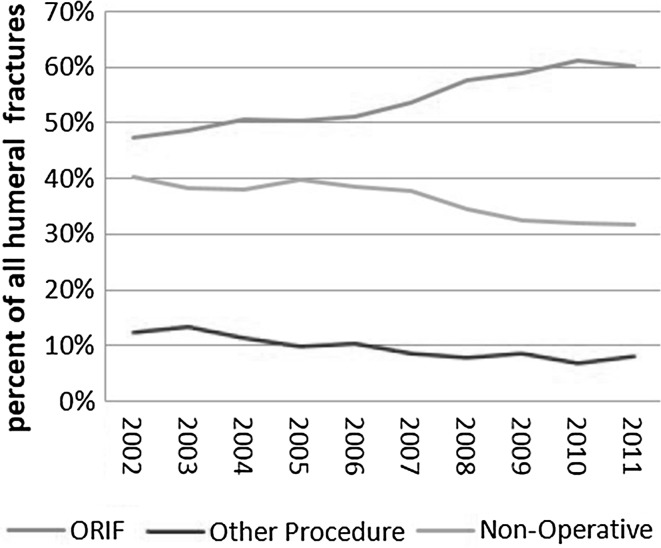
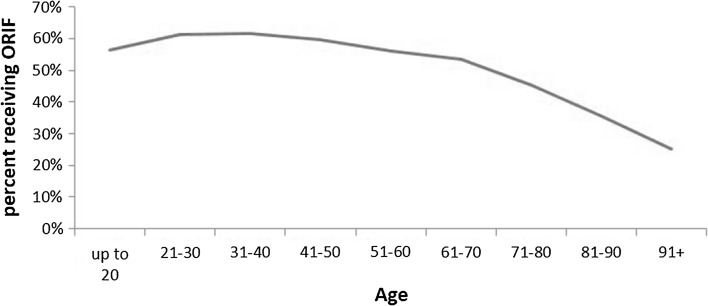
27,908 humeral shaft fractures were identified. Utilization of ORIF increased from 47.2% of humeral shaft fractures in 2002 to 60.3% in 2011. Demographically, patients who underwent ORIF were younger (51.5 versus 59.7 years, p < 0.001; odds ratio 0.87 per decade of age). There were modest increases in ORIF usage with private insurance, open fracture, and hospital size, which persisted with multivariate regression analysis. Surprisingly, there was a tendency to shift from a slight increase in ORIF for males with the bivariate case to a slight preference for females in the multivariate case.
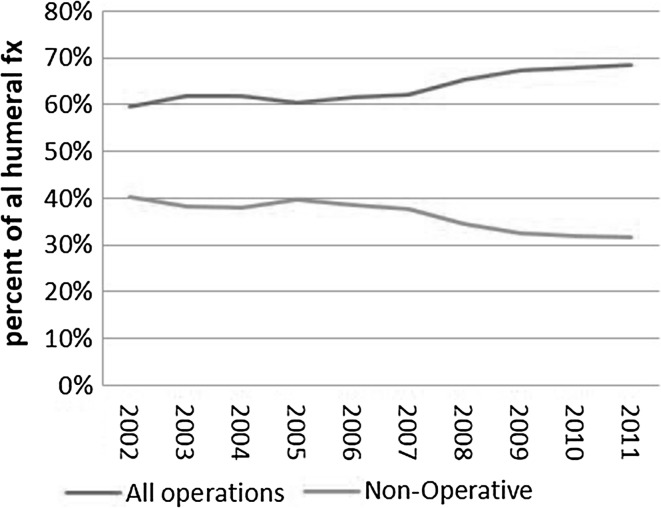
Utilization of ORIF for humeral shaft fractures has been steadily increasing with time. Surgical intervention was more common with younger patients, female gender, private insurance, and larger hospital size. The increasing incidence of surgical management for humeral shaft fractures may represent a public health burden given the historical success of non-operative management.
IV.
肱骨干骨折的发病率随时间不断上升。在成本控制的大环境下,这已成为一个日益严重的公共卫生问题。本研究的目的是分析肱骨干骨折手术治疗的全国趋势,并确定预测手术干预的因素。
通过国际疾病分类第九版临床修订本代码812.21和812.31,在美国全国住院患者样本中识别2002年至2011年的肱骨干骨折。切开复位内固定术(ORIF)通过代码79.31(肱骨ORIF)识别。分析的其他病例代码为79.01(闭合复位无内固定)、79.11(闭合复位有内固定)和79.21(切开复位无内固定)。采用多因素回归分析确定ORIF使用的预测因素。
共识别出27908例肱骨干骨折。ORIF的使用率从2002年肱骨干骨折的47.2%增加到2011年的60.3%。从人口统计学角度来看,接受ORIF治疗的患者更年轻(51.5岁对59.7岁,p<0.001;每增加十岁年龄的比值比为0.87)。使用私人保险、开放性骨折和医院规模较大时,ORIF的使用有适度增加,多因素回归分析后这种情况依然存在。令人惊讶的是,在多因素分析中,出现了从双变量分析中男性ORIF略有增加到女性略有偏好的转变。
随着时间的推移,肱骨干骨折的ORIF使用率一直在稳步上升。手术干预在年轻患者、女性、私人保险和医院规模较大时更为常见。鉴于非手术治疗的历史成功,肱骨干骨折手术治疗发病率的增加可能代表着一种公共卫生负担。
IV级。