Miao Zhijiang, Xie Zhenrong, Miao Jing, Ran Jieyu, Feng Yue, Xia Xueshan
Faculty of Life Science and Technology, Kunming University of Science and Technology, Kunming 650500, China.
Yunnan Institute of Digestive Disease, the First Affiliated Hospital of Kunming Medical University, Kunming 650032, China.
Viruses. 2017 May 9;9(5):100. doi: 10.3390/v9050100.
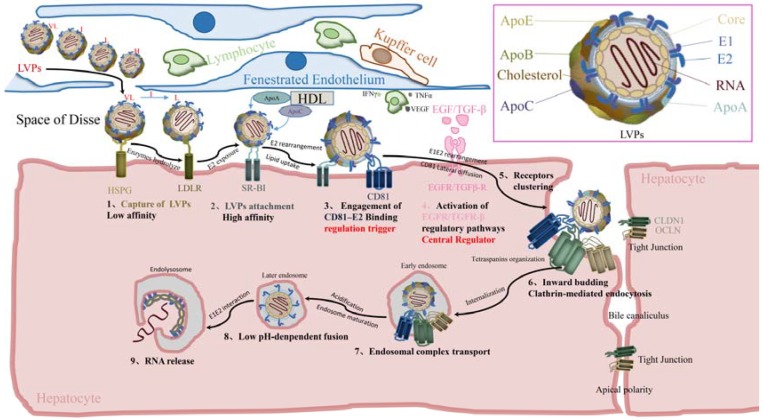
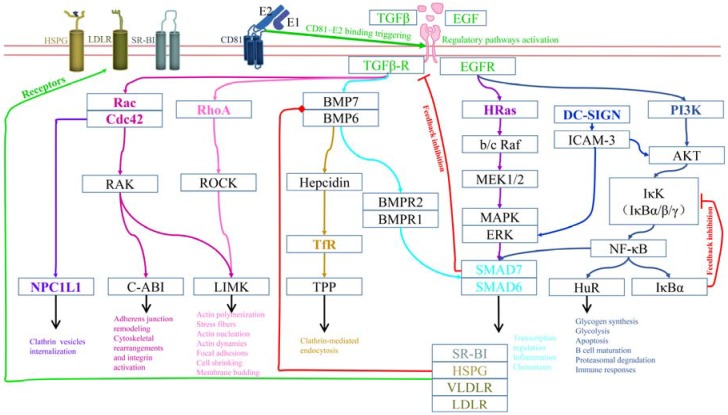
Hepatitis C virus (HCV) is a model for the study of virus-host interaction and host cell responses to infection. Virus entry into hepatocytes is the first step in the HCV life cycle, and this process requires multiple receptors working together. The scavenger receptor class B type I (SR-BI) and claudin-1 (CLDN1), together with human cluster of differentiation (CD) 81 and occludin (OCLN), constitute the minimal set of HCV entry receptors. Nevertheless, HCV entry is a complex process involving multiple host signaling pathways that form a systematic regulatory network; this network is centrally controlled by upstream regulators epidermal growth factor receptor (EGFR) and transforming growth factor β receptor (TGFβ-R). Further feedback regulation and cell-to-cell spread of the virus contribute to the chronic maintenance of HCV infection. A comprehensive and accurate disclosure of this critical process should provide insights into the viral entry mechanism, and offer new strategies for treatment regimens and targets for HCV therapeutics.
丙型肝炎病毒(HCV)是研究病毒与宿主相互作用以及宿主细胞对感染反应的模型。病毒进入肝细胞是HCV生命周期的第一步,这一过程需要多种受体协同作用。B类I型清道夫受体(SR-BI)和紧密连接蛋白-1(CLDN1),与人分化簇(CD)81和闭合蛋白(OCLN)一起,构成了HCV进入受体的最小集合。然而,HCV进入是一个复杂的过程,涉及多个宿主信号通路,这些信号通路形成一个系统的调控网络;该网络由上游调节因子表皮生长因子受体(EGFR)和转化生长因子β受体(TGFβ-R)集中控制。病毒的进一步反馈调节和细胞间传播有助于HCV感染的慢性维持。对这一关键过程的全面准确揭示应能深入了解病毒进入机制,并为治疗方案提供新策略以及HCV治疗的靶点。