Challa Divya N V, Crowson Cynthia S, Davis John M
Division of Rheumatology, Department of Medicine, Mayo Clinic, Rochester, MN, USA.
Division of Biostatistics and Informatics, Department of Health Sciences Research, Mayo Clinic, Rochester, MN, USA.
Rheumatol Ther. 2017 Jun;4(1):201-208. doi: 10.1007/s40744-017-0063-5. Epub 2017 May 9.
The patient global assessment of disease activity is a crucial component of various measures of disease activity in rheumatoid arthritis (RA). Our objective was to identify underlying latent traits driving the patient global assessment using a quantitative, multivariable data reduction approach.
This was a prospective cross-sectional study of consecutive patients with RA. The patient sample was stratified to include 50 patients with patient-provider discordance (i.e., at least 25-mm absolute difference between the patient and provider global assessments) and 20 patients with patient-provider concordance (i.e., less than 25-mm absolute difference between the patient and provider global assessments). Data were collected from the most recent rheumatology visit, including patient characteristics, current RA medications, and comorbidities. Participants completed several validated patient-reported outcome measures. The data were evaluated using factor analysis, and then linear regression was used to determine the variability in the patient global assessment explained by the factor scores.
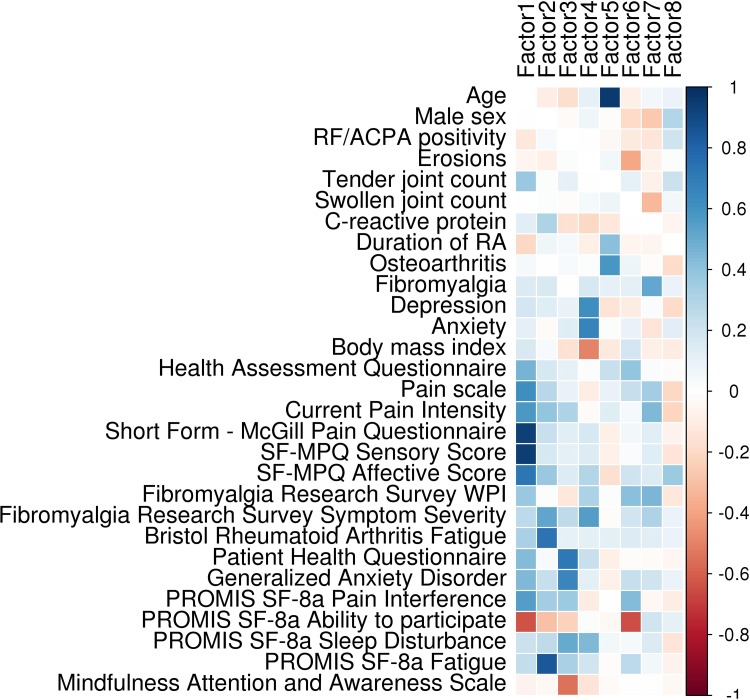
The study included 70 patients with mean age of 61 years, 73% female, and with mean disease duration of 8 years. The means (SD) for the patient and provider global assessments were 44.6 (22.7) and 20.1 (17.7), respectively. Factor analysis yielded eight factors that represented measurements of pain, fatigue, depression or anxiety symptoms, prior diagnosis of depression or anxiety, advanced age and degenerative arthritis, inability to participate, fibromyalgia (clinical diagnosis and Widespread Pain Index), and undetermined. Linear regression analysis showed that fibromyalgia explained the greatest proportion of the variance in the patient global assessment followed by the other factors.
Latent factors underlying the patient global assessment include pain, depression and anxiety, inability to participate, fibromyalgia, advanced age, and degenerative arthritis.
患者对疾病活动的整体评估是类风湿关节炎(RA)各种疾病活动度测量的关键组成部分。我们的目标是使用定量多变量数据降维方法来识别驱动患者整体评估的潜在特质。
这是一项对连续的RA患者进行的前瞻性横断面研究。患者样本分层包括50例患者与医疗服务提供者评估不一致(即患者与医疗服务提供者的整体评估之间至少有25毫米的绝对差异)和20例患者与医疗服务提供者评估一致(即患者与医疗服务提供者的整体评估之间绝对差异小于25毫米)。从最近的风湿病就诊中收集数据,包括患者特征、当前的RA药物治疗和合并症。参与者完成了多项经过验证的患者报告结局测量。使用因子分析对数据进行评估,然后使用线性回归来确定由因子得分解释的患者整体评估中的变异性。
该研究纳入了70例患者,平均年龄61岁,73%为女性,平均病程8年。患者和医疗服务提供者的整体评估均值(标准差)分别为44.6(22.7)和20.1(17.7)。因子分析产生了八个因子,分别代表疼痛、疲劳、抑郁或焦虑症状、既往抑郁或焦虑诊断、高龄和退行性关节炎、无法参与、纤维肌痛(临床诊断和广泛性疼痛指数)以及未确定。线性回归分析表明,纤维肌痛解释了患者整体评估中最大比例的方差,其次是其他因子。
患者整体评估背后的潜在因素包括疼痛、抑郁和焦虑、无法参与、纤维肌痛、高龄和退行性关节炎。