Kay Jeffrey, Memon Muzammil, Rogozinsky Joelle, de Sa Darren, Simunovic Nicole, Seil Romain, Karlsson Jon, Ayeni Olufemi Rolland
Michael G. DeGroote School of Medicine, McMaster University, Hamilton, ON, Canada.
Department of Medicine and School of Physical and Occupational Therapy, McGill University, Montreal, Canada.
J Exp Orthop. 2017 Dec;4(1):15. doi: 10.1186/s40634-017-0090-8. Epub 2017 May 10.
The purpose of this study was to evaluate the frequency with which free papers presented at the 2008 and 2010 European Society of Sports Traumatology Knee Surgery and Arthroscopy (ESSKA) congress were ultimately published in peer-reviewed journals. Moreover, this study evaluated whether any correlations exist between the level of evidence of the free papers and their frequency of publication or the impact factor of the journals in which they are published.
Free papers presented at the 2008 and 2010 ESSKA congresses were included for assessment. Clinical papers (observational studies and trials involving direct interaction between an investigator and human subjects) were graded for level of evidence by two independent reviewers. A comprehensive strategy was used to search the databases PubMed, Ovid (MEDLINE), and EMBASE for all publications corresponding to the included free papers.
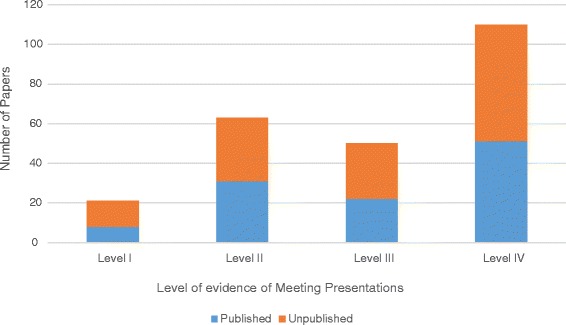
Three hundred-ninety presentations were evaluated, of which 215 (55%) were ultimately published in a peer-reviewed journal within five years of the presentation date. The mean time from presentation to publication was 16 months (SD 25 months). There was no significant difference in the distribution of the level of evidence between studies that were ultimately published, versus those that were not published (n.s.). The level of evidence of the published study was not a significant predictor of the impact factor of the journal in which it was published (n.s.). Presentations were most commonly published in Knee Surgery, Sports Traumatology, Arthroscopy (24%) and The American Journal of Sports Medicine (22%).
Free papers at the 2008 and 2010 ESSKA congress were published at a frequency that is comparable to that at other orthopaedic meetings. The publication rate was similar across all levels of evidence. Further encouragement of manuscript preparation and submission following these meetings could help to ensure important research findings are disseminated to large audiences.
本研究旨在评估在2008年和2010年欧洲运动创伤学、膝关节外科与关节镜学会(ESSKA)大会上发表的大会发言论文最终在同行评审期刊上发表的频率。此外,本研究还评估了大会发言论文的证据水平与其发表频率或发表期刊的影响因子之间是否存在任何相关性。
纳入2008年和2010年ESSKA大会上发表的大会发言论文进行评估。临床论文(涉及研究者与人类受试者直接互动的观察性研究和试验)由两名独立评审员对证据水平进行分级。采用综合策略在PubMed、Ovid(MEDLINE)和EMBASE数据库中搜索与纳入的大会发言论文对应的所有出版物。
共评估了390篇大会发言论文,其中215篇(55%)在发言日期后的五年内最终发表在同行评审期刊上。从发言到发表的平均时间为16个月(标准差25个月)。最终发表的研究与未发表的研究在证据水平分布上无显著差异(无统计学意义)。已发表研究的证据水平并非其发表期刊影响因子的显著预测因素(无统计学意义)。大会发言论文最常发表在《膝关节外科、运动创伤学、关节镜》(24%)和《美国运动医学杂志》(22%)上。
2008年和2010年ESSKA大会上的大会发言论文发表频率与其他骨科会议相当。所有证据水平的发表率相似。在这些会议之后进一步鼓励稿件准备和提交有助于确保重要的研究结果能够传播给广大受众。