Takeuchi Hideya, Kawanaka Hirohumi, Fukuyama Seiichi, Kubo Nobuhide, Hiroshige Shoji, Yano Tokujiro
Department of Surgery, National Hospital Organization Beppu Medical Center, Beppu, Oita, Japan.
Clinical Research Institute, National Hospital Organization Beppu Medical Center, Beppu, Oita, Japan.
PLoS One. 2017 May 10;12(5):e0177137. doi: 10.1371/journal.pone.0177137. eCollection 2017.
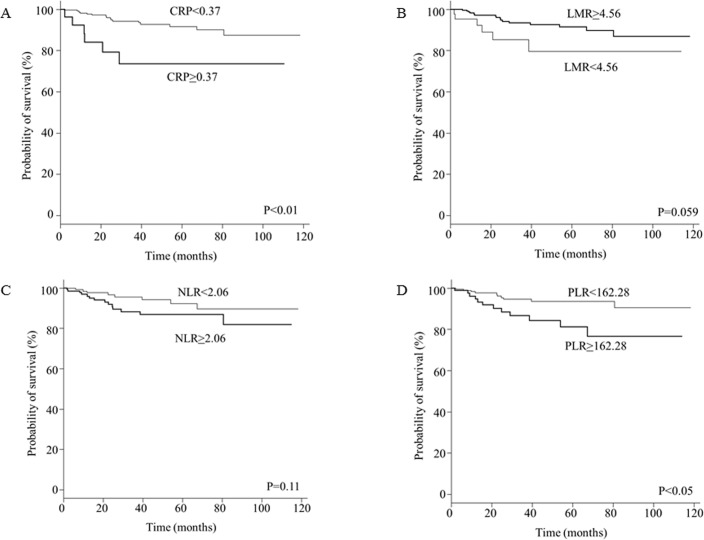
Peripheral blood-derived inflammation-based markers, including C-reactive protein (CRP), neutrophil-to-lymphocyte ratio (NLR), lymphocyte-to-monocyte ratio (LMR), and platelet-to-lymphocyte ratio (PLR) are indicators of prognosis in various malignant tumors. The present study aimed to identify the inflammation-based parameters that are most suitable for predicting outcomes in patients with breast cancer. Two hundred ninety-six patients who underwent surgery for localized breast cancer were reviewed retrospectively. The association between clinicopathological factors and inflammation-based parameters were investigated. Univariate and multivariate Cox regression analyses were performed to identify independent prognostic indicators associated with disease-free survival (DFS). The NLR level correlated significantly with tumor size (P<0.05). The PLR level correlated with the expression of estrogen receptor and lymph node involvement (P<0.05). Univariate analysis revealed that lower CRP and PLR values as well as tumor size, lymph node involvement, and nuclear grade were significantly associated with superior DFS (CRP: P<0.01; PLR, tumor size, lymph node involvement, and nuclear grade: P<0.05). On multivariate analysis, CRP (hazard ratio [HR]: 2.85, 95% confidence interval [CI]: 1.03-7.88, P<0.05), PLR (HR: 2.61, 95% CI: 1.07-6.36, P<0.05) and nuclear grade (HR: 3.066, 95% CI: 1.26-7.49, P<0.05) were significant prognostic indicators of DFS in patients with breast cancer. Neither LMR nor NLR significantly predicted DFS. Both preoperative CRP and PLR values were independently associated with poor prognosis in patients with breast carcinoma; these were superior to other inflammation-based scores in terms of prognostic ability.
外周血源性炎症标志物,包括C反应蛋白(CRP)、中性粒细胞与淋巴细胞比值(NLR)、淋巴细胞与单核细胞比值(LMR)以及血小板与淋巴细胞比值(PLR),是各种恶性肿瘤预后的指标。本研究旨在确定最适合预测乳腺癌患者预后的炎症相关参数。对296例接受局部乳腺癌手术的患者进行了回顾性分析。研究了临床病理因素与炎症相关参数之间的关联。进行单因素和多因素Cox回归分析,以确定与无病生存期(DFS)相关的独立预后指标。NLR水平与肿瘤大小显著相关(P<0.05)。PLR水平与雌激素受体表达及淋巴结受累相关(P<0.05)。单因素分析显示,较低的CRP和PLR值以及肿瘤大小、淋巴结受累和核分级与较好的DFS显著相关(CRP:P<0.01;PLR、肿瘤大小、淋巴结受累和核分级:P<0.05)。多因素分析显示,CRP(风险比[HR]:2.85,95%置信区间[CI]:1.03-7.88,P<0.05)、PLR(HR:2.61,95%CI:1.07-6.36,P<0.05)和核分级(HR:3.066,95%CI:1.26-7.49,P<0.05)是乳腺癌患者DFS的显著预后指标。LMR和NLR均未显著预测DFS。术前CRP和PLR值均与乳腺癌患者的不良预后独立相关;在预后能力方面,它们优于其他基于炎症的评分。