Chiu Hsien-Tsai, Li Tsai-Chung, Li Chia-Ing, Liu Chiu-Shong, Lin Wen-Yuan, Lin Cheng-Chieh
Department of Public Health, College of Public Health, China Medical University, Taichung, Taiwan.
Clinical Research Outcome and Training Center, Big Data Center, China Medical University Hospital, Taichung, Taiwan.
PLoS One. 2017 May 10;12(5):e0177184. doi: 10.1371/journal.pone.0177184. eCollection 2017.
This study aims to examine the association between visit-to-visit glucose variability, which was measured by coefficient of variation (CV) of fasting plasma glucose (FPG) and hemoglobin A1c (HbA1c), and risk of chronic obstructive pulmonary disease (COPD) in a large number of patients with type 2 diabetes with an average follow-up of 7.58 years.
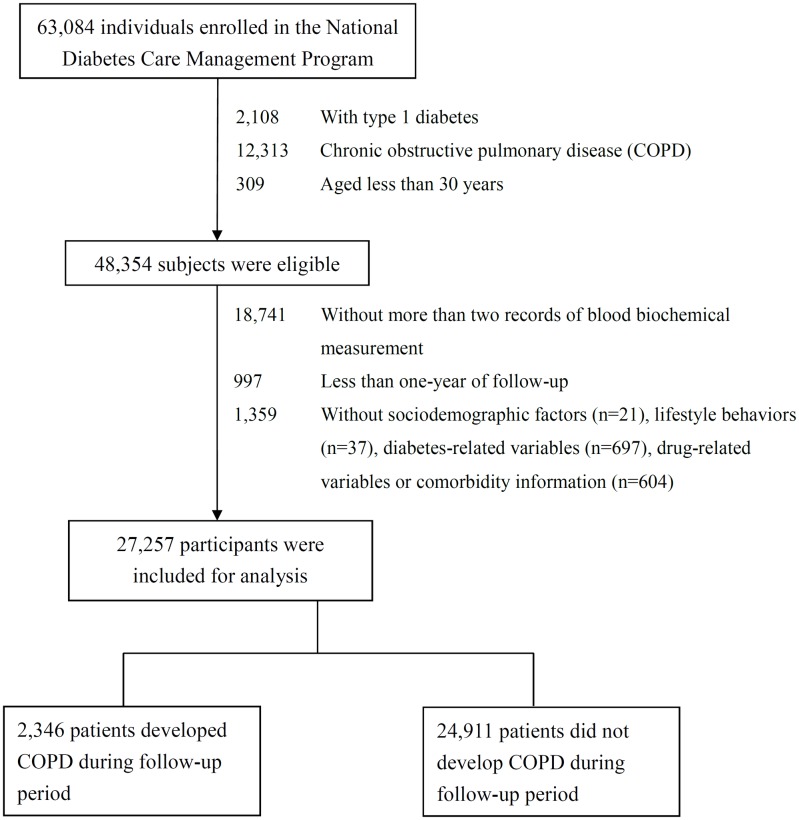
We conducted a retrospective cohort study on 27,257 patients with type 2 diabetes who participated in the National Diabetes Case Management Program in Taiwan. Visit-to-visit variability in HbA1c and FPG at baseline and the incidence of COPD were analyzed using a modified Cox proportional hazards model considering competing risks.
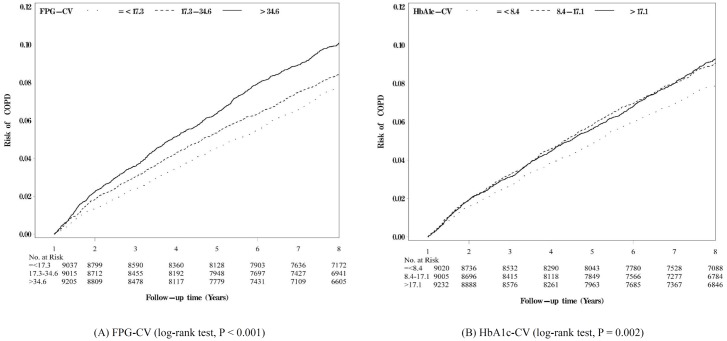
A total of 2,346 incident cases of COPD. Patients were grouped into tertiles of FPG-CV and HbA1c-CV. The incidence rates in the first, second, and third tertiles were 9.87, 11.06, and 13.19, respectively, for FPG-CV and 10.2, 11.81, and 12.07, for HbA1c-CV per 1000 person-years. After adjusting for age, gender, diabetes duration, treatment type, smoking, hypertension, hyperlipidemia, baseline FPG and HbA1c levels, and complications, both FPG-CV and HbA1c-CV were independently associated with COPD. The hazard ratios of COPD for the third terile compared with the first tertile of FPG-CV were 1.26 (95% confidence interval [CI]: 1.13-1.40). Moreover, the hazard ratios of COPD for the third and second tertiles compared with the first tertile of HbA1c-CV were 1.13 (1.02-1.25) and 1.13 (1.02-1.26), respectively.
Patients with FPG-CV higher than 34.6% or HbA1c-CV higher than 8.4% exhibited an increased risk of COPD. This finding confirmed the linear relationship of FPG-CV and HbA1c-CV to COPD. Visit-to-visit variability in FPG and HbA1c levels are strong predictors of COPD in patients with type 2 diabetes. Future studies should focus on lung dysfunction in diabetes, and adequate glucose control strategy in regular clinical practices must be established for COPD prevention.
本研究旨在探讨以空腹血糖(FPG)和糖化血红蛋白(HbA1c)变异系数(CV)衡量的就诊间血糖变异性与大量2型糖尿病患者慢性阻塞性肺疾病(COPD)风险之间的关联,平均随访时间为7.58年。
我们对参与台湾国家糖尿病病例管理计划的27257例2型糖尿病患者进行了一项回顾性队列研究。使用考虑竞争风险的改良Cox比例风险模型分析基线时HbA1c和FPG的就诊间变异性以及COPD的发病率。
共有2346例COPD发病病例。患者按FPG-CV和HbA1c-CV三分位数分组。FPG-CV每1000人年在第一、第二和第三三分位数中的发病率分别为9.87、11.06和13.19,HbA1c-CV分别为10.2、11.81和12.07。在调整年龄、性别、糖尿病病程、治疗类型、吸烟、高血压、高脂血症、基线FPG和HbA1c水平以及并发症后,FPG-CV和HbA1c-CV均与COPD独立相关。与FPG-CV第一三分位数相比,第三三分位数的COPD风险比为1.26(95%置信区间[CI]:1.13-1.40)。此外,与HbA1c-CV第一三分位数相比,第三和第二三分位数的COPD风险比分别为1.13(1.02-1.25)和1.13(1.02-1.26)。
FPG-CV高于34.6%或HbA1c-CV高于8.4%的患者COPD风险增加。这一发现证实了FPG-CV和HbA1c-CV与COPD之间的线性关系。FPG和HbA1c水平的就诊间变异性是2型糖尿病患者COPD的有力预测指标。未来的研究应关注糖尿病患者的肺功能障碍,并且必须在常规临床实践中建立适当的血糖控制策略以预防COPD。