Institute of Medicinal Plant Development, Chinese Academy of Medical Sciences and Peking Union Medical College, Beijing, 100193, China.
Sci Rep. 2017 May 10;7(1):1669. doi: 10.1038/s41598-017-01804-2.
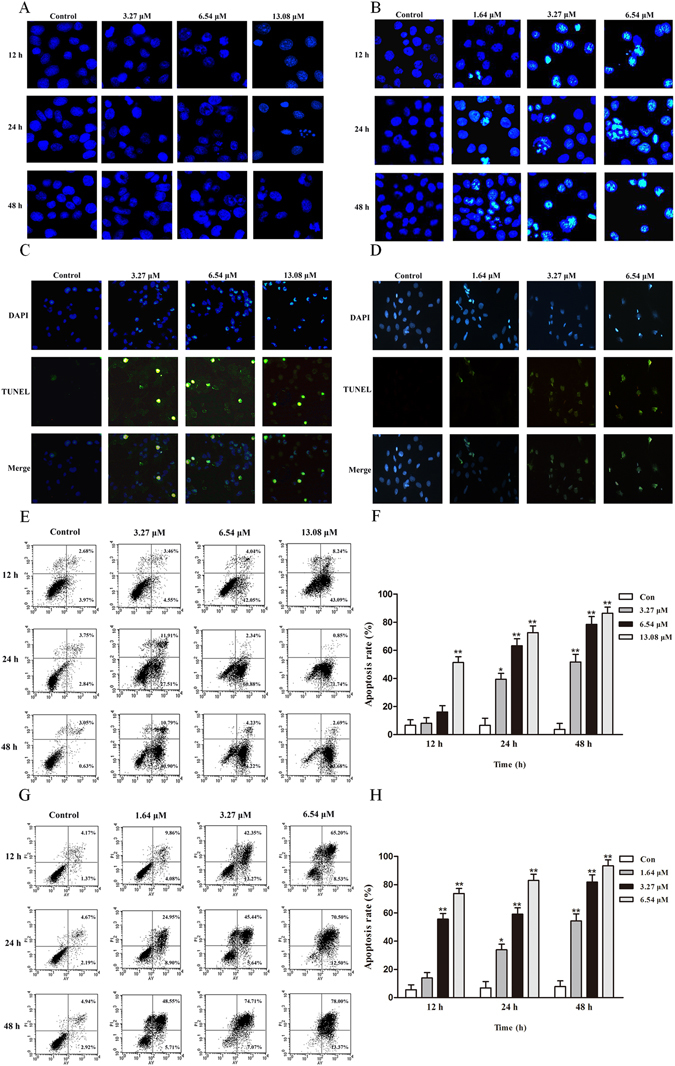
There is a strong rationale to therapeutically target the PI3K/Akt/mTOR and MAPK/ERK pathways in cervical carcinoma since they are highly deregulated in this disease. Previous study by our group have demonstrated that Zeylenone (Zey) exhibited strong suppressive activity on PI3K/AKT/mTOR and MAPK/ERK signaling, providing a foundation to investigate its antitumor activity in cervical carcinoma. Herein, the present study aimed to investigate suppressive effect of Zey on HeLa and CaSki cells, and further explore the underlying mechanisms. Cells were treated with Zey for indicated time, followed by measuring its effects on cell viability, colony formation, cell cycle, cell apoptosis, and signal pathways. In vivo antitumor activity of Zey was then assessed with nude xenografts. We found that Zey substantially suppressed cell proliferation, induced cell cycle arrest, and increased cell apoptosis, accompanied by increased production of ROS, decreased mitochondrial membrane potential, activated caspase apoptotic cascade, and attenuated PI3K/Akt/mTOR and MAPK/ERK pathways. Additionally, in vivo experiments showed that Zey exerted good antitumor efficacy against HeLa bearing mice models via decreasing levels of p-PI3K and p-ERK. Collectively, these data clearly demonstrated the antitumor activity of Zey in cervical carcinoma cells, which is most likely via the regulation of PI3K/Akt/mTOR and MAPK/ERK pathways.
在宫颈癌中,PI3K/Akt/mTOR 和 MAPK/ERK 途径高度失调,因此从治疗角度靶向这些途径具有很强的合理性。我们小组的先前研究表明,Zeylenone(Zey)对 PI3K/AKT/mTOR 和 MAPK/ERK 信号具有很强的抑制活性,为研究其在宫颈癌中的抗肿瘤活性提供了基础。在此,本研究旨在研究 Zey 对 HeLa 和 CaSki 细胞的抑制作用,并进一步探讨其潜在机制。用 Zey 处理细胞指定的时间,然后测量其对细胞活力、集落形成、细胞周期、细胞凋亡和信号通路的影响。然后用裸鼠异种移植评估 Zey 的体内抗肿瘤活性。我们发现 Zey 可显著抑制细胞增殖,诱导细胞周期停滞,并增加细胞凋亡,同时伴随着 ROS 产生增加、线粒体膜电位降低、半胱天冬酶凋亡级联激活以及 PI3K/Akt/mTOR 和 MAPK/ERK 途径的减弱。此外,体内实验表明,Zey 通过降低 p-PI3K 和 p-ERK 水平对携带 HeLa 的小鼠模型发挥了良好的抗肿瘤作用。总之,这些数据清楚地表明 Zey 在宫颈癌细胞中具有抗肿瘤活性,这可能是通过调节 PI3K/Akt/mTOR 和 MAPK/ERK 途径实现的。