Pereira Valter L, Dobre Mirela, Dos Santos Sandra G, Fuzatti Juliana S, Oliveira Carlos R, Campos Luciana A, Brateanu Andrei, Baltatu Ovidiu C
Center of Innovation, Technology and Education at Anhembi Morumbi University-Laureate International UniversitiesSao Jose dos Campos, Brazil.
Heart Institute of Santa Casa Charity (IACOR)Fernandopolis, Brazil.
Front Physiol. 2017 Apr 26;8:248. doi: 10.3389/fphys.2017.00248. eCollection 2017.
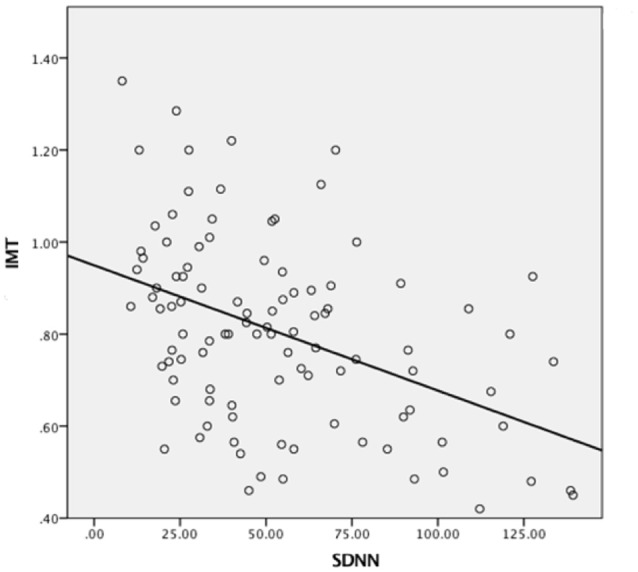
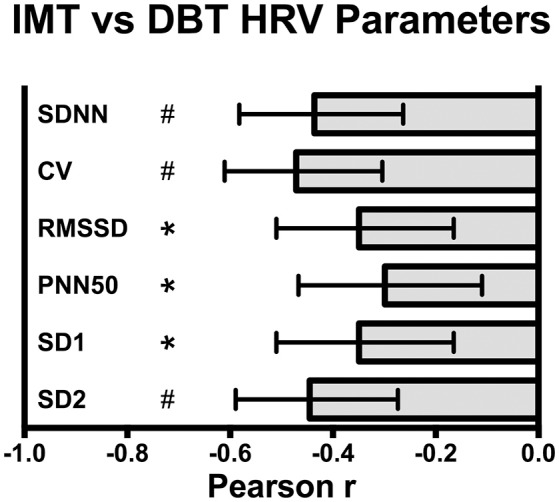
Atherosclerotic carotid intima-media thickness (IMT) may be associated with alterations in the sensitivity of carotid baroreceptors. The aim of this study was to investigate the association between carotid IMT and the autonomic modulation of heart rate variability (HRV). A total of 101 subjects were enrolled in this prospective observational study. The carotid IMT was determined by duplex ultrasonography. The cardiac autonomic function was determined through HRV measures during the Deep Breathing Test. Linear regression models, adjusted for demographics, comorbidities, body mass index, waist-hip-ratio, and left ventricular ejection fraction were used to evaluate the association between HRV parameters and carotid IMT. Participants had a mean age of 60.4 ± 13.4 years and an estimated 10-year atherosclerotic cardiovascular disease (ASCVD) risk score (using the Pooled Cohort Equations) of 16.4 ± 17. The mean carotid media thickness was highest (0.90 ± 0.19 mm) in the first quartile of the standard deviation of all RR intervals (SDNN) (19.7 ± 5.1 ms) and progressively declined in each subsequent quartile to 0.82 ± 0.21 mm, 0.81 ± 0.16 mm, and 0.68 ± 0.19 in quartiles 2 (36.5 ± 5.9 ms), 3 (57.7 ± 6.2 ms) and 4 (100.9 ± 22.2 ms), respectively. In multivariable adjusted models, there was a statistical significant association between SDNN and carotid IMT (OR -0.002; 95%CI -0.003 to -0.001, = 0.005). The same significant association was found between carotid IMT and other measures of HRV, including coefficient of variation of RR intervals (CV) and dispersion of points along the line of identity (SD2). In a cohort of individuals at increased cardiovascular risk, carotid IMT as a marker of subclinical atherosclerosis was associated with alterations of HRV indicating an impaired cardiac autonomic control, independently of other cardiovascular risk factors.
动脉粥样硬化性颈动脉内膜中层厚度(IMT)可能与颈动脉压力感受器敏感性的改变有关。本研究的目的是调查颈动脉IMT与心率变异性(HRV)自主神经调节之间的关联。共有101名受试者纳入了这项前瞻性观察研究。通过双功超声测定颈动脉IMT。在深呼吸试验期间通过HRV测量来确定心脏自主神经功能。使用针对人口统计学、合并症、体重指数、腰臀比和左心室射血分数进行调整的线性回归模型来评估HRV参数与颈动脉IMT之间的关联。参与者的平均年龄为60.4±13.4岁,使用合并队列方程估计的10年动脉粥样硬化性心血管疾病(ASCVD)风险评分为16.4±17。在所有RR间期标准差(SDNN)的第一个四分位数(19.7±5.1毫秒)中,平均颈动脉中层厚度最高(0.90±0.19毫米),在随后的每个四分位数中逐渐下降,在四分位数2(36.5±5.9毫秒)、3(57.7±6.2毫秒)和4(100.9±22.2毫秒)中分别为0.82±0.21毫米、0.81±0.16毫米和0.68±0.19毫米。在多变量调整模型中,SDNN与颈动脉IMT之间存在统计学显著关联(OR -0.002;95%CI -0.003至-0.001,P = 0.005)。在颈动脉IMT与其他HRV测量指标之间也发现了相同的显著关联,包括RR间期变异系数(CV)和沿一致性线的点离散度(SD2)。在心血管风险增加的个体队列中,作为亚临床动脉粥样硬化标志物的颈动脉IMT与HRV改变有关,表明心脏自主神经控制受损,且独立于其他心血管危险因素。