van der Meij Eva, van der Ploeg Hidde P, van den Heuvel Baukje, Dwars Boudewijn J, Meijerink W J H Jeroen, Bonjer H Jaap, Huirne Judith A F, Anema Johannes R
Department of Public and Occupational Health, EMGO+ Institute for Health and Care Research, VU University Medical Center, van der Boechorsstraat 7, 1081 BT, Amsterdam, The Netherlands.
Department of Obstetrics and Gynaecology, VU University Medical Center, Amsterdam, The Netherlands.
BMC Surg. 2017 May 12;17(1):56. doi: 10.1186/s12893-017-0223-0.
Postoperative recovery after abdominal surgery is measured mostly based on subjective or self-reported data. In this article we aim to evaluate whether recovery of daily physical activity levels can be measured postoperatively with the use of an accelerometer.
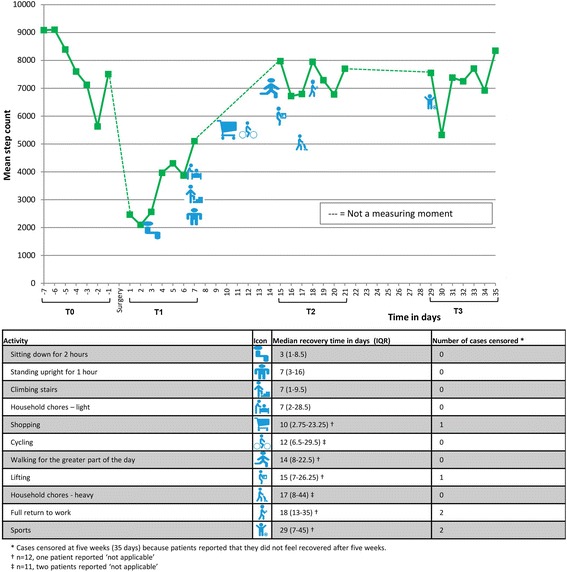
In this multicenter, observational pilot study, 30 patients undergoing laparoscopic abdominal surgery (hysterectomy, adnexal surgery, cholecystectomy and hernia inguinal surgery) were included. Patients were instructed to wear an Actigraph wGT3X-BT accelerometer during one week before surgery (baseline) and during the first, third and fifth week after surgery. Wear time, steps taken and physical activity intensity levels (sedentary, light, moderate and vigorous) were measured. Patients were blinded for the accelerometer outcomes. Additionally, an activity diary comprising patients' self-reported time of being recovered and a list of 18 activities, in which the dates of resumption of these 18 activities were recorded after surgery, was completed by the patient.
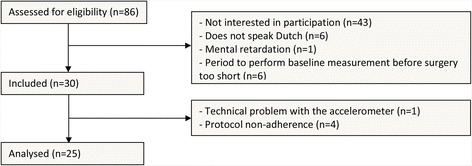
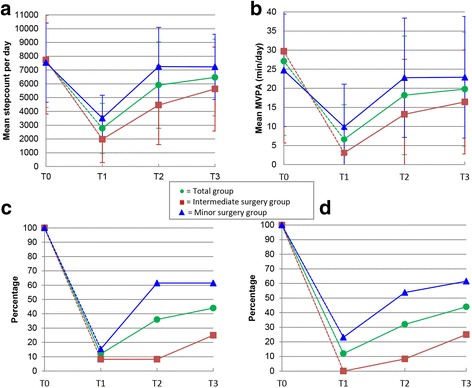
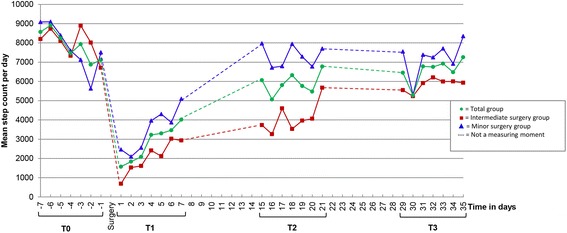
Five patients were excluded from analyses because of technical problems with the accelerometer (n = 1) and protocol non-adherence (n = 4). Light, moderate, vigorous, combined moderate and vigorous intensity physical activity (MVPA), and step counts showed a clear recovery curve after surgery. Patients who underwent minor surgery reached their baseline step count and MVPA three weeks after surgery. Patients who underwent intermediate surgery had not yet reached their baseline step count during the last measuring week (five weeks after surgery). The results of the activity diaries showed a fair agreement with the accelerometer results (Cohens Kappa range: 0.273-0.391). Wearing the accelerometer was well tolerated and not regarded as being burdensome by the patients.
The accelerometer appeared to be a feasible way to measure recovery of postoperative physical activity levels in this study and was well tolerated by the patients. The agreement with self-reported physical recovery times was fair.
腹部手术后的恢复情况大多基于主观或自我报告的数据来衡量。在本文中,我们旨在评估是否可以使用加速度计在术后测量日常身体活动水平的恢复情况。
在这项多中心观察性试点研究中,纳入了30例行腹腔镜腹部手术(子宫切除术、附件手术、胆囊切除术和腹股沟疝手术)的患者。患者被要求在手术前一周(基线)以及术后第一、第三和第五周佩戴Actigraph wGT3X-BT加速度计。测量佩戴时间、步数以及身体活动强度水平(久坐、轻度、中度和剧烈)。患者对加速度计的结果不知情。此外,患者还需完成一份活动日记,记录其自我报告的恢复时间以及一份包含18项活动的清单,记录术后恢复这18项活动的日期。
由于加速度计技术问题(n = 1)和未遵守方案(n = 4),5名患者被排除在分析之外。轻度、中度、剧烈、中度和剧烈强度身体活动组合(MVPA)以及步数在术后呈现出明显的恢复曲线。接受小型手术的患者在术后三周达到了基线步数和MVPA。接受中型手术的患者在最后测量周(术后五周)尚未达到基线步数。活动日记的结果与加速度计的结果显示出较好的一致性(科恩卡方范围:0.273 - 0.391)。佩戴加速度计耐受性良好,患者并不认为其带来负担。
在本研究中,加速度计似乎是测量术后身体活动水平恢复情况的一种可行方法,且患者耐受性良好。与自我报告的身体恢复时间的一致性较好。