Miyamoto Noriko, Mandai Michiko, Kojima Hiroshi, Kameda Takanori, Shimozono Masataka, Nishida Akihiro, Kurimoto Yasuo
Department of Ophthalmology, Kobe City Medical Center General Hospital.
Department of Ophthalmology, Institute of Biomedical Research and Innovation.
Clin Ophthalmol. 2017 Apr 28;11:809-816. doi: 10.2147/OPTH.S133332. eCollection 2017.
To evaluate the response to and dependence on aflibercept or ranibizumab in patients with age-related macular degeneration (AMD).
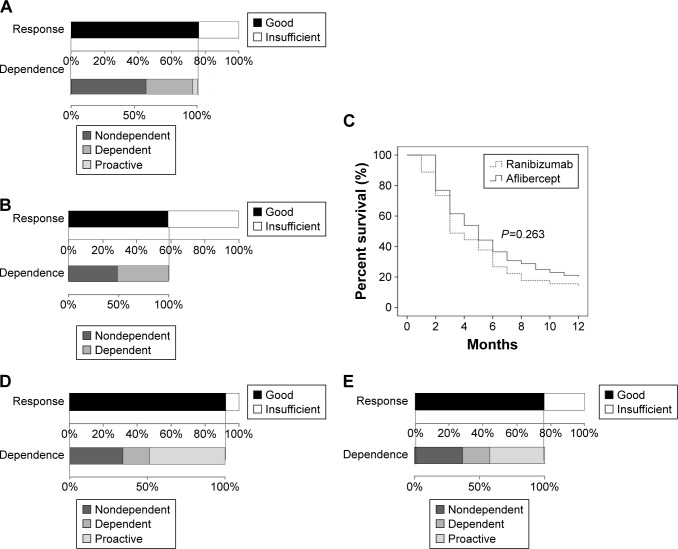
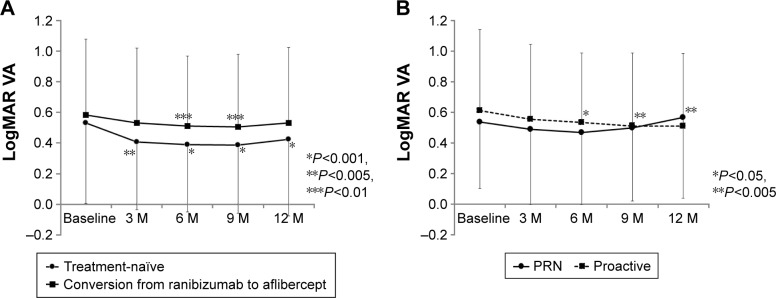
We retrospectively reviewed AMD patients who received induction therapy with aflibercept or ranibizumab for the following parameters: whether complete resolution of the retinal fluid ("good response") was achieved and whether recurrence was observed within 3 months ("dependent") after the induction treatment. With aflibercept treatment, treatment-naïve eyes with a good response/non-dependence were recommended a pro re nata regimen, and other eyes were recommended a proactive bimonthly regimen, followed by monitoring of visual acuity (VA) for 12 months. The measured values of the groups were compared using one-way analysis of variance with Tukey's test to evaluate the difference between baseline and postinjection VA.
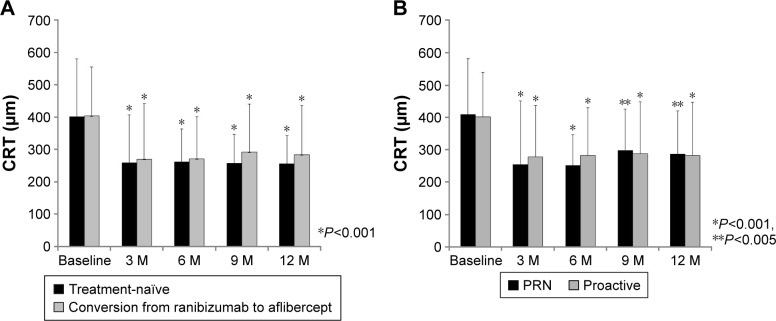
Among the treatment-naïve eyes, 76% had a good response to aflibercept and 37% of these were aflibercept-dependent, while 58% had a good response to ranibizumab but 51% of these were ranibizumab-dependent. Among the eyes that converted from ranibizumab treatment, 92% of the good responders to ranibizumab with dependence and 76% of the poor responders on ranibizumab had a good response to aflibercept. With aflibercept treatment, the mean VA of treatment-naïve patients was significantly better than the baseline VA over 12 months (<0.001), and the VA of the converted group improved significantly with proactive treatment and the improvement was continuously maintained from 6 to 12 months.
The evaluation of response to and dependence on anti-vascular endothelial growth factor therapies in AMD was useful and practical in managing therapeutic protocols to obtain a good VA.
评估年龄相关性黄斑变性(AMD)患者对阿柏西普或雷珠单抗的反应及依赖性。
我们回顾性分析了接受阿柏西普或雷珠单抗诱导治疗的AMD患者的以下参数:是否实现视网膜积液完全消退(“良好反应”)以及诱导治疗后3个月内是否观察到复发(“依赖”)。对于接受阿柏西普治疗的初治眼,对有良好反应/非依赖性的眼推荐按需治疗方案,对其他眼推荐积极的每两个月一次的治疗方案,随后监测视力(VA)12个月。使用单因素方差分析和Tukey检验比较各组测量值,以评估基线和注射后VA之间的差异。
在初治眼中,76%对阿柏西普有良好反应,其中37%对阿柏西普有依赖性,而58%对雷珠单抗有良好反应,但其中51%对雷珠单抗有依赖性。在从雷珠单抗治疗转换的眼中,92%对雷珠单抗有依赖性的良好反应者和76%对雷珠单抗反应不佳者对阿柏西普有良好反应。接受阿柏西普治疗时,初治患者的平均VA在12个月内显著优于基线VA(<0.001),转换组的VA通过积极治疗显著改善,且改善在6至12个月持续维持。
评估AMD患者对抗血管内皮生长因子疗法的反应及依赖性,对于管理治疗方案以获得良好视力是有用且实用的。