Comi Eleonora, Lanza Marco, Ferrari Flora, Mauri Valeria, Caselli Gianfranco, Rovati Lucio Claudio
Department of Pharmacology and Toxicology, Rottapharm Biotech.
PhD Program in Neuroscience, University of Milan-Bicocca.
J Pain Res. 2017 May 4;10:1033-1043. doi: 10.2147/JPR.S132026. eCollection 2017.
CR4056, (2-phenyl-6-(1H-imidazol-1yl) quinazoline), an imidazoline-2 (I2) receptor ligand, is a promising analgesic drug that has been reported to be effective in several animal models of pain. The aim of this study was to evaluate the effects of CR4056 in two well-established rat models of osteoarthritis (OA), mimicking the painful and structural components of human OA.
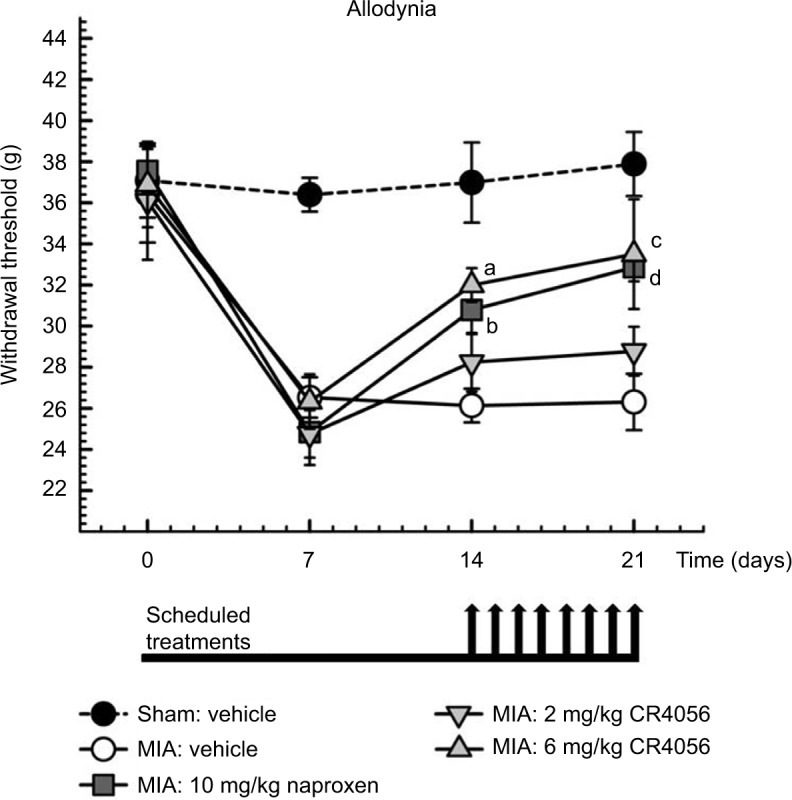
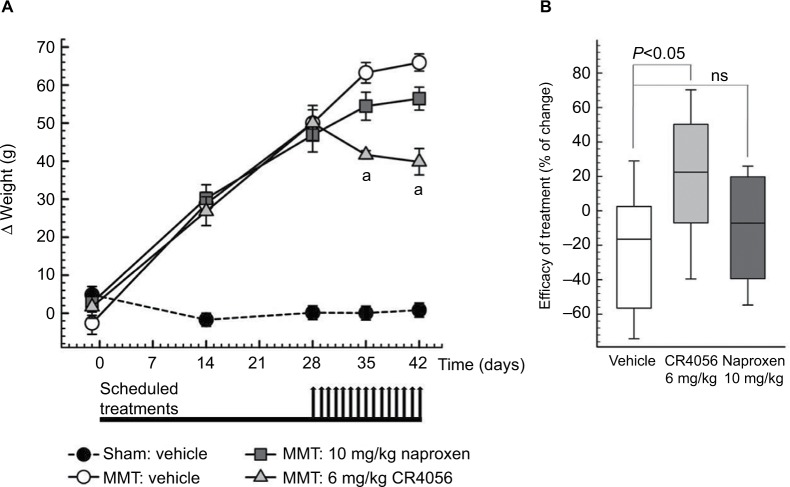
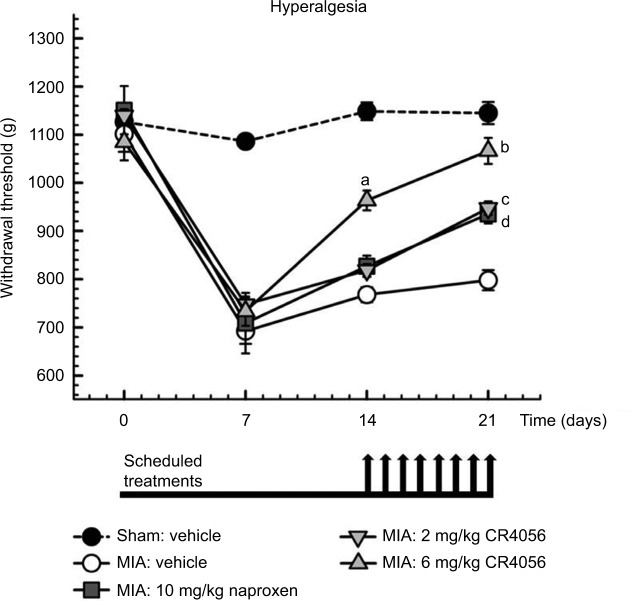
Knee OA was induced either by single intra-articular injection of monoiodoacetate (MIA) or by medial meniscal tear (MMT) in the right knee of male rats. In the MIA model, allodynia and hyperalgesia were measured as paw withdrawal threshold to mechanical stimulation. In the MMT model, pain behavior was analyzed as weight-bearing asymmetry (i.e. difference in hind paw weight distribution, HPWD) between the injured and the contralateral limbs.
Acute oral administration of CR4056, 14 days after MIA injection, significantly and dose-dependently reduced allodynia and hyperalgesia 90 minutes after treatment, whereas acute naproxen administration significantly reduced allodynia but not hyperalgesia. After 7 days of repeated treatment, both CR4056 and naproxen showed significant anti-allodynic and anti-hyperalgesic effects in the MIA model. Rats undergoing MMT surgery developed a significant and progressive asymmetry in HPWD compared with sham-operated animals. Repeated treatment with CR4056 significantly reduced the progression of the pain behavior, whereas naproxen had no effects.
The data presented here show that the I2 ligand CR4056 could be a new effective treatment for OA pain. The compound is currently under Phase II clinical evaluation for this indication.
CR4056(2-苯基-6-(1H-咪唑-1-基)喹唑啉),一种咪唑啉-2(I2)受体配体,是一种有前景的镇痛药,据报道在多种疼痛动物模型中有效。本研究的目的是评估CR4056在两种成熟的骨关节炎(OA)大鼠模型中的作用,这两种模型模拟了人类OA的疼痛和结构成分。
通过在雄性大鼠右膝单次关节内注射单碘乙酸盐(MIA)或内侧半月板撕裂(MMT)诱导膝OA。在MIA模型中,将机械刺激的爪退缩阈值作为痛觉过敏和痛觉超敏的指标进行测量。在MMT模型中,将负重不对称(即后爪重量分布差异,HPWD)作为损伤侧和对侧肢体之间的疼痛行为进行分析。
在MIA注射14天后急性口服CR4056,治疗90分钟后显著且剂量依赖性地减轻了痛觉过敏和痛觉超敏,而急性给予萘普生显著减轻了痛觉过敏但未减轻痛觉超敏。在重复治疗7天后,CR4056和萘普生在MIA模型中均显示出显著的抗痛觉过敏和抗痛觉超敏作用。与假手术动物相比,接受MMT手术的大鼠在HPWD方面出现了显著且逐渐加重的不对称。CR4056重复治疗显著减轻了疼痛行为的进展,而萘普生则无此作用。
此处呈现的数据表明,I2配体CR4056可能是OA疼痛的一种新的有效治疗方法。该化合物目前正在针对此适应症进行II期临床评估。