Lebreton François, Manson Abigail L, Saavedra Jose T, Straub Timothy J, Earl Ashlee M, Gilmore Michael S
Department of Ophthalmology and Department of Microbiology and Immunobiology, Harvard Medical School, Boston, MA 02114, USA; Department of Ophthalmology, Massachusetts Eye and Ear Infirmary, Boston, MA 02114, USA; Infectious Disease & Microbiome Program, Broad Institute, Cambridge, MA 02142, USA.
Infectious Disease & Microbiome Program, Broad Institute, Cambridge, MA 02142, USA.
Cell. 2017 May 18;169(5):849-861.e13. doi: 10.1016/j.cell.2017.04.027. Epub 2017 May 11.
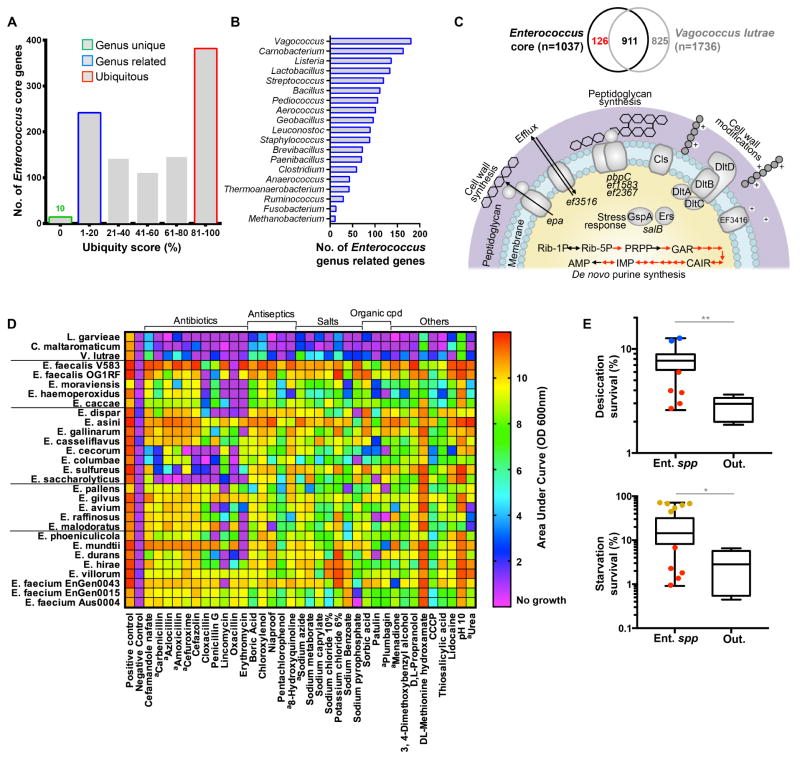
We examined the evolutionary history of leading multidrug resistant hospital pathogens, the enterococci, to their origin hundreds of millions of years ago. Our goal was to understand why, among the vast diversity of gut flora, enterococci are so well adapted to the modern hospital environment. Molecular clock estimation, together with analysis of their environmental distribution, phenotypic diversity, and concordance with host fossil records, place the origins of the enterococci around the time of animal terrestrialization, 425-500 mya. Speciation appears to parallel the diversification of hosts, including the rapid emergence of new enterococcal species following the End Permian Extinction. Major drivers of speciation include changing carbohydrate availability in the host gut. Life on land would have selected for the precise traits that now allow pathogenic enterococci to survive desiccation, starvation, and disinfection in the modern hospital, foreordaining their emergence as leading hospital pathogens.
我们研究了主要的多重耐药医院病原体肠球菌的进化史,追溯到数亿年前它们的起源。我们的目标是了解在种类繁多的肠道菌群中,为什么肠球菌能如此良好地适应现代医院环境。分子钟估计,结合对其环境分布、表型多样性以及与宿主化石记录的一致性分析,将肠球菌的起源定位在动物登陆时期,即4.25 - 5亿年前。物种形成似乎与宿主的多样化平行,包括二叠纪末大灭绝后新肠球菌物种的迅速出现。物种形成的主要驱动因素包括宿主肠道中碳水化合物可用性的变化。陆地生活可能选择了那些精确的特征,这些特征如今使致病性肠球菌能够在现代医院环境中经受住干燥、饥饿和消毒,注定它们会成为主要的医院病原体。