Raza Shaneabbas, Meyer Megan, Goodyear Casey, Hammer Kimberly D P, Guo Bin, Ghribi Othman
Department of Biomedical Sciences, University of North Dakota School of Medicine and Health Sciences, 501 North Columbia Road, Grand Forks, ND 58202 USA.
Department of Veteran Affairs, Fargo VA Health Care System, Fargo, ND 58102 USA.
Cancer Cell Int. 2017 May 11;17:52. doi: 10.1186/s12935-017-0422-x. eCollection 2017.
For every six men, one will be diagnosed with prostate cancer (PCa) in their lifetime. Estrogen receptors (ERs) are known to play a role in prostate carcinogenesis. However, it is unclear whether the estrogenic effects are mediated by estrogen receptor α (ERα) or estrogen receptor β (ERβ). Although it is speculated that ERα is associated with harmful effects on PCa, the role of ERβ in PCa is still ill-defined. The cholesterol oxidized metabolite 27-hydroxycholesterol (27-OHC) has been found to bind to ERs and act as a selective ER modulator (SERM). Increased 27-OHC levels are found in individuals with hypercholesterolemia, a condition that is suggested to be a risk factor for PCa.
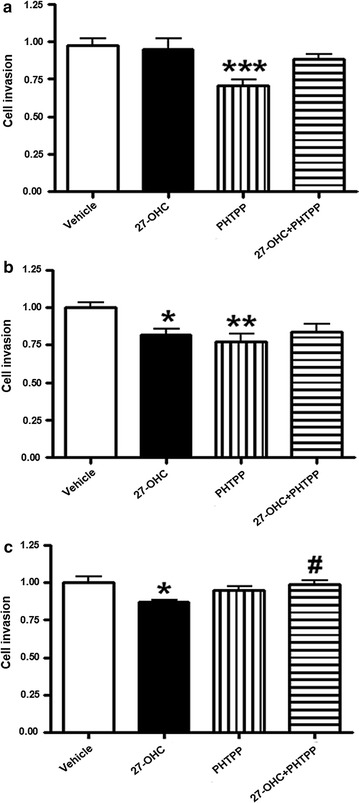
In the present study, we determined the extent to which 27-OHC causes deleterious effects in the non-tumorigenic RWPE-1, the low tumorigenic LNCaP, and the highly tumorigenic PC3 prostate cancer cells. We conducted cell metabolic activity and proliferation assays using MTS and CyQUANT dyes, protein expression analyses via immunoblots and gene expression analyses via RT-PCR. Additionally, immunocytochemistry and invasion assays were performed to analyze intracellular protein distribution and quantify transepithelial cell motility.
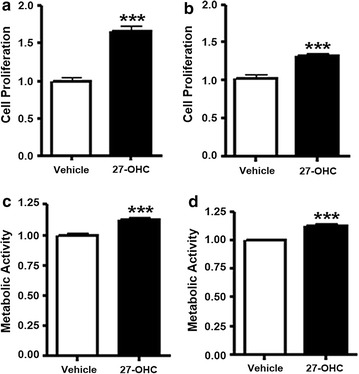
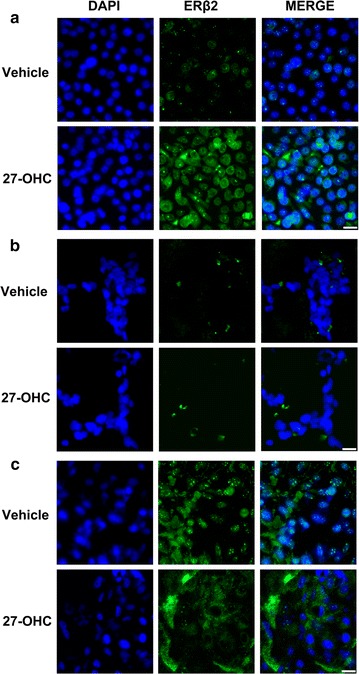
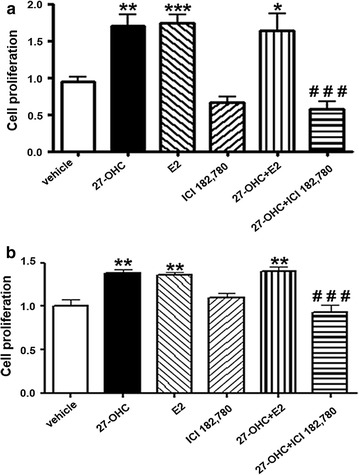
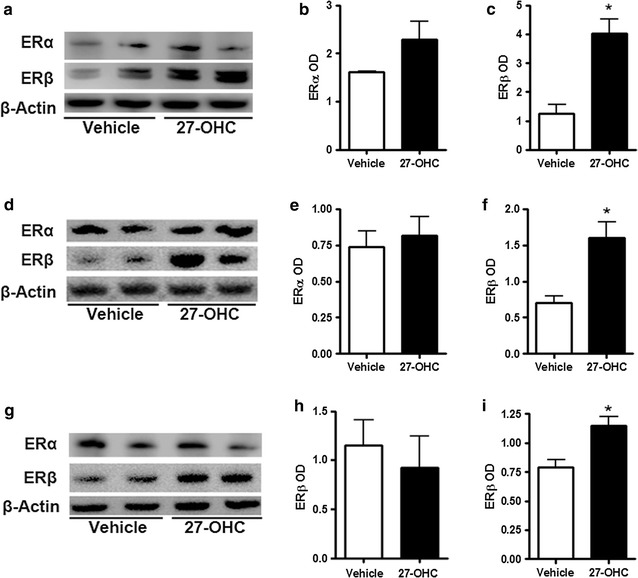
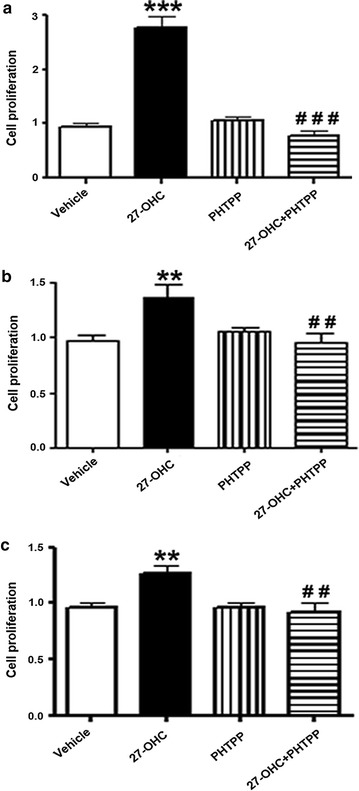
We found that incubation of LNCaP and PC3 cells with 27-OHC significantly increased cell proliferation. We also demonstrate that the ER inhibitor ICI 182,780 (fulvestrant) significantly reduced 27-OH-induced cell proliferation, indicating the involvement of ERs in proliferation. Interestingly, ERβ levels, and to a lesser extent ERα, were significantly increased following incubation of PCa cells with 27-OHC. Furthermore, in the presence of the ERβ specific inhibitor, PHTPP, 27-OHC-induced proliferation is attenuated.
Altogether, our results show for the first time that 27-OHC, through ER activation, triggers deleterious effect in prostate cancer cell lines. We propose that dysregulated levels of 27-OHC may trigger or exacerbate prostate cancer via acting on ERβ.
每六个男性中就有一人在其一生中会被诊断出患有前列腺癌(PCa)。已知雌激素受体(ERs)在前列腺癌发生过程中起作用。然而,尚不清楚雌激素效应是由雌激素受体α(ERα)还是雌激素受体β(ERβ)介导。尽管推测ERα与前列腺癌的有害影响有关,但ERβ在前列腺癌中的作用仍不明确。已发现胆固醇氧化代谢物27-羟基胆固醇(27-OHC)可与ERs结合并作为选择性ER调节剂(SERM)发挥作用。在高胆固醇血症患者中发现27-OHC水平升高,而高胆固醇血症被认为是前列腺癌的一个危险因素。
在本研究中,我们确定了27-OHC在非致瘤性RWPE-1、低致瘤性LNCaP和高致瘤性PC3前列腺癌细胞中造成有害影响的程度。我们使用MTS和CyQUANT染料进行细胞代谢活性和增殖测定,通过免疫印迹进行蛋白质表达分析,并通过RT-PCR进行基因表达分析。此外,进行免疫细胞化学和侵袭测定以分析细胞内蛋白质分布并量化跨上皮细胞运动。
我们发现用27-OHC处理LNCaP和PC3细胞可显著增加细胞增殖。我们还证明ER抑制剂ICI 182,780(氟维司群)可显著降低27-OH诱导的细胞增殖,表明ERs参与了增殖过程。有趣的是,用27-OHC处理前列腺癌细胞后,ERβ水平显著升高,ERα水平也有较小程度的升高。此外,在存在ERβ特异性抑制剂PHTPP的情况下,27-OHC诱导的增殖减弱。
总之,我们的结果首次表明27-OHC通过激活ERs在前列腺癌细胞系中引发有害作用。我们提出,27-OHC水平失调可能通过作用于ERβ触发或加剧前列腺癌。