Sani Gabriele, Simonetti Alessio, Reginaldi Daniela, Koukopoulos Alexia E, Del Casale Antonio, Manfredi Giovanni, Kotzalidis Georgios D, Girardi Paolo
NESMOS Department (Neurosciences, Mental Health, and Sensory Organs), Sapienza University of Rome, School of Medicine and Psychology, Sant'Andrea Hospital, Rome, Italy.
Centro Lucio Bini, Rome, Italy.
Curr Neuropharmacol. 2017 Apr;15(3):394-401. doi: 10.2174/1570159X14666160607085851.
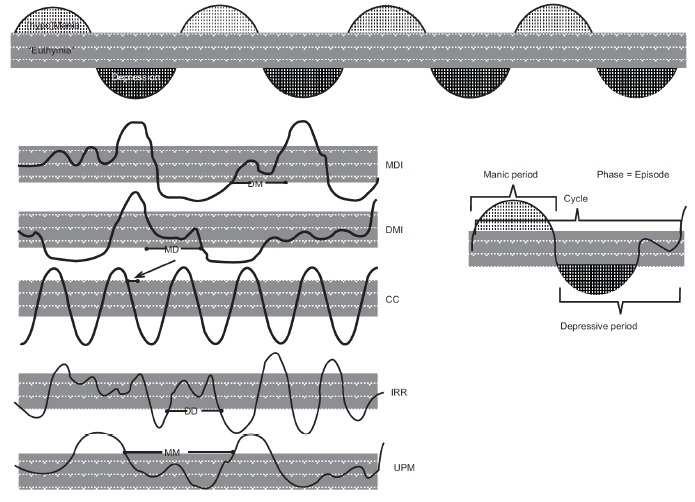
Cyclicity is the essential feature of Bipolar disorder, but the effect of different cycle patterns on the clinical features is poorly understood. Moreover, no studies investigated the relationship between mania and depression inside the manic-depressive cycle.
The aim of this study is to verify the presence of a relationship between the manic and the depressive phase during the course of bipolar disorder.
160 consecutive patients with BD type I were recruited and followed for a mean period of 10 years. During the follow-up period, four types of euthymic phases were collected: free intervals present between a depressive and a manic/hypomanic episode (D-M); free intervals present between a manic/hypomanic and a depressive episode (M-D); free intervals present between two depressive episodes (D-D); free intervals present between two manic/hypomanic episodes (M-M). One-way ANOVA using the groups as independent variable and the duration of the free intervals as dependent variables was used. Furthermore, ANOVA was followed by Fisher's Protected Least Significant Difference post-hoc test to measure between-group differences.
M-D-free interval phases were shorter than D-M-free intervals. M-D intervals were the shortest ones, the D-D and D-M did not differ, and the M-M were the longest.
The strict temporal link between manic and depressive phases supports the idea that the manic-depressive cycle usually begins with a manic episode, and that the subsequent depression is often the consequence of subsiding mania.
循环性是双相情感障碍的基本特征,但不同循环模式对临床特征的影响尚不清楚。此外,尚无研究探讨躁狂抑郁循环中躁狂与抑郁之间的关系。
本研究旨在验证双相情感障碍病程中躁狂期与抑郁期之间是否存在关联。
招募了160例连续的I型双相情感障碍患者,并进行了平均10年的随访。在随访期间,收集了四种类型的心境正常期:抑郁发作与躁狂/轻躁狂发作之间的无发作间期(D-M);躁狂/轻躁狂发作与抑郁发作之间的无发作间期(M-D);两次抑郁发作之间的无发作间期(D-D);两次躁狂/轻躁狂发作之间的无发作间期(M-M)。以这些组为自变量,无发作间期的持续时间为因变量,进行单因素方差分析。此外,方差分析后采用Fisher保护最小显著差事后检验来测量组间差异。
M-D无发作间期阶段短于D-M无发作间期。M-D间期最短,D-D和D-M无差异,M-M最长。
躁狂期与抑郁期之间严格的时间联系支持了这样一种观点,即躁狂抑郁循环通常始于躁狂发作,随后的抑郁往往是躁狂消退的结果。