Yamada Hodaka, Umemoto Tomio, Kakei Masafumi, Momomura Shin-Ichi, Kawakami Masanobu, Ishikawa San-E, Hara Kazuo
First Department of Comprehensive Medicine, Jichi Medical University Saitama Medical Center, 1-847 Amanumacho, Omiya, Saitama 330-8503 Japan.
Internal Medicine, Nerima Hikarigaoka Hospital, 2-11-1 Hikarigaoka, Nerima, Tokyo, 179-0072 Japan.
Nutr Metab (Lond). 2017 May 8;14:33. doi: 10.1186/s12986-017-0188-0. eCollection 2017.
Saturated fatty acids have been shown to cause insulin resistance and low-grade chronic inflammation, whereas unsaturated fatty acids suppress inflammation via G-protein coupled receptor 120 (GPR120) in macrophages. However, the anti-inflammatory effects of unsaturated fatty acids in adipocytes have yet to be elucidated. Hence, the aims of the present study were to evaluate the anti-inflammatory effects of eicosapentaenoic acid (EPA) via GPR120 in adipocytes.
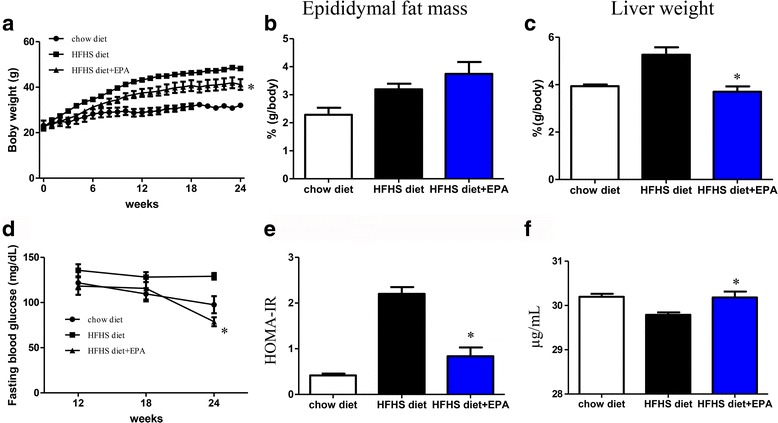
We used 250 μM palmitate as a representative saturated fatty acid. 3T3-L1 adipocytes were used for in vitro studies. We further evaluated the effect of EPA supplementation in a high-fat/high-sucrose (HFHS) diet-induced adipose tissue inflammatory mouse model.
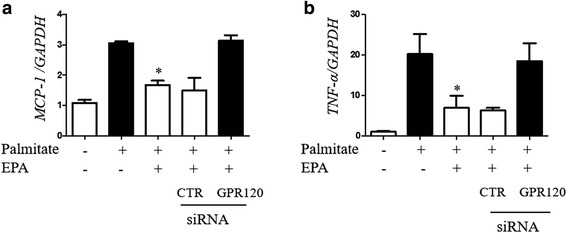
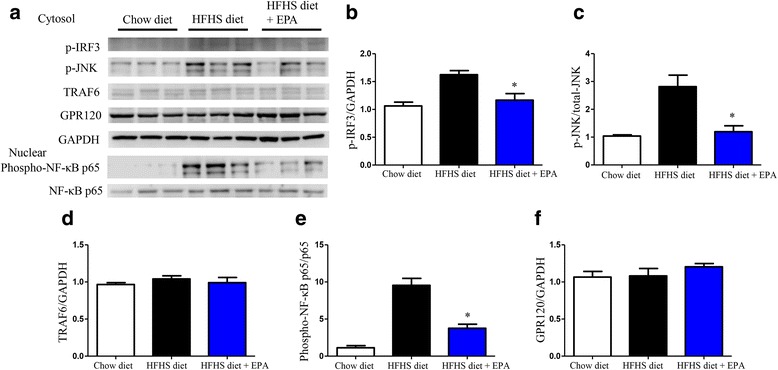
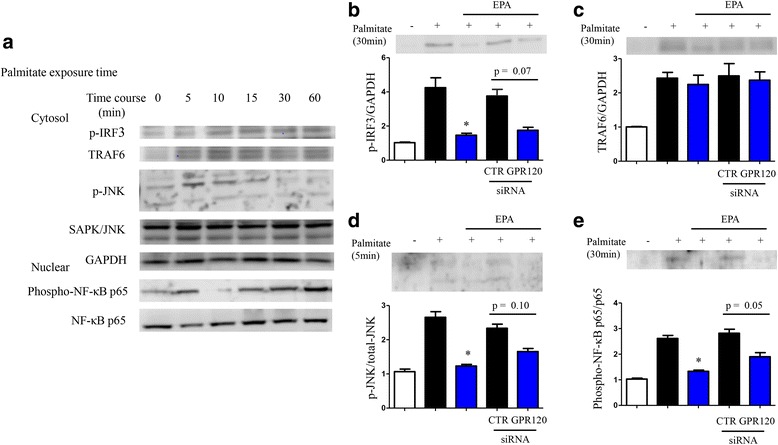
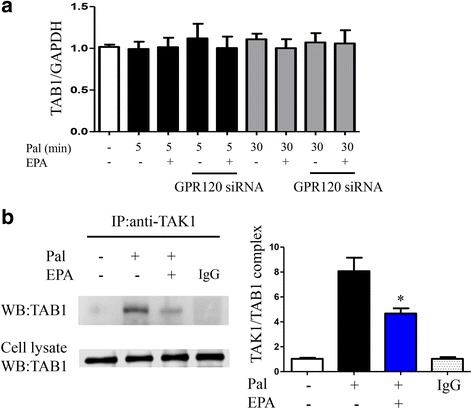
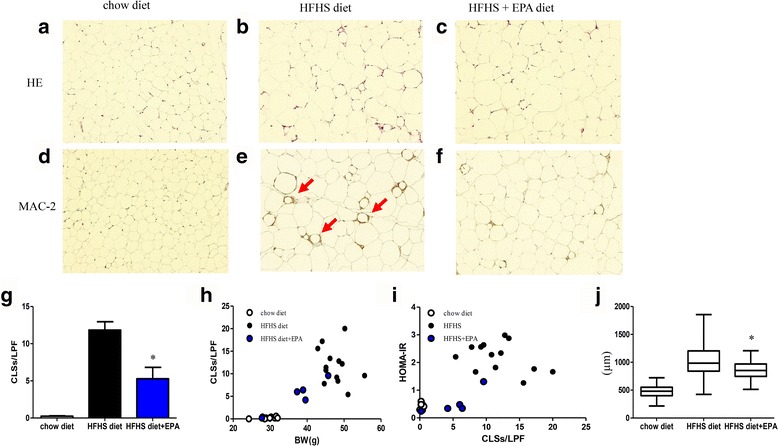
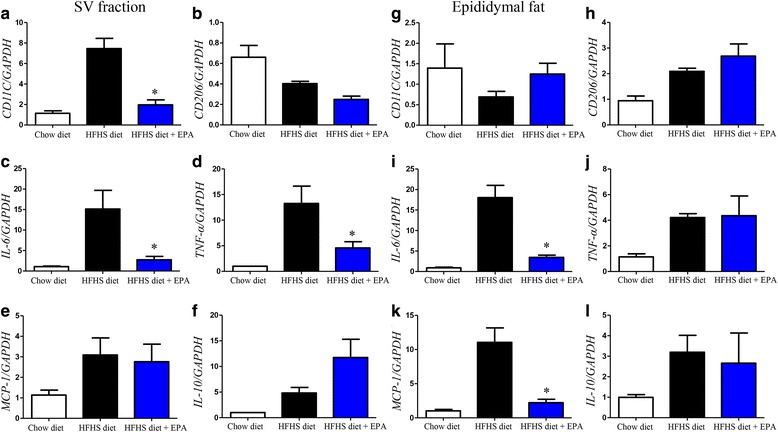
EPA attenuated palmitate-induced increases in inflammatory gene expression and NF-κB phosphorylation in 3T3-L1 adipocytes. Silencing of GPR120 abolished the anti-inflammatory effects of EPA. In GPR120 downstream signal analysis, EPA was found to decrease palmitate-induced increases in TAK1/TAB1 complex expression. EPA supplementation suppressed HFHS-induced crown-like structure formation in epididymal adipose tissue and altered macrophage phenotypes from M1 to M2 in the stromal vascular fraction. Moreover, the EPA-containing diet attenuated increases in adipose p-JNK and phospho-p65 NF-κB levels.
In conclusion, the findings of the present study demonstrate that EPA suppresses palmitate-induced inflammation via GPR120 by inhibiting the TAK1/TAB1 interaction in adipocytes. EPA supplementation reduced HFHS diet-induced inflammatory changes in mouse adipose tissues. These results demonstrate adipose GPR120 as a potential therapeutic target for decreasing inflammation.
饱和脂肪酸已被证明会导致胰岛素抵抗和低度慢性炎症,而不饱和脂肪酸可通过巨噬细胞中的G蛋白偶联受体120(GPR120)抑制炎症。然而,不饱和脂肪酸在脂肪细胞中的抗炎作用尚未阐明。因此,本研究的目的是评估二十碳五烯酸(EPA)通过GPR120在脂肪细胞中的抗炎作用。
我们使用250μM棕榈酸作为代表性饱和脂肪酸。3T3-L1脂肪细胞用于体外研究。我们进一步评估了在高脂/高糖(HFHS)饮食诱导的脂肪组织炎症小鼠模型中补充EPA的效果。
EPA减弱了棕榈酸诱导的3T3-L1脂肪细胞中炎症基因表达增加和NF-κB磷酸化。GPR120沉默消除了EPA的抗炎作用。在GPR120下游信号分析中,发现EPA可降低棕榈酸诱导的TAK1/TAB1复合物表达增加。补充EPA可抑制HFHS诱导的附睾脂肪组织中冠状结构形成,并使基质血管部分的巨噬细胞表型从M1转变为M2。此外,含EPA的饮食减弱了脂肪组织中p-JNK和磷酸化p65 NF-κB水平的增加。
总之,本研究结果表明,EPA通过抑制脂肪细胞中的TAK1/TAB1相互作用,经由GPR120抑制棕榈酸诱导的炎症。补充EPA可减少HFHS饮食诱导的小鼠脂肪组织炎症变化。这些结果表明脂肪GPR120是减轻炎症的潜在治疗靶点。