Amary Fernanda, Berisha Fitim, Ye Hongtao, Gupta Manu, Gutteridge Alice, Baumhoer Daniel, Gibbons Rebecca, Tirabosco Roberto, O'Donnell Paul, Flanagan Adrienne M
*Royal National Orthopaedic Hospital NHS Trust, Stanmore, Greater London †Cancer Institute, University College London, London, UK ‡Basel Bone Tumour Reference Centre (BBTRC), University Hospital Basel and University of Basel, Basel, Switzerland.
Am J Surg Pathol. 2017 Aug;41(8):1059-1068. doi: 10.1097/PAS.0000000000000859.
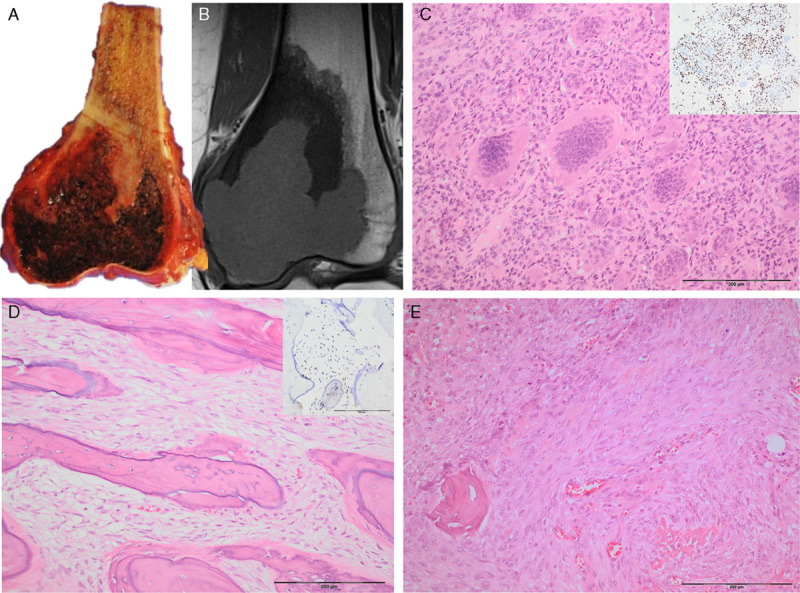
Giant cell tumor of bone (GCTB) is a locally aggressive subarticular tumor. Having recently reported that H3.3 G34W mutations are characteristic of this tumor type, we have now investigated the sensitivity and specificity of the anti-histone H3.3 G34W rabbit monoclonal antibody in a wide variety of tumors including histologic mimics of GCTB to assess its value as a diagnostic marker. We also determined the incidence of H3.3 G34 mutations in primary malignant bone tumors as assessed by genotype and H3.3 G34W immunostaining. A total of 3163 tumors were tested. Totally, 213/235 GCTB (90.6%) showed nuclear H3.3 p.G34W immunoreactivity. This was not the case for the rare variants, p.G34L, M, and V, which occurred most commonly in the small bones of the hands, patella, and the axial skeleton. If these sites were excluded from the analysis, H3.3 G34W expression was found in 97.8% of GCTB. Malignant bone tumors initially classified as osteosarcomas were the only other lesions (n=11) that showed G34W expression. Notably an additional 2 previously reported osteosarcomas with a p.G34R mutation were not immunoreactive for the antibody. A total of 11/13 of these malignant H3.3-mutant tumors exhibited an osteoclast-rich component: when imaging was available all but one presented at a subarticular site. We propose that subarticular primary malignant bone sarcoma with H3.3 mutations represent true malignant GCTB, even in the absence of a benign GCTB component.
骨巨细胞瘤(GCTB)是一种具有局部侵袭性的关节下肿瘤。最近有报道称H3.3 G34W突变是这种肿瘤类型的特征,我们现在研究了抗组蛋白H3.3 G34W兔单克隆抗体在包括GCTB组织学模仿物在内的多种肿瘤中的敏感性和特异性,以评估其作为诊断标志物的价值。我们还通过基因分型和H3.3 G34W免疫染色确定了原发性恶性骨肿瘤中H3.3 G34突变的发生率。总共检测了3163个肿瘤。总体而言,213/235例GCTB(90.6%)显示核H3.3 p.G34W免疫反应性。罕见变体p.G34L、M和V并非如此,它们最常见于手部小骨、髌骨和中轴骨骼。如果将这些部位排除在分析之外,在97.8%的GCTB中发现了H3.3 G34W表达。最初分类为骨肉瘤的恶性骨肿瘤是仅有的其他显示G34W表达的病变(n = 11)。值得注意的是,另外2例先前报道的具有p.G34R突变的骨肉瘤对该抗体无免疫反应性。这些恶性H3.3突变肿瘤中共有11/13表现出富含破骨细胞的成分:当有影像学资料时,除1例外,所有病例均出现在关节下部位。我们提出,即使没有良性GCTB成分,具有H3.3突变的关节下原发性恶性骨肉瘤也代表真正的恶性GCTB。