Liu Yutong, Conboy Irina
Department of Bioengineering and QB3 Institute, Univerisity of California, Berkeley, 174 Stanley Hall, Berkeley, CA, 94720, USA.
Skelet Muscle. 2017 May 15;7(1):7. doi: 10.1186/s13395-017-0125-y.
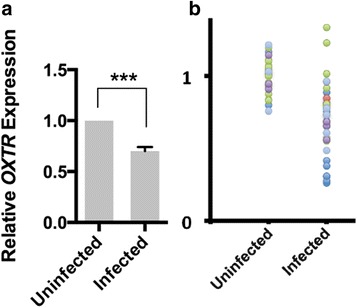
shRNA lentiviral vectors are extensively used for gene knockdowns in mammalian cells, and non-target shRNAs typically are considered the proper experimental control for general changes caused by RNAi. However, the effects of non-target lentivirus controls on the modulation of cell signaling pathways remain largely unknown. In this study, we evaluated the effect of control lentiviral transduction on oxytocin receptor (OXTR) expression through the ERK/MAPK pathway in mouse and human skeletal muscle cells, on myogenic activity, and in vivo on mouse muscle regeneration. Furthermore, we mined published data for the influence of viral infections on OXTR levels in human populations and found that unrelated viral pathologies have a common consequence: diminished levels of OXTR.
We examined the change in OXTR mRNA expression upon transduction with control and Smad3-targeting viral vectors through real time RT-PCR and Western blotting, and confirmed with immunofluorescence. Changes in Smad3 and OXTR expression were examined both in vitro with mouse and human myoblasts and in vivo in mouse satellite cells. The general effects of viral infections on OXTR downregulation in humans were also examined by analyzing published Gene Expression Omnibus (GEO) datasets. The change in myoblast myogenic activity caused by the viral transduction (the percent of Pax7 + Ki67+ cells) was examined by immunofluorescence.
Results shown in this work establish that lentiviral control vectors significantly downregulate OXTR expression at mRNA and protein levels and diminish key downstream effectors of OXTR, ERK signaling, reducing the myogenic proliferation of infected cells. This effect is evolutionarily conserved between mouse and human myogenic cells, and it manifests in satellite cells after control lentiviral transduction of mice in vivo. Furthermore, an examination of published datasets uncovered similar OXTR downregulation in humans that are afflicted with different viral infections. Additionally, cells transduced with Smad3-targeting shRNA downregulate OXTR even more than cells transduced with control viruses.
Our work suggests that experimental cohorts transduced with control viruses may not behave the same as un-transduced cells and animals, specifically that control viral vectors significantly change the intensity of key cell-signaling pathways, such as OXTR/ERK. Our results further demonstrate that lentiviral transduction significantly decreases myogenic proliferation and suggest that viral infections in general may play a role in decreasing muscle health and regeneration, a decline in metabolic health, and a lower sense of well-being, as these rely on effective OXTR signaling. Additionally, our data suggest pathway crosstalk between TGF-β/pSmad3 and OXTR, implying that sustained attenuation of the TGF-β/pSmad3 pathway will reduce pro-regenerative OXTR/pERK signaling.

短发夹RNA慢病毒载体广泛用于哺乳动物细胞中的基因敲低,非靶向短发夹RNA通常被认为是RNA干扰引起的一般变化的合适实验对照。然而,非靶向慢病毒对照对细胞信号通路调节的影响在很大程度上仍然未知。在本研究中,我们评估了对照慢病毒转导对小鼠和人类骨骼肌细胞中通过ERK/MAPK途径的催产素受体(OXTR)表达、对成肌活性以及在小鼠体内对肌肉再生的影响。此外,我们挖掘了已发表的数据,以了解病毒感染对人类群体中OXTR水平的影响,发现无关的病毒病理学有一个共同的结果:OXTR水平降低。
我们通过实时RT-PCR和蛋白质印迹法检测了用对照和靶向Smad3的病毒载体转导后OXTR mRNA表达的变化,并用免疫荧光法进行了确认。在体外分别用小鼠和人类成肌细胞以及在体内用小鼠卫星细胞检测了Smad3和OXTR表达的变化。还通过分析已发表的基因表达综合数据库(GEO)数据集,研究了病毒感染对人类中OXTR下调的总体影响。通过免疫荧光法检测了病毒转导引起的成肌细胞成肌活性的变化(Pax7+Ki67+细胞的百分比)。
本研究结果表明,慢病毒对照载体在mRNA和蛋白质水平上显著下调OXTR表达,并减少OXTR的关键下游效应器ERK信号传导,从而降低受感染细胞的成肌增殖。这种效应在小鼠和人类成肌细胞之间具有进化保守性,并且在体内对小鼠进行对照慢病毒转导后,在卫星细胞中也有体现。此外,对已发表数据集的检查发现,患有不同病毒感染的人类中也存在类似的OXTR下调。此外,用靶向Smad3的短发夹RNA转导的细胞比用对照病毒转导的细胞更能下调OXTR。
我们的研究表明,用对照病毒转导的实验队列可能与未转导的细胞和动物表现不同,特别是对照病毒载体显著改变关键细胞信号通路的强度,如OXTR/ERK。我们的结果进一步表明,慢病毒转导显著降低成肌增殖,并表明一般而言病毒感染可能在降低肌肉健康和再生、代谢健康下降以及幸福感降低方面起作用,因为这些都依赖于有效的OXTR信号传导。此外,我们的数据表明TGF-β/pSmad3和OXTR之间存在通路串扰,这意味着TGF-β/pSmad3通路的持续减弱将减少促再生的OXTR/pERK信号传导。