Steffensmeier Andrew M, Kirkham Karen, Wiemann John M
Department of Orthopedic Surgery, Boonshoft School of Medicine, Wright State University, Dayton, Ohio, United States.
Department of Internal Medicine, Boonshoft School of Medicine, Wright State University, Dayton, Ohio, United States.
J Orthop Case Rep. 2016 Nov-Dec;6(5):62-64. doi: 10.13107/jocr.2250-0685.634.
Avascular necrosis (AVN) of the femoral or humeral heads in patients with sickle cell anemia is a common and painful condition. There is currently no gold standard treatment protocol for this condition. Typically, the pain is managed with narcotics and activity restriction until there has been collapse of the subchondral bone with a degree of arthrosis sufficient to warrant total joint arthroplasty. This method entails prolonged pain for the patient and decreases the ability to function occupationally and recreationally.
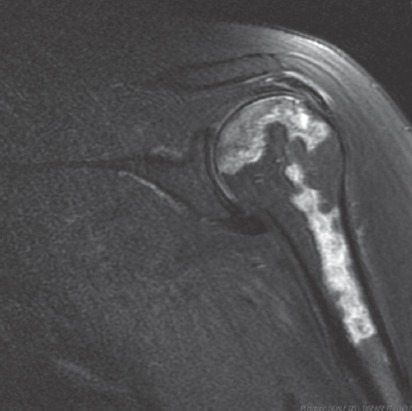
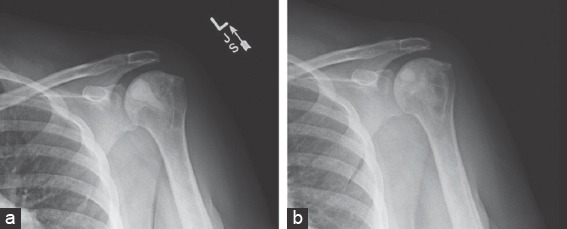
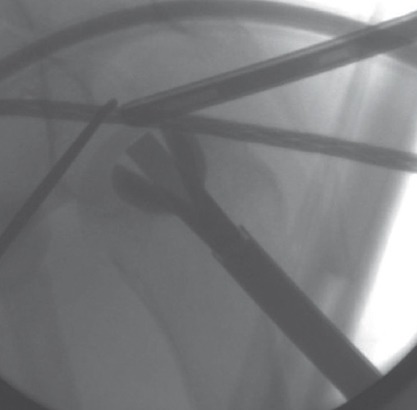
A 51-year-old African-American woman with a history of sickle cell anemia presented for the evaluation of significant bilateral shoulder pain that was confirmed to be AVN via radiographs and magnetic resonance imaging of both her humeral heads without joint collapse. She tried and failed conservative management with physical therapy and optimization of sickle cell treatment with pain medications for years, so she desired surgical management. Arthroscopically assisted core decompression of her humeral heads with synthetic grafting was performed in an attempt at joint preservation.
This report demonstrates a technique of staged decompression of necrotic bone in the bilateral humeral heads with synthetic bone grafting to determine if this could function as a joint preservation strategy. This procedure was considered successful to alleviate the patients' pain in both of her arms. The application of this procedure is significant because it could be used in various future medical joint preservation cases for a wide range of patients.
镰状细胞贫血患者的股骨头或肱骨头缺血性坏死是一种常见且疼痛的病症。目前针对这种病症尚无金标准治疗方案。通常,在软骨下骨塌陷且关节病程度足以进行全关节置换术之前,疼痛通过使用麻醉药和限制活动来控制。这种方法会使患者长期疼痛,并降低其工作和娱乐功能。
一名51岁有镰状细胞贫血病史的非裔美国女性因双侧肩部剧痛前来评估,通过对其双侧肱骨头进行X线片和磁共振成像检查确诊为缺血性坏死,且关节未塌陷。多年来,她尝试通过物理治疗和优化镰状细胞治疗方案并使用止痛药进行保守治疗,但均失败,因此她希望接受手术治疗。为尝试保留关节,对其肱骨头进行了关节镜辅助下的带合成移植物的髓芯减压术。
本报告展示了一种对双侧肱骨头坏死骨进行分期减压并植入合成骨移植物的技术,以确定这是否可作为一种关节保留策略。该手术被认为成功缓解了患者双臂的疼痛。此手术方法的应用意义重大,因为它可用于未来广泛患者的各种医疗关节保留病例。