de Amorim Robson Luis Oliveira, Brunoni André Russowsky, de Oliveira Mirian Akiko Furutani, Zaninotto Ana Luiza Costa, Nagumo Marcia Mitie, Guirado Vinícius Monteiro de Paula, Neville Iuri Santana, Benute Gláucia Rosana Guerra, de Lucia Mara Cristina Souza, Paiva Wellingson Silva, de Andrade Almir Ferreira, Teixeira Manoel Jacobsen
Division of Neurosurgery, University of São Paulo Medical School, São Paulo, Brazil.
Division of Psychiatry and Psychology, University Hospital of São Paulo University, São Paulo, Brazil.
Front Neurol. 2017 May 2;8:164. doi: 10.3389/fneur.2017.00164. eCollection 2017.
Mild traumatic brain injury (MTBI) represents 70-80% of all treated brain injuries. A considerable proportion of MTBI patients experience post-concussion symptoms for a prolonged period after MTBI, and these symptoms are diagnosed as persistent post-concussion syndrome (PPCS). PPCS is defined as a range of physical, cognitive, and emotional symptoms. However, memory and executive dysfunction seems to be one of the most debilitating symptoms. Recently, non-invasive brain stimulation has been studied as a potential treatment method for traumatic brain injury (TBI) patients. Therefore, our primary goal is to verify the effects of transcranial direct current stimulation (tDCS) in patients with PPCS who demonstrate cognitive deficits in long-term episodic memory, working memory, and executive function following MTBI.
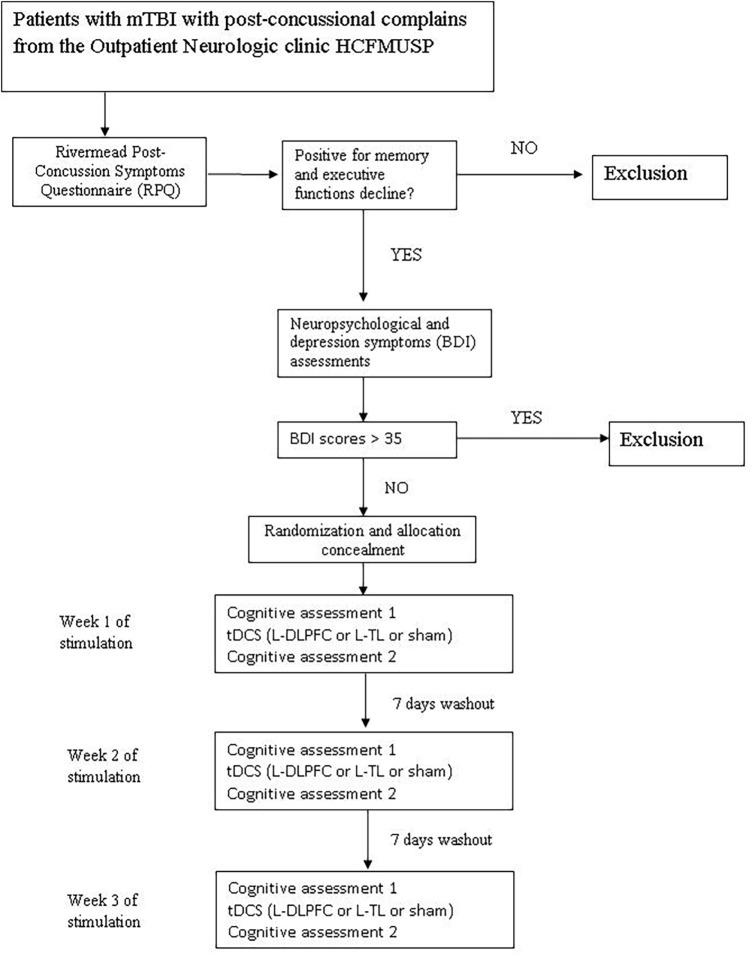
METHODS/DESIGN: This is a randomized crossover trial of patients with a history of MTBI with cognitive deficits in memory and executive function. Thirty adult patients will be randomized in a crossover manner to receive three weekly sessions of anodal tDCS (2 mA) at left dorsolateral prefrontal cortex, left temporal cortex, and sham stimulation that will be performed at 7-day intervals (washout period). The clinical diagnosis of PPCS will be determined using the Rivermead Post-Concussion Symptoms Questionnaire. Patients who meet the inclusion criteria will be assessed with a neuropsychological evaluation. A new battery of computerized neuropsychological tests will be performed before and immediately after each stimulation. Statistical analysis will be performed to determine trends of cognitive improvement.
There is paucity of studies regarding the use of tDCS in TBI patients, and although recent results showed controversial data regarding the effects of tDCS in such patients, we will address specifically patients with PPCS and MTBI and no brain abnormalities on CT scan other than subarachnoid hemorrhage. Moreover, due to the missing information on literature regarding the best brain region to be studied, we will evaluate two different regions to find immediate effects of tDCS on memory and executive dysfunction.
www.ClinicalTrials.gov, identifier NCT02292589 (https://register.clinicaltrials.gov).
轻度创伤性脑损伤(MTBI)占所有接受治疗的脑损伤的70 - 80%。相当一部分MTBI患者在MTBI后长时间经历脑震荡后症状,这些症状被诊断为持续性脑震荡后综合征(PPCS)。PPCS被定义为一系列身体、认知和情感症状。然而,记忆和执行功能障碍似乎是最使人衰弱的症状之一。最近,非侵入性脑刺激已被研究作为创伤性脑损伤(TBI)患者的一种潜在治疗方法。因此,我们的主要目标是验证经颅直流电刺激(tDCS)对PPCS患者的效果,这些患者在MTBI后长期情景记忆、工作记忆和执行功能方面存在认知缺陷。
方法/设计:这是一项针对有MTBI病史且在记忆和执行功能方面存在认知缺陷患者的随机交叉试验。30名成年患者将以交叉方式随机分组,接受每周三次在左侧背外侧前额叶皮层、左侧颞叶皮层进行的阳极tDCS(2毫安)治疗,以及每隔7天进行一次的假刺激(洗脱期)。PPCS的临床诊断将使用Rivermead脑震荡后症状问卷来确定。符合纳入标准的患者将接受神经心理学评估。在每次刺激前和刺激后立即进行一组新的计算机化神经心理学测试。将进行统计分析以确定认知改善的趋势。
关于tDCS在TBI患者中的应用研究较少,尽管最近的结果显示关于tDCS在此类患者中的效果存在有争议的数据,但我们将专门针对PPCS和MTBI患者且CT扫描除蛛网膜下腔出血外无脑部异常的患者进行研究。此外,由于文献中缺乏关于最佳研究脑区的信息,我们将评估两个不同区域以发现tDCS对记忆和执行功能障碍的即时效果。
www.ClinicalTrials.gov,标识符NCT02292589(https://register.clinicaltrials.gov)