Sasaki Konosuke, Haga Mayu, Bao Sarina, Sato Haruka, Saiki Yoshikatsu, Maruyama Ryoko
Tohoku University School of Medicine, Sendai, Japan.
Gerontol Geriatr Med. 2017 May 2;3:2333721417708071. doi: 10.1177/2333721417708071. eCollection 2017 Jan-Dec.
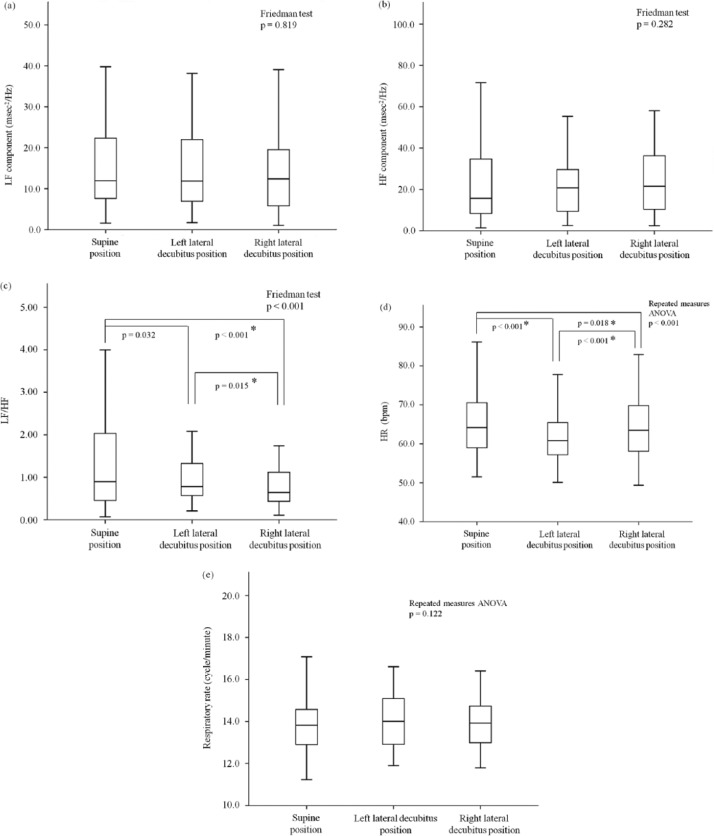
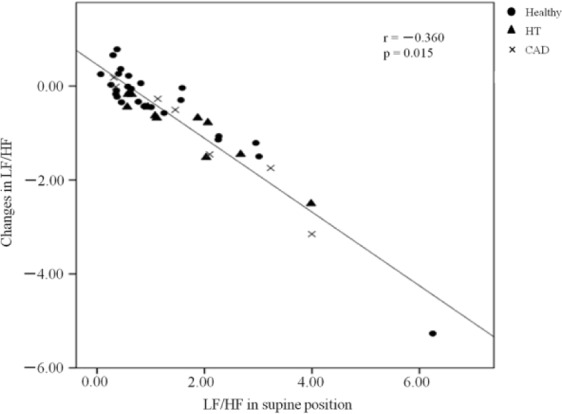
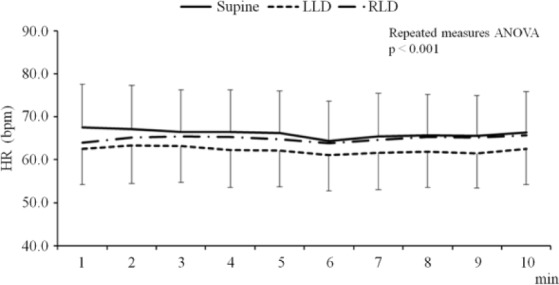
The aim of this study was to evaluate the effect of the supine, left lateral decubitus, and right lateral decubitus positions on autonomic nervous activity in elderly adults by using spectral analysis of heart rate variability (HRV). Forty-five adults aged 73.6 ± 5.7 years were enrolled. After lying in the supine position, all participants moved to the lateral decubitus positions in a random order and maintained the positions for 10 min, while electrocardiographic data were recorded to measure HRV. The lowest heart rate continued for 10 min when participants were in the left lateral decubitus position compared with the other two positions ( < .001), while the HRV indexes remained unchanged. The low-frequency HRV to high-frequency HRV ratio (LF/HF) for the right lateral decubitus position was significantly lower than that for the other positions. The right lateral decubitus position may attenuate sympathetic nerve activity in elderly adults.
本研究旨在通过心率变异性(HRV)频谱分析,评估仰卧位、左侧卧位和右侧卧位对老年人自主神经活动的影响。纳入了45名年龄为73.6±5.7岁的成年人。在仰卧位躺卧后,所有参与者按随机顺序转换至侧卧位,并保持该姿势10分钟,同时记录心电图数据以测量HRV。与其他两个姿势相比,参与者处于左侧卧位时最低心率持续了10分钟(<0.001),而HRV指标保持不变。右侧卧位的低频HRV与高频HRV比值(LF/HF)显著低于其他姿势。右侧卧位可能会减弱老年人的交感神经活动。