Friedrich Christin, Mamareli Panagiota, Thiemann Sophie, Kruse Friederike, Wang Zuobai, Holzmann Bernhard, Strowig Till, Sparwasser Tim, Lochner Matthias
Institute of Infection Immunology, TWINCORE, Centre for Experimental and Clinical Infection Research; a joint venture between the Medical School Hannover (MHH) and the Helmholtz Centre for Infection Research (HZI), Hannover, Germany.
Institute of Medical Microbiology and Hygiene, University of Freiburg, Freiburg Medical Centre, Freiburg, Germany.
PLoS Pathog. 2017 May 16;13(5):e1006357. doi: 10.1371/journal.ppat.1006357. eCollection 2017 May.
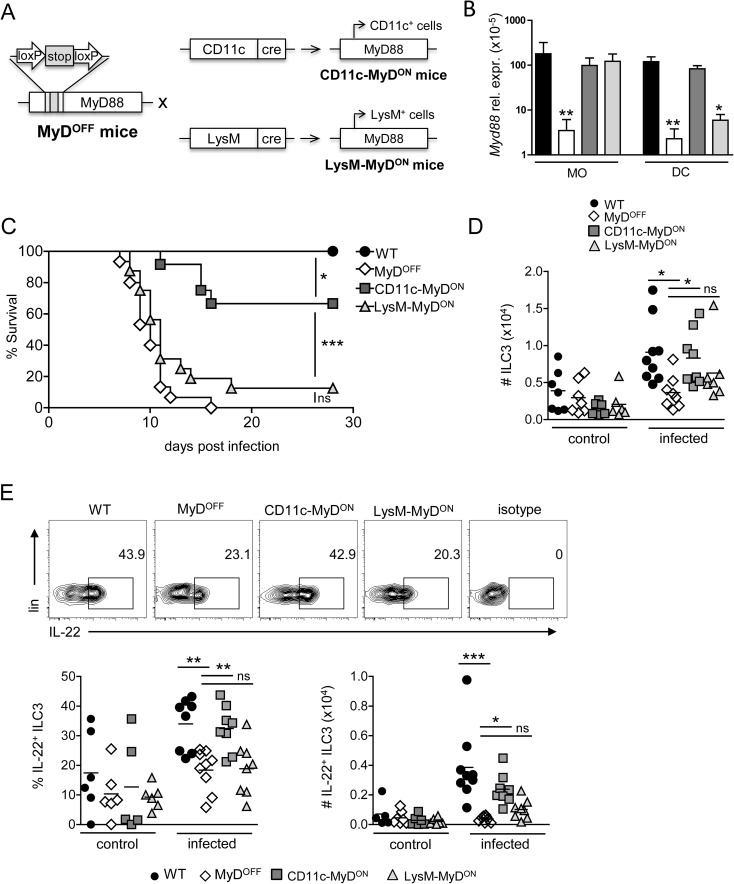
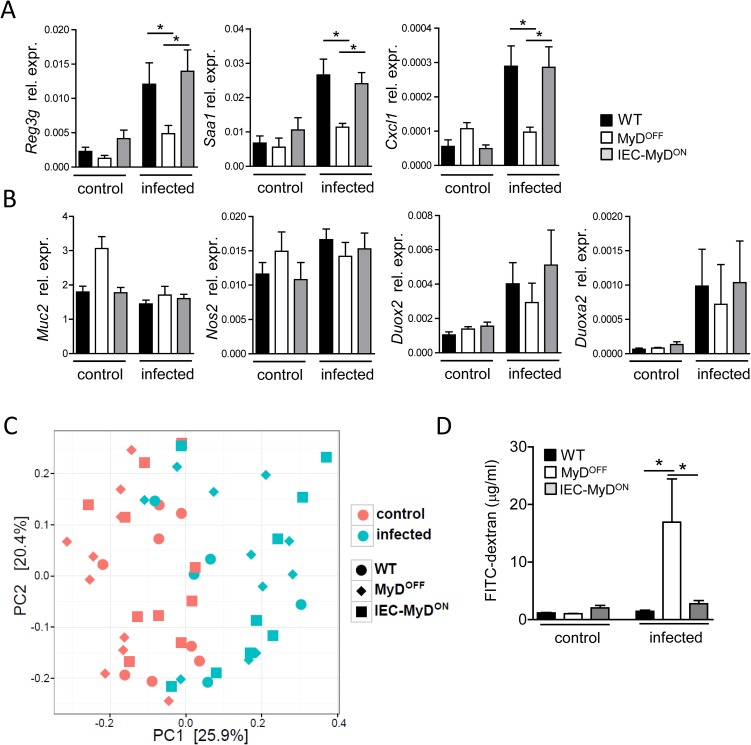
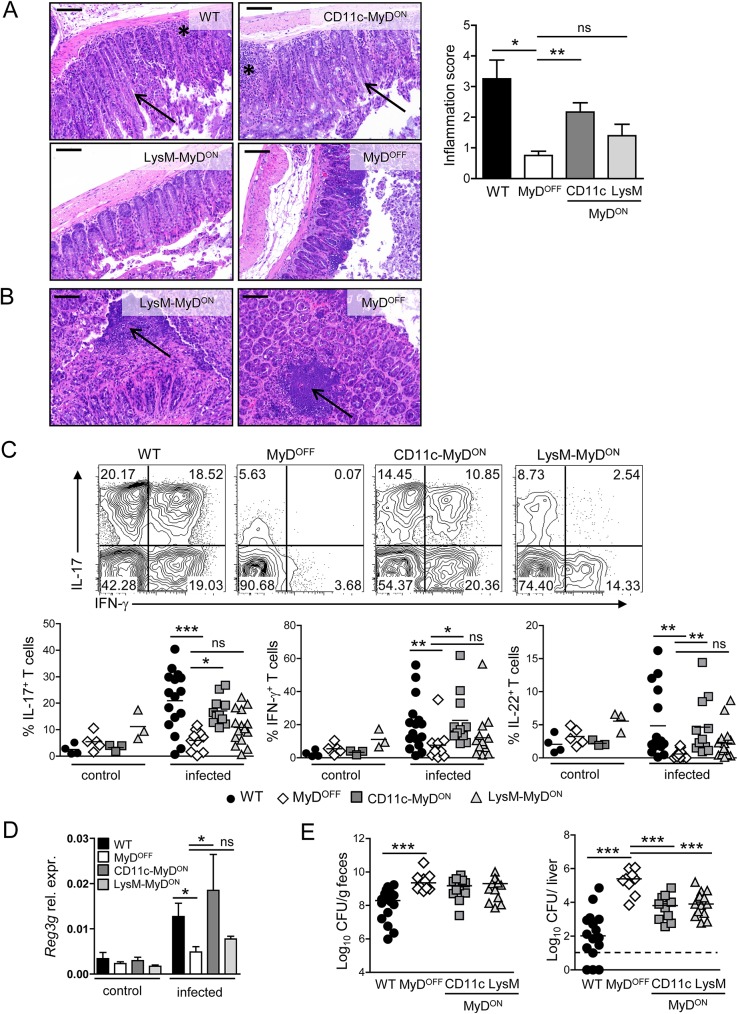
MyD88-mediated signaling downstream of Toll-like receptors and the IL-1 receptor family is critically involved in the induction of protective host responses upon infections. Although it is known that MyD88-deficient mice are highly susceptible to a wide range of bacterial infections, the cell type-specific contribution of MyD88 in protecting the host against intestinal bacterial infection is only poorly understood. In order to investigate the importance of MyD88 in specific immune and nonimmune cell types during intestinal infection, we employed a novel murine knock-in model for MyD88 that enables the cell type-specific reactivation of functional MyD88 expression in otherwise MyD88-deficient mice. We report here that functional MyD88 signaling in CD11c+ cells was sufficient to activate intestinal dendritic cells (DC) and to induce the early group 3 innate lymphoid cell (ILC3) response as well as the development of colonic Th17/Th1 cells in response to infection with the intestinal pathogen C. rodentium. In contrast, restricting MyD88 signaling to several other cell types, including macrophages (MO), T cells or ILC3 did not induce efficient intestinal immune responses upon infection. However, we observed that the functional expression of MyD88 in intestinal epithelial cells (IEC) also partially protected the mice during intestinal infection, which was associated with enhanced epithelial barrier integrity and increased expression of the antimicrobial peptide RegIIIγ and the acute phase protein SAA1 by epithelial cells. Together, our data suggest that MyD88 signaling in DC and IEC is both essential and sufficient to induce a full spectrum of host responses upon intestinal infection with C. rodentium.
髓样分化因子88(MyD88)介导的Toll样受体和白细胞介素-1受体家族下游信号传导在感染时诱导宿主保护性反应中起关键作用。虽然已知MyD88缺陷小鼠对多种细菌感染高度敏感,但MyD88在保护宿主抵抗肠道细菌感染中的细胞类型特异性作用仍知之甚少。为了研究MyD88在肠道感染期间特定免疫和非免疫细胞类型中的重要性,我们采用了一种新型的MyD88小鼠敲入模型,该模型能够在原本MyD88缺陷的小鼠中实现功能性MyD88表达的细胞类型特异性重新激活。我们在此报告,CD11c⁺细胞中的功能性MyD88信号足以激活肠道树突状细胞(DC),并诱导早期第3组固有淋巴细胞(ILC3)反应以及结肠Th17/Th1细胞的发育,以应对肠道病原体鼠柠檬酸杆菌的感染。相比之下,将MyD88信号传导限制在包括巨噬细胞(MO)、T细胞或ILC3在内的其他几种细胞类型中,在感染时并未诱导有效的肠道免疫反应。然而,我们观察到肠道上皮细胞(IEC)中MyD88的功能性表达在肠道感染期间也部分保护了小鼠,这与增强的上皮屏障完整性以及上皮细胞中抗菌肽RegIIIγ和急性期蛋白SAA1表达增加有关。总之,我们的数据表明,DC和IEC中的MyD88信号传导对于鼠柠檬酸杆菌肠道感染时诱导宿主的全谱反应既必不可少又足够充分。