Karlas Thomas, Weise Lara, Kuhn Stephanie, Krenzien Felix, Mehdorn Matthias, Petroff David, Linder Nicolas, Schaudinn Alexander, Busse Harald, Keim Volker, Pratschke Johann, Wiegand Johannes, Splith Katrin, Schmelzle Moritz
Department of Medicine, Neurology and Dermatology, Division of Gastroenterology and Rheumatology, University Hospital Leipzig, Leipzig, Germany.
IFB Adiposity Diseases, Leipzig University Medical Center, Leipzig, Germany.
J Transl Med. 2017 May 19;15(1):106. doi: 10.1186/s12967-017-1208-6.
The assessment of fibrosis and inflammatory activity is essential to identify patients with non-alcoholic fatty liver disease (NAFLD) at risk for progressive disease. Serum markers and ultrasound-based methods can replace liver biopsy for fibrosis staging, whereas non-invasive characterization of inflammatory activity remains a clinical challenge. Cell-free DNA (cfDNA) is a novel non-invasive biomarker for assessing cellular inflammation and cell death, which has not been evaluated in NAFLD.
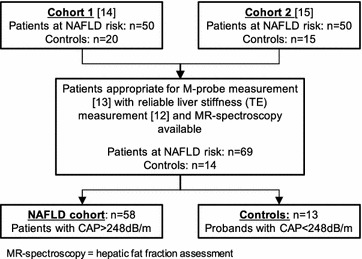
Patients and healthy controls from two previous studies were included. NAFLD disease activity and severity were non-invasively characterized by liver stiffness measurement (transient elastography, TE) including steatosis assessment with controlled attenuation parameter (CAP), single-proton magnetic resonance spectroscopy (H-MRS) for determination of hepatic fat fraction, aminotransferases and serum ferritin. cfDNA levels (90 and 222 bp fragments) were analyzed using quantitative real-time PCR.
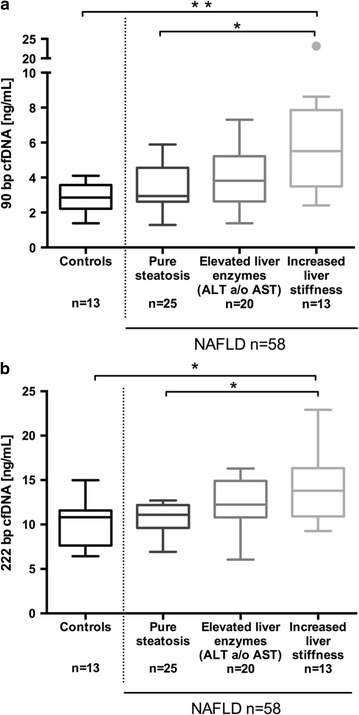
Fifty-eight NAFLD patients (age 62 ± 11 years, BMI 28.2 ± 3.5 kg/m) and 13 healthy controls (age 38 ± 12 years, BMI 22.4 ± 2.1 kg/m) were included. 90 bp cfDNA levels were significantly higher in NAFLD patients compared to healthy controls: 3.7 (1.3-23.1) vs. 2.9 (1.4-4.1) ng/mL (p = 0.014). In the NAFLD cohort, circulating cfDNA correlated significantly with disease activity and severity, especially in patients with elevated liver stiffness (n = 13, 22%) compared to cases with TE values ≤7 kPa: cf90 bp 6.05 (2.41-23.13) vs. 3.16 (1.29-7.31) ng/mL (p < 0.001), and cf222 bp 14.41 (9.27-22.90) vs. 11.32 (6.05-18.28) ng/mL (p = 0.0041).
Cell-free DNA plasma concentration correlates with established non-invasive markers of NAFLD activity and severity. Therefore, cfDNA should be further evaluated as biomarker for identifying patients at risk for progressive NAFLD.
纤维化和炎症活动的评估对于识别非酒精性脂肪性肝病(NAFLD)进展风险患者至关重要。血清标志物和基于超声的方法可替代肝活检进行纤维化分期,而炎症活动的非侵入性特征描述仍是一项临床挑战。游离DNA(cfDNA)是一种用于评估细胞炎症和细胞死亡的新型非侵入性生物标志物,尚未在NAFLD中进行评估。
纳入两项先前研究中的患者和健康对照。通过肝脏硬度测量(瞬时弹性成像,TE)对NAFLD疾病活动和严重程度进行非侵入性特征描述,包括使用受控衰减参数(CAP)评估脂肪变性、采用单质子磁共振波谱(H-MRS)测定肝脏脂肪分数、检测转氨酶和血清铁蛋白。使用定量实时PCR分析cfDNA水平(90和222bp片段)。
纳入58例NAFLD患者(年龄62±11岁,BMI 28.2±3.5kg/m²)和13例健康对照(年龄38±12岁,BMI 22.4±2.1kg/m²)。与健康对照相比,NAFLD患者的90bp cfDNA水平显著更高:3.7(1.3 - 23.1) vs. 2.9(1.4 - 4.1)ng/mL(p = 0.014)。在NAFLD队列中,循环cfDNA与疾病活动和严重程度显著相关,特别是与肝脏硬度升高的患者(n = 13,22%)相比,TE值≤7kPa的患者:cf90bp为6.05(2.41 - 23.13) vs. 3.16(1.29 - 7.31)ng/mL(p < 0.001),cf222bp为14.41(9.27 - 22.90) vs. 11.32(6.05 - 18.28)ng/mL(p = 0.0041)。
游离DNA血浆浓度与已确立的NAFLD活动和严重程度的非侵入性标志物相关。因此,cfDNA应作为识别进展性NAFLD风险患者的生物标志物进行进一步评估。