Crocker Jonny, Saywell Darren, Bartram Jamie
The Water Institute, University of North Carolina at Chapel Hill, USA.
Plan International USA, USA.
Int J Hyg Environ Health. 2017 May;220(3):551-557. doi: 10.1016/j.ijheh.2017.02.011. Epub 2017 May 9.
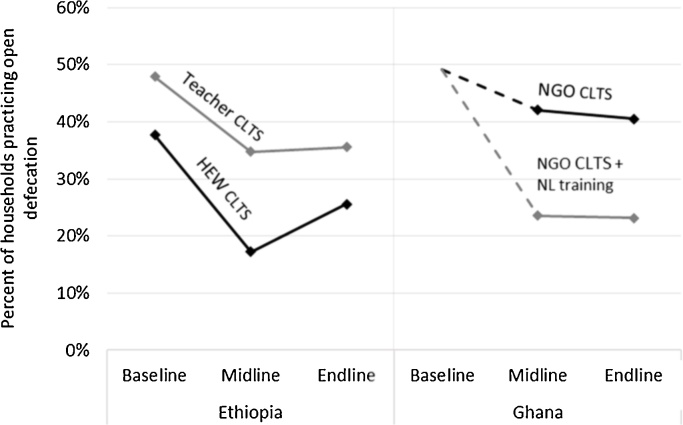
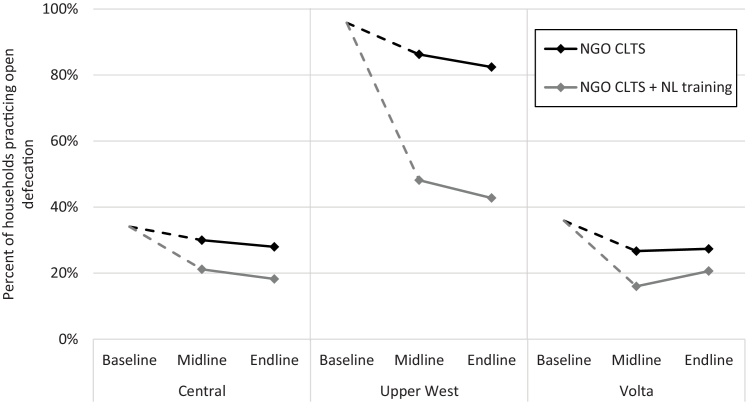
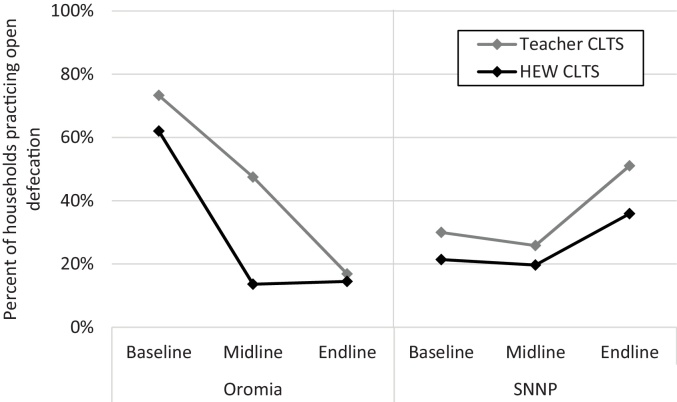
We conducted a study to evaluate the sustainability of community-led total sanitation (CLTS) outcomes in Ethiopia and Ghana. Plan International, with local actors, implemented four CLTS interventions from 2012 to 2014: health extension worker-facilitated CLTS and teacher-facilitated CLTS in Ethiopia, and NGO-facilitated CLTS with and without training for natural leaders in Ghana. We previously evaluated these interventions using survey data collected immediately after implementation ended, and concluded that in Ethiopia health extension workers were more effective facilitators than teachers, and that in Ghana training natural leaders improved CLTS outcomes. For this study, we resurveyed 3831 households one year after implementation ended, and analyzed latrine use and quality to assess post-intervention changes in sanitation outcomes, to determine if our original conclusions were robust. In one of four interventions evaluated (health extension worker-facilitated CLTS in Ethiopia), there was an 8 percentage point increase in open defecation in the year after implementation ended, challenging our prior conclusion on their effectiveness. For the other three interventions, the initial decreases in open defecation of 8-24 percentage points were sustained, with no significant changes occurring in the year after implementation. On average, latrines in Ethiopia were lower quality than those in Ghana. In the year following implementation, forty-five percent of households in Ethiopia repaired or rebuilt latrines that had become unusable, while only 6% did in Ghana possibly due to higher latrine quality. Across all four interventions and three survey rounds, most latrines remained unimproved. Regardless of the intervention, households in villages higher latrine use were more likely to have sustained latrine use, which together with the high latrine repair rates indicates a potential social norm. There are few studies that revisit villages after an initial evaluation to assess sustainability of sanitation outcomes. This study provides new evidence that CLTS outcomes can be sustained in the presence of training provided to local actors, and strengthens previous recommendations that CLTS is not appropriate in all settings and should be combined with efforts to address barriers households face to building higher quality latrines.
我们开展了一项研究,以评估埃塞俄比亚和加纳由社区主导的全面卫生(CLTS)成果的可持续性。国际计划组织与当地行为体合作,在2012年至2014年期间实施了四项CLTS干预措施:在埃塞俄比亚由卫生推广工作者推动的CLTS和由教师推动的CLTS,以及在加纳由非政府组织推动的CLTS(分为有无对自然领袖进行培训两种情况)。我们之前利用实施结束后立即收集的调查数据对这些干预措施进行了评估,得出的结论是,在埃塞俄比亚,卫生推广工作者比教师更有效地推动了CLTS,在加纳,培训自然领袖改善了CLTS成果。在本研究中,我们在实施结束一年后对3831户家庭进行了重新调查,并分析了厕所的使用情况和质量,以评估干预后卫生成果的变化,从而确定我们原来的结论是否可靠。在评估的四项干预措施中的一项(埃塞俄比亚由卫生推广工作者推动的CLTS)中,实施结束后的一年内露天排便率上升了8个百分点,这对我们之前关于其有效性的结论提出了挑战。对于其他三项干预措施,露天排便率最初下降了8 - 24个百分点,并得以维持,在实施后的一年中没有发生显著变化。平均而言,埃塞俄比亚的厕所质量低于加纳的厕所。在实施后的一年里,埃塞俄比亚45%的家庭对无法使用的厕所进行了维修或重建,而在加纳只有6%的家庭这样做了,这可能是因为加纳的厕所质量更高。在所有四项干预措施和三轮调查中,大多数厕所仍未得到改善。无论干预措施如何,在厕所使用率较高的村庄,家庭更有可能持续使用厕所,这与较高的厕所维修率一起表明了一种潜在的社会规范。很少有研究在初步评估后对村庄进行重新调查,以评估卫生成果的可持续性。本研究提供了新的证据,表明在向当地行为体提供培训的情况下,CLTS成果可以持续,并强化了之前的建议,即CLTS并不适用于所有情况,应与解决家庭在建造高质量厕所时面临的障碍的努力相结合。