INSERM UMRS-1160, Paris, France
Service d'Hématologie Adulte, Hôpital Saint-Louis, Paris, France.
Haematologica. 2017 Aug;102(8):1368-1377. doi: 10.3324/haematol.2017.165001. Epub 2017 May 18.
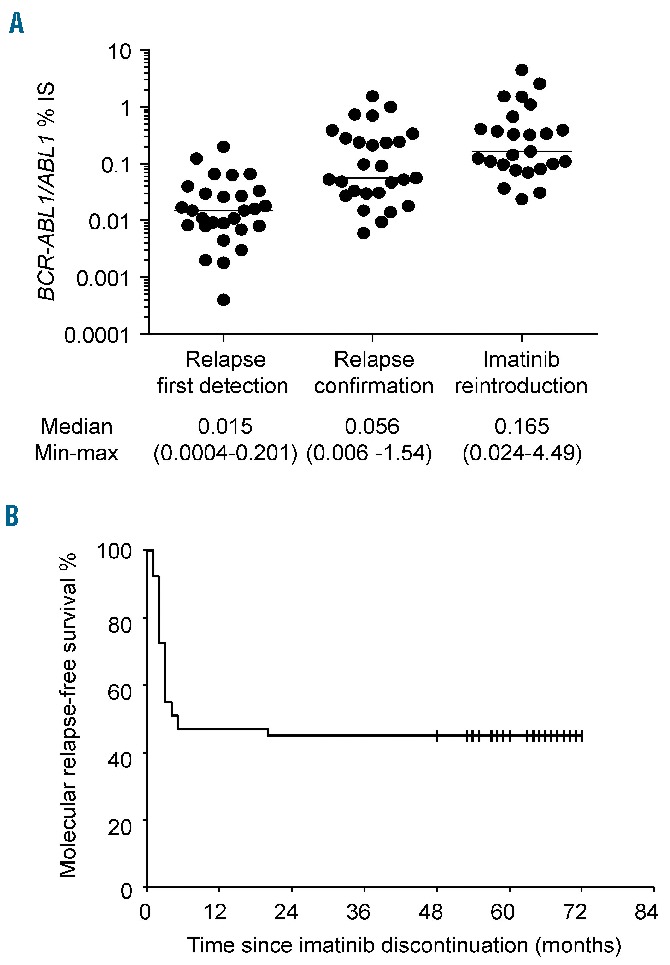
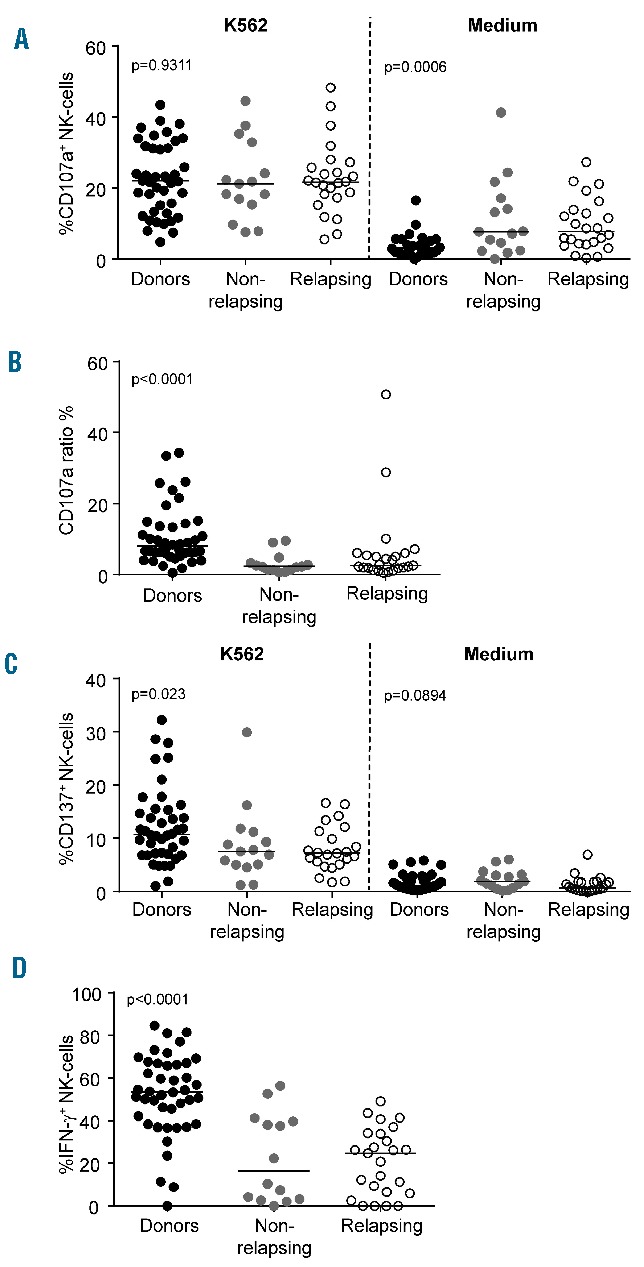
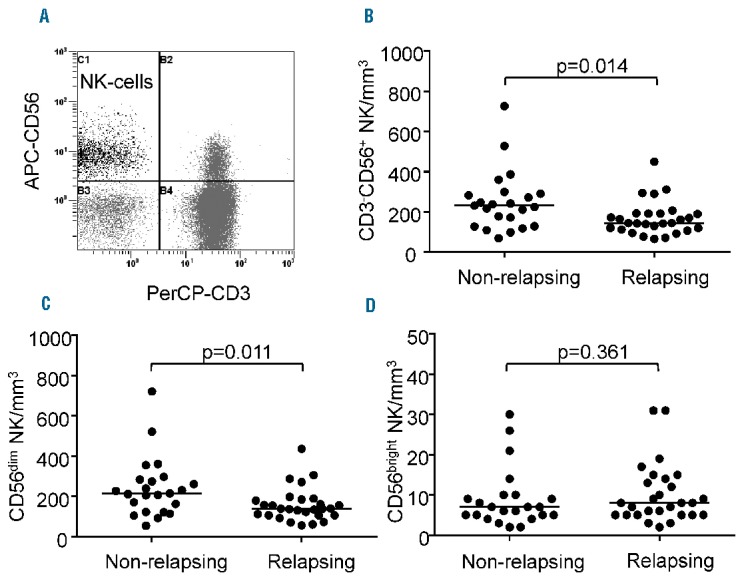
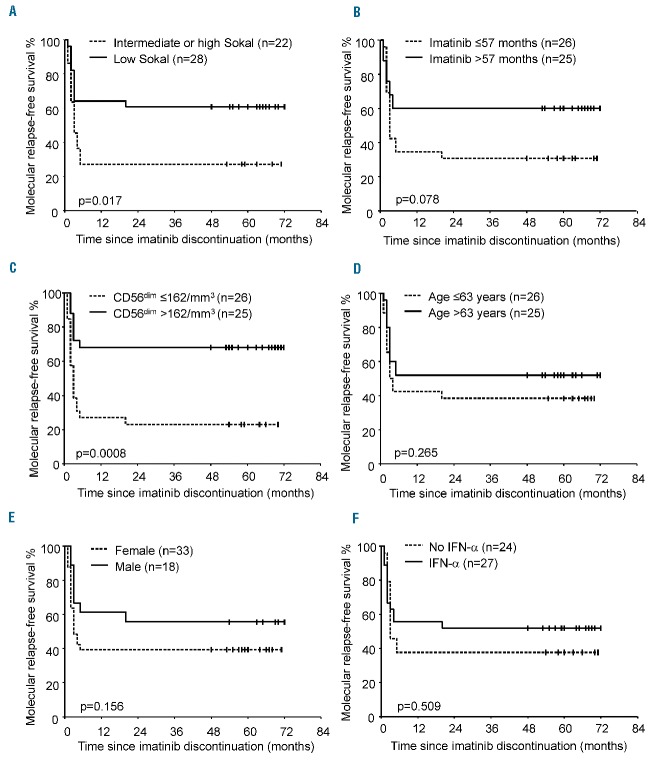
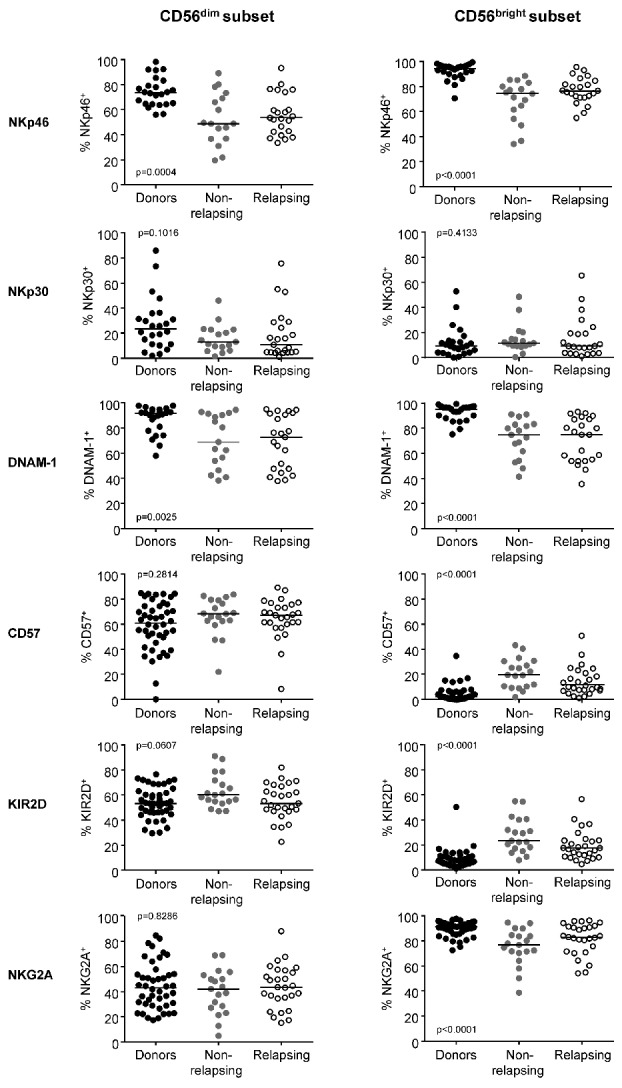
Despite persistence of leukemic stem cells, patients with chronic myeloid leukemia who achieve and maintain deep molecular responses may successfully stop the tyrosine kinase inhibitor imatinib. However, questions remain unanswered regarding the biological basis of molecular relapse after imatinib cessation. In IMMUNOSTIM, we monitored 51 patients from the French Stop IMatinib trial for peripheral blood T cells and natural killer cells. Molecular relapse-free survival at 24 months was 45.1% (95% CI: 31.44%-58.75%). At the time of imatinib discontinuation, non-relapsing patients had significantly higher numbers of natural killer cells of the cytotoxic CD56 subset than had relapsing patients, while CD56 natural killer cells, T cells and their subsets did not differ significantly. Furthermore, the CD56 natural killer-cell count was an independent prognostic factor of molecular-relapse free survival in a multivariate analysis. However, expression of natural killer-cell activating receptors, leukemia cell line K562-specific degranulation and cytokine-induced interferon-gamma secretion were decreased in non-relapsing and relapsing patients as compared with healthy individuals. After imatinib cessation, the natural killer-cell count increased significantly and stayed higher in non-relapsing patients than in relapsing patients, while receptor expression and functional properties remained unchanged. Altogether, our results suggest that natural killer cells may play a role in controlling leukemia-initiating cells at the origin of relapse after imatinib cessation, provided that these cells are numerous enough to compensate for their functional defects. Further research will decipher mechanisms underlying functional differences between natural killer cells from patients and healthy individuals and evaluate the potential interest of immunostimulatory approaches in tyrosine kinase inhibitor discontinuation strategies. .
尽管白血病干细胞持续存在,但达到并维持深度分子缓解的慢性髓性白血病患者可能成功停止酪氨酸激酶抑制剂伊马替尼治疗。然而,关于伊马替尼停药后分子复发的生物学基础仍有许多问题尚未得到解答。在 IMMUNOSTIM 研究中,我们监测了来自法国停止伊马替尼试验的 51 名患者的外周血 T 细胞和自然杀伤细胞。24 个月时无分子复发的生存率为 45.1%(95%CI:31.44%-58.75%)。在伊马替尼停药时,未复发患者的细胞毒性 CD56 亚群自然杀伤细胞数量显著高于复发患者,而 CD56 自然杀伤细胞、T 细胞及其亚群在两组间无显著差异。此外,在多变量分析中,CD56 自然杀伤细胞计数是无分子复发生存的独立预后因素。然而,与健康个体相比,非复发和复发患者的自然杀伤细胞激活受体表达、白血病细胞系 K562 特异性脱颗粒和细胞因子诱导的干扰素-γ分泌均降低。伊马替尼停药后,非复发患者的自然杀伤细胞计数显著增加且持续高于复发患者,而受体表达和功能特性保持不变。总之,我们的研究结果表明,自然杀伤细胞可能在伊马替尼停药后复发的白血病起始细胞中发挥作用,前提是这些细胞数量足够多,足以弥补其功能缺陷。进一步的研究将阐明患者和健康个体自然杀伤细胞之间功能差异的机制,并评估免疫刺激方法在酪氨酸激酶抑制剂停药策略中的潜在意义。