Power Melinda C, Tingle Jonathan V, Reid Robert I, Huang Juebin, Sharrett A Richey, Coresh Josef, Griswold Michael, Kantarci Kejal, Jack Clifford R, Knopman David, Gottesman Rebecca F, Mosley Thomas H
Department of Epidemiology and Biostatistics, George Washington University Milken Institute School of Public Health, Washington, DC
Center of Biostatistics and Bioinformatics, University of Mississippi Medical Center, Jackson, MS.
J Am Heart Assoc. 2017 May 18;6(5):e005608. doi: 10.1161/JAHA.117.005608.
Diffusion tensor imaging measures of white matter (WM) microstructural integrity appear to provide earlier indication of WM injury than WM hyperintensities; however, risk factors for poor WM microstructural integrity have not been established. Our study quantifies the association between vascular risk factors in midlife and late life with measures of late-life WM microstructural integrity.
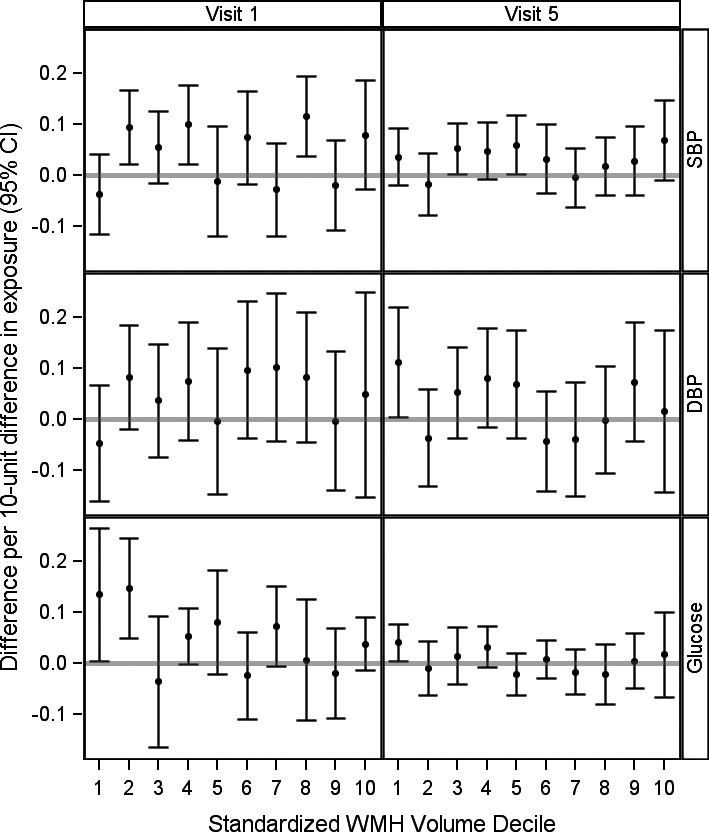
We used data from 1851 participants in ARIC (Atherosclerosis Risk in Communities Study) who completed 3-T magnetic resonance imaging, including diffusion tensor imaging, as part of the ARIC Neurocognitive Study (ARIC-NCS). We quantified the association among lipids, glucose, and blood pressure from the baseline ARIC visit (1987-1989, ages 44-65, midlife) and visit 5 of ARIC (2011-2013, ages 67-90, late life, concurrent with ARIC-NCS) with regional and overall WM mean diffusivity and fractional anisotropy obtained at ARIC visit 5 for ARIC participants. We also considered whether these associations were independent of or modified by WM hyperintensity volumes. We found that elevated blood pressure in midlife and late life and elevated glucose in midlife, but not late life, were associated with worse late-life WM microstructural integrity. These associations were independent of the degree of WM hyperintensity, and the association between glucose and WM microstructural integrity appeared stronger for those with the least WM hyperintensity. There was little support for an adverse association between lipids and WM microstructural integrity.
Hypertension in both midlife and late life and elevated glucose in midlife are related to worse WM microstructural integrity in late life.
白质(WM)微观结构完整性的扩散张量成像测量似乎比WM高信号能更早地提示WM损伤;然而,WM微观结构完整性差的危险因素尚未明确。我们的研究量化了中年和老年血管危险因素与老年WM微观结构完整性测量之间的关联。
我们使用了社区动脉粥样硬化风险研究(ARIC)中1851名参与者的数据,这些参与者完成了3-T磁共振成像,包括扩散张量成像,作为ARIC神经认知研究(ARIC-NCS)的一部分。我们量化了ARIC基线访视(1987 - 1989年,年龄44 - 65岁,中年)以及ARIC第5次访视(2011 - 2013年,年龄67 - 90岁,老年,与ARIC-NCS同时进行)时的脂质、葡萄糖和血压与ARIC参与者在ARIC第5次访视时获得的区域和整体WM平均扩散率及分数各向异性之间的关联。我们还考虑了这些关联是否独立于WM高信号体积或受其影响。我们发现中年和老年时血压升高以及中年时葡萄糖升高(而非老年时)与老年WM微观结构完整性较差有关。这些关联独立于WM高信号程度,并且对于WM高信号最少的人群,葡萄糖与WM微观结构完整性之间的关联似乎更强。几乎没有证据支持脂质与WM微观结构完整性之间存在不良关联。
中年和老年的高血压以及中年时葡萄糖升高与老年时较差的WM微观结构完整性有关。