Gioia Laura, Klahr Ana, Kate Mahesh, Buck Brian, Dowlatshahi Dariush, Jeerakathil Thomas, Emery Derek, Butcher Kenneth
Division of Neurology, University of Alberta, 7th Floor Clinical Sciences Building, 11350-83rd Avenue, Edmonton, AB, T6G 2B7, Canada.
Division of Neurology, University of Ottawa, Ottawa, ON, Canada.
BMC Neurol. 2017 May 19;17(1):100. doi: 10.1186/s12883-017-0884-4.
Aggressively lowering blood pressure (BP) in acute intracerebral hemorrhage (ICH) may improve outcome. Although there is no evidence that BP reduction changes cerebral blood flow, retrospective magnetic resonance imaging (MRI) studies have demonstrated sub-acute ischemic lesions in ICH patients. The primary aim of this study is to assess ischemic lesion development in patients randomized to two different BP treatment strategies. We hypothesize aggressive BP reduction is not associated with ischemic injury after ICH.
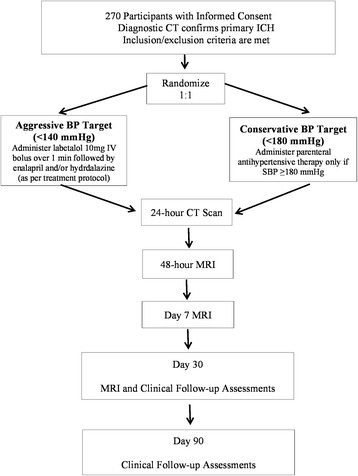
The Intracerebral Hemorrhage Acutely Decreasing Blood Pressure Trial II (ICH ADAPT II) is a phase II multi-centre randomized open-label, blinded-endpoint trial. Acute ICH patients (N = 270) are randomized to a systolic blood pressure (SBP) target of <140 or <180 mmHg. Acute ICH patients within 6 h of onset and two SBP measurements ≥140 mmHg recorded >2 mins apart qualify. SBP is managed with a pre-defined treatment protocol. Patients undergo MRI at 48 h, Days 7 and 30, with clinical assessment at Day 30 and 90. The primary outcome is diffusion weighted imaging (DWI) lesion frequency at 48 h. Secondary outcomes include cumulative DWI lesion rate frequency within 30 days, absolute hematoma growth, prediction of DWI lesion incidence, 30-day mortality rates, day 90 functional outcome, and cognitive status.
This trial will assess the impact of hypertensive therapies on physiological markers of ischemic injury. The findings of this study will provide evidence for the link, or lack thereof, between BP reduction and ischemic injury in ICH patients.
This study is registered with clinicaltrials.gov ( NCT02281838 , first received October 29, 2014).
在急性脑出血(ICH)中积极降低血压(BP)可能改善预后。尽管没有证据表明降低血压会改变脑血流量,但回顾性磁共振成像(MRI)研究已在ICH患者中发现亚急性缺血性病变。本研究的主要目的是评估随机接受两种不同血压治疗策略的患者中缺血性病变的发展情况。我们假设积极降低血压与ICH后缺血性损伤无关。
脑出血急性降压试验II(ICH ADAPT II)是一项II期多中心随机开放标签、终点设盲试验。急性ICH患者(N = 270)被随机分为收缩压(SBP)目标为<140或<180 mmHg。发病6小时内且两次SBP测量值≥140 mmHg且间隔>2分钟的急性ICH患者符合条件。SBP采用预定义的治疗方案进行管理。患者在48小时、第7天和第30天接受MRI检查,并在第30天和第90天进行临床评估。主要结局是48小时时弥散加权成像(DWI)病变频率。次要结局包括30天内累积DWI病变率频率、绝对血肿增长、DWI病变发生率预测、30天死亡率、90天功能结局和认知状态。
本试验将评估高血压治疗对缺血性损伤生理标志物的影响。本研究结果将为ICH患者降低血压与缺血性损伤之间的关联(或缺乏关联)提供证据。
本研究已在clinicaltrials.gov注册(NCT02281838,首次接收时间为2014年10月29日)。