Yamanashi Keiji, Marumo Satoshi, Sumitomo Ryota, Shoji Tsuyoshi, Fukui Motonari, Katayama Toshiro, Huang Cheng-Long
Department of Thoracic Surgery, Kurashiki Central Hospital, Okayama, Japan.
Respiratory Disease Center, Tazuke Kofukai Foundation, Medical Research Institute, Kitano Hospital, 2-4-20 Ohgimachi, Kita-ku, Osaka, 530-8480, Japan.
J Cardiothorac Surg. 2017 May 19;12(1):35. doi: 10.1186/s13019-017-0606-4.
Long-acting β-adrenoceptor agonists have been shown to increase the risk of atrial arrhythmias in patients with stable chronic obstructive pulmonary disease. The aim of this study was to investigate whether perioperative long-acting β-adrenoceptor agonists treatment would increase the risk of postoperative atrial arrhythmias after lung cancer surgery in chronic obstructive pulmonary disease patients.
We retrospectively analyzed 174 consecutive chronic obstructive pulmonary disease patients with non-small-cell lung cancer who underwent lobectomy or segmentectomy. The subjects were divided into those with or without perioperative long-acting β-adrenoceptor agonists treatment. Postoperative cardiopulmonary complications were compared between the two groups.
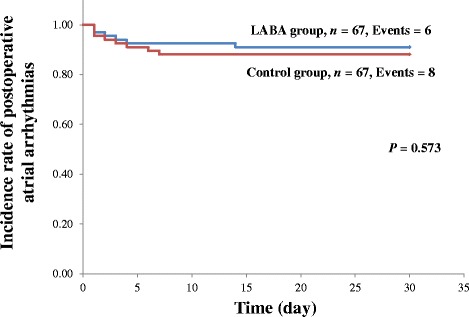
There were no statistically significant differences between the perioperative long-acting β-adrenoceptor agonists treatment group and the control group in the incidence of postoperative atrial arrhythmias (P = 0.629). In 134 propensity-score-matched pairs, including variables such as age, gender, comorbidities, smoking history, operation procedure, lung-cancer staging, and respiratory function, there were no significant differences between the two groups in the incidence of postoperative cardiopulmonary complications, including atrial arrhythmias.
Perioperative administration of long-acting β-adrenoceptor agonists might not increase the incidence of postoperative atrial arrhythmias after surgical resection for non-small-cell lung cancer in chronic obstructive pulmonary disease patients.
长效β肾上腺素能受体激动剂已被证明会增加稳定期慢性阻塞性肺疾病患者发生房性心律失常的风险。本研究的目的是调查围手术期使用长效β肾上腺素能受体激动剂治疗是否会增加慢性阻塞性肺疾病患者肺癌手术后发生术后房性心律失常的风险。
我们回顾性分析了174例连续接受肺叶切除术或肺段切除术的非小细胞肺癌合并慢性阻塞性肺疾病患者。将受试者分为围手术期接受或未接受长效β肾上腺素能受体激动剂治疗的两组。比较两组术后心肺并发症情况。
围手术期长效β肾上腺素能受体激动剂治疗组与对照组在术后房性心律失常发生率方面无统计学显著差异(P = 0.629)。在134对倾向评分匹配的病例中,包括年龄、性别、合并症、吸烟史、手术方式、肺癌分期和呼吸功能等变量,两组在包括房性心律失常在内的术后心肺并发症发生率方面无显著差异。
围手术期给予长效β肾上腺素能受体激动剂可能不会增加慢性阻塞性肺疾病患者非小细胞肺癌手术切除术后房性心律失常的发生率。