Lumniczky Katalin, Szatmári Tünde, Sáfrány Géza
Division of Radiation Medicine, National Public Health Centre, National Research Directorate for Radiobiology and Radiohygiene, Budapest, Hungary.
Front Immunol. 2017 May 5;8:517. doi: 10.3389/fimmu.2017.00517. eCollection 2017.
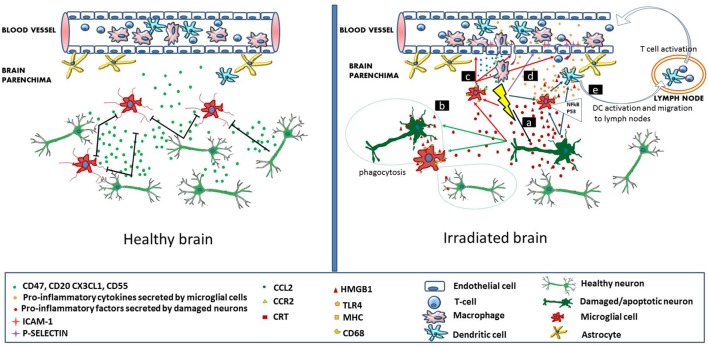
Radiation-induced late brain injury consisting of vascular abnormalities, demyelination, white matter necrosis, and cognitive impairment has been described in patients subjected to cranial radiotherapy for brain tumors. Accumulating evidence suggests that various degrees of cognitive deficit can develop after much lower doses of ionizing radiation, as well. The pathophysiological mechanisms underlying these alterations are not elucidated so far. A permanent deficit in neurogenesis, chronic microvascular alterations, and blood-brain barrier dysfunctionality are considered among the main causative factors. Chronic neuroinflammation and altered immune reactions in the brain, which are inherent complications of brain irradiation, have also been directly implicated in the development of cognitive decline after radiation. This review aims to give a comprehensive overview on radiation-induced immune alterations and inflammatory reactions in the brain and summarizes how these processes can influence cognitive performance. The available data on the risk of low-dose radiation exposure in the development of cognitive impairment and the underlying mechanisms are also discussed.
接受脑部肿瘤头颅放疗的患者中已出现由血管异常、脱髓鞘、白质坏死和认知障碍组成的放射性迟发性脑损伤。越来越多的证据表明,低得多的电离辐射剂量后也会出现不同程度的认知缺陷。这些改变背后的病理生理机制迄今尚未阐明。神经发生的永久性缺陷、慢性微血管改变和血脑屏障功能障碍被认为是主要致病因素。脑部放疗的固有并发症——慢性神经炎症和大脑中改变的免疫反应,也直接与放疗后认知功能下降的发生有关。本综述旨在全面概述辐射诱导的大脑免疫改变和炎症反应,并总结这些过程如何影响认知表现。还讨论了低剂量辐射暴露在认知障碍发生中的风险及潜在机制的现有数据。