Peng Feng, Hu Dan, Lin Xiandong, Chen Gang, Liang Binying, Li Chao, Chen Yan, Cui Zhaolei, Zhang Hejun, Lin Jixiu, Zheng Xiongwei, Niu Wenquan
Department of Cardiology, The First Affiliated Hospital of Fujian Medical University, Fuzhou, Fujian, China.
Department of Pathology, Fujian Provincial Cancer Hospital, The Affiliated Hospital of Fujian Medical University, Fuzhou, Fujian, China.
J Cancer. 2017 Mar 12;8(6):967-975. doi: 10.7150/jca.18000. eCollection 2017.
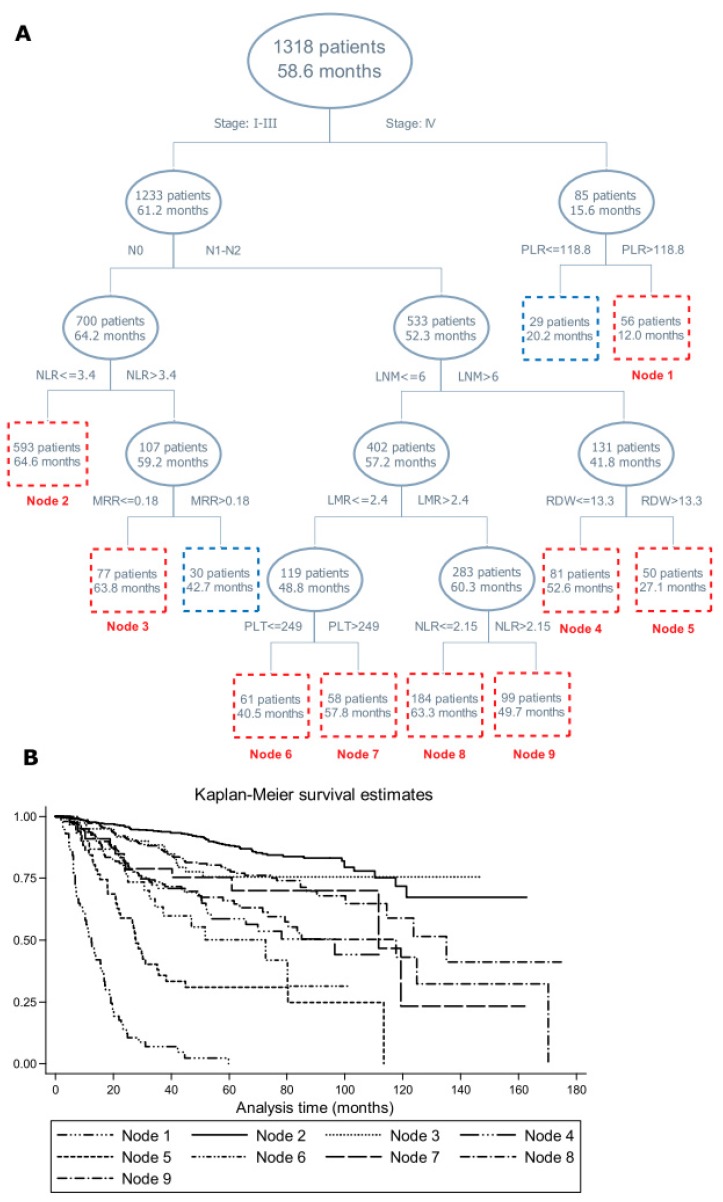
We sought to evaluate the prognosis of preoperative blood routine parameters for the mortality of colorectal cancer patients after surgery by eliciting a subset of data from the ongoing Fujian prospective investigation of cancer (FIESTA) study. 1318 colorectal cancer patients with completed survival data were enrolled between 2000 and 2008. Effect-size estimates are expressed as hazard ratio (HR) and 95% confidence interval (CI). The median follow-up time was 58.6 months. Elevated levels of neutrophil (adjusted HR, 95% CI, P: 1.22, 1.06-1.41, 0.006) and monocyte (1.32, 1.06-1.65, 0.013) were significantly associated with an increased risk of colorectal cancer mortality, whereas that of lymphocyte (0.60, 0.44-0.82, 0.001) and red blood cell count (0.20, 0.09-0.43, <0.001) were significantly associated with a reduced risk. Additionally, remarkable significance was reached for the neutrophil-to-lymphocyte ratio (1.12, 1.06-1.19, <0.001) and lymphocyte-to-monocyte ratio (0.60, 0.46-0.79, <0.001). Based on individual effect-estimates, a new derivate, monocyte to red blood cell count ratio namely MRR was created, and its association with colorectal cancer mortality was strikingly significant (1.48, 1.18-1.85, 0.001). Notably, elevated MRR was significantly associated with the mortality of early stage colorectal cancer, especially in patients with stage I-II (1.63, 1.04-2.56, 0.034), invasion depth T1-T2 (2.85, 1.45-5.61, 0.002), regional lymph node metastasis N0 (1.89, 1.29-2.77, 0.001) and tumor size ≤ 4.5 cm (1.84, 1.25-2.70, 0.002). We created a new derivate MRR, which was superior over classic blood routine derivates, and importantly the MRR exhibited a stronger ability in predicting poor prognosis of colorectal cancer, especially at the early stage.
我们试图通过从正在进行的福建癌症前瞻性调查(FIESTA)研究中提取一部分数据,来评估术前血常规参数对结直肠癌患者术后死亡率的预后价值。2000年至2008年间,共纳入了1318例有完整生存数据的结直肠癌患者。效应量估计值以风险比(HR)和95%置信区间(CI)表示。中位随访时间为58.6个月。中性粒细胞水平升高(校正HR,95%CI,P:1.22,1.06 - 1.41,0.006)和单核细胞水平升高(1.32,1.06 - 1.65,0.013)与结直肠癌死亡风险增加显著相关,而淋巴细胞水平(0.60,0.44 - 0.82,0.001)和红细胞计数(0.20,0.09 - 0.43,<0.001)与死亡风险降低显著相关。此外,中性粒细胞与淋巴细胞比值(1.12,1.06 - 1.19,<0.001)和淋巴细胞与单核细胞比值(0.60,0.46 - 0.79,<0.001)也具有显著意义。基于个体效应估计值,创建了一个新的衍生指标,即单核细胞与红细胞计数比值(MRR),其与结直肠癌死亡率的关联极为显著(1.48,1.18 - 1.85,0.001)。值得注意的是,MRR升高与早期结直肠癌死亡率显著相关,尤其是I - II期患者(1.63,1.04 - 2.56,0.034)、浸润深度T1 - T2患者(2.85,1.45 - 5.61,0.002)、区域淋巴结转移N0患者(1.89,1.29 - 2.77,0.001)和肿瘤大小≤4.5 cm的患者(1.84,1.25 - 2.70,0.002)。我们创建了一个新的衍生指标MRR,它优于经典的血常规衍生指标,重要的是,MRR在预测结直肠癌不良预后方面表现出更强的能力,尤其是在早期阶段。