Carty Catherine I, Fahey Alan G, Sheehy Morgan R, Taylor Steve, Lean Ian J, McAloon Conor G, O'Grady Luke, Mulligan Finbar J
School of Veterinary Medicine, University College Dublin, Dublin, Ireland.
School of Agricultural Food Science and Nutrition, University College Dublin, Dublin, Ireland.
Ir Vet J. 2017 May 18;70:14. doi: 10.1186/s13620-017-0092-y. eCollection 2017.
Milk fat is important in terms of economic value and in its potential to provide information concerning cow diet and health. Under current milk payment schemes in Ireland farmer income is directly linked to milk fat production.
A descriptive analysis of milk fat depression (MFD) as calculated from test day milk recording data across all milk recording herds from 2004 to 2014 was undertaken. A dataset of 17 million test day records was used to calculate the prevalence of MFD in Irish milk recorded herds and to create a graphical description of the major descriptive epidemiological trends in milk fat depression in time and space in Ireland. The bulk tank equivalent (BTE) for test day milk fat was calculated for each herd and for cohorts of cows within herds using the formula; BTE milk fat = sum test day fat kg/sum test day milk kg. Milk fat depression was defined as BTE <3.3% milk fat and BTE > 3.2% milk protein.
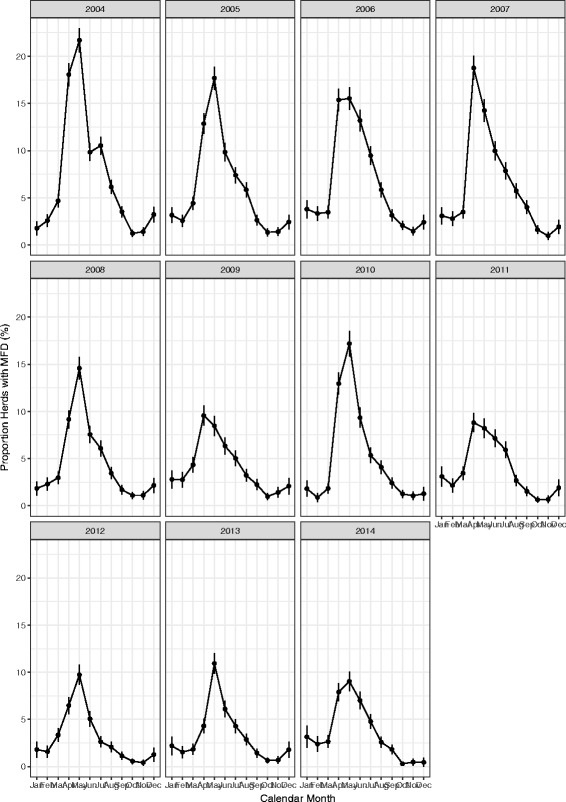
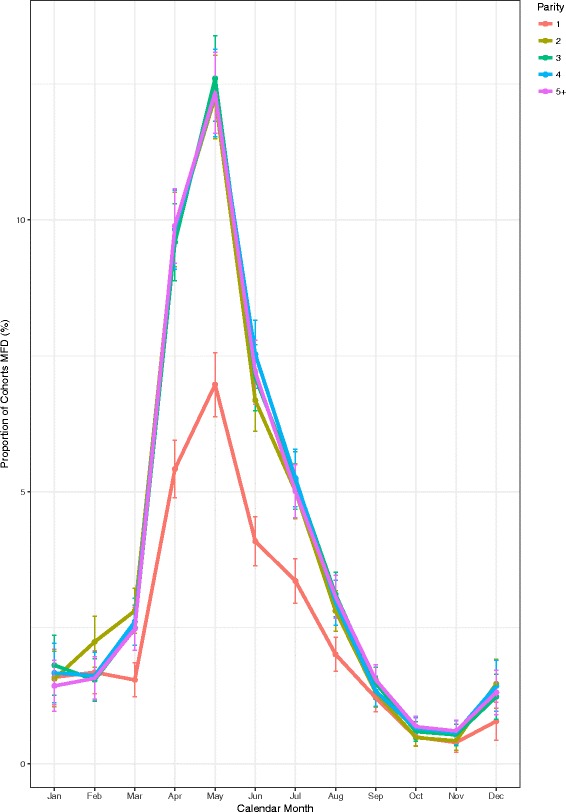
The annual prevalence of MFD decreased significantly over time in a linear manner until 2014. Across all years the highest prevalence of MFD occurred in April or May. The highest prevalence occurred most commonly in May, with 9.1% of herds experiencing MFD in 2014. The highest prevalence of MFD in autumn calved cohorts occurred at 181-210 days in milk whereas it occurred at days 61-90 in milk in spring calving cohorts. The stage of lactation for the most common occurrence of MFD in both the spring and autumn cohorts corresponded with the month of May. There were some notable spatial patterns regarding variations in prevalence of MFD across the country. Cohorts of cows with the highest genetic values for milk yield had the highest prevalence of MFD whereas cohorts of cows with the highest breeding values for milk fat percent had the lowest prevalence of MFD.
A subpopulation of Irish herds experienced the condition of MFD. Descriptive analysis suggested spatial, temporal and animal level associations. This condition warrants further investigation.
乳脂肪在经济价值方面以及在提供有关奶牛饮食和健康信息的潜力方面都很重要。在爱尔兰当前的牛奶支付计划下,农民收入与乳脂肪产量直接相关。
对2004年至2014年所有奶牛记录牛群的测奶日牛奶记录数据计算得出的乳脂肪降低(MFD)进行了描述性分析。使用了一个包含1700万条测奶日记录的数据集来计算爱尔兰奶牛记录牛群中MFD的患病率,并对爱尔兰乳脂肪降低在时间和空间上的主要描述性流行病学趋势进行图形描述。使用公式计算每个牛群以及牛群内奶牛群组的测奶日乳脂肪的批量罐等效值(BTE);BTE乳脂肪=测奶日脂肪千克总和/测奶日牛奶千克总和。乳脂肪降低定义为BTE<3.3%乳脂肪且BTE>3.2%乳蛋白。
直到2014年,MFD的年患病率随时间呈线性显著下降。在所有年份中,MFD的最高患病率出现在4月或5月。最高患病率最常出现在5月,2014年有9.1%的牛群出现MFD。秋季产犊群组中MFD的最高患病率出现在产奶181 - 210天,而春季产犊群组中出现在产奶61 - 90天。春季和秋季群组中最常出现MFD的泌乳阶段与5月相对应。关于全国MFD患病率的变化存在一些显著的空间模式。产奶量遗传值最高的奶牛群组MFD患病率最高,而乳脂肪百分比育种值最高的奶牛群组MFD患病率最低。
爱尔兰部分牛群出现了MFD状况。描述性分析表明存在空间、时间和动物水平的关联。这种状况值得进一步研究。