Xu Wei, Li Haoyang, Wang Qian, Hua Chen, Zhang Hanzhen, Li Weihua, Jiang Shibo, Lu Lu
Key Laboratory of Medical Molecular Virology of Ministries of Education and Health, School of Basic Medical Sciences and Shanghai Public Health Clinical Center, Fudan University, Shanghai 200032, China.
Key Laboratory of Reproduction Regulation of NPFPC, SIPPR, IRD, Fudan University, Shanghai 200032, China.
Biomed Res Int. 2017;2017:6096134. doi: 10.1155/2017/6096134. Epub 2017 Apr 26.
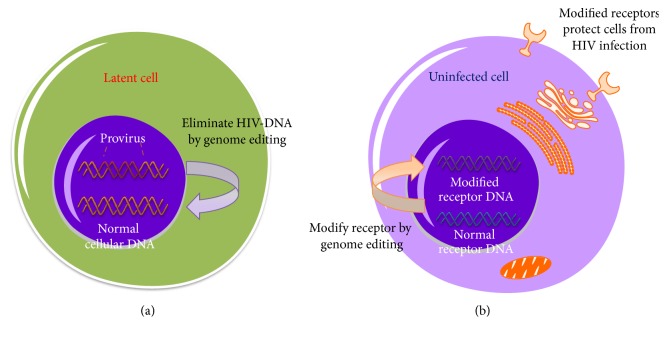
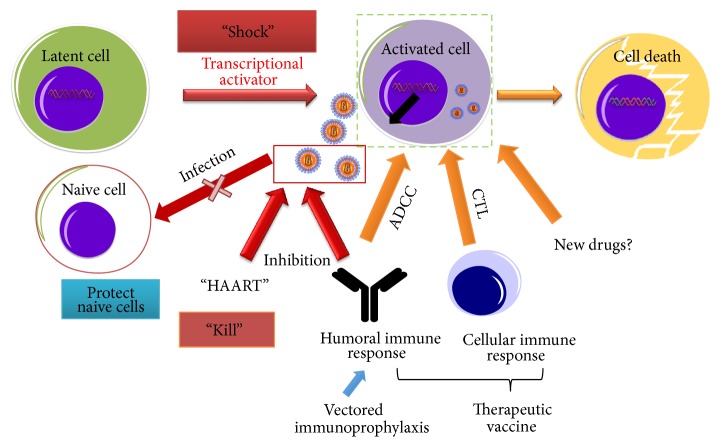
Combined antiretroviral therapy (cART) has been successful in prolonging lifespan and reducing mortality of patients infected with human immunodeficiency virus (HIV). However, the eradication of latent HIV reservoirs remains a challenge for curing HIV infection (HIV cure) because of HIV latency in primary memory CD4 T cells. Currently, two types of HIV cures are in development: a "sterilizing cure" and a "functional cure." A sterilizing cure refers to the complete elimination of replication-competent proviruses in the body, while a functional cure refers to the long-term control of HIV replication without treatment. Based on these concepts, significant progress has been made in different areas. This review focuses on recent advancements and future prospects for HIV cures.
联合抗逆转录病毒疗法(cART)已成功延长了人类免疫缺陷病毒(HIV)感染者的寿命并降低了死亡率。然而,由于HIV在初始记忆CD4 T细胞中的潜伏性,根除潜伏的HIV储存库仍然是治愈HIV感染(治愈HIV)的一项挑战。目前,两种类型的HIV治愈方法正在研发中:“灭菌治愈”和“功能性治愈”。灭菌治愈是指完全消除体内具有复制能力的前病毒,而功能性治愈是指在不进行治疗的情况下长期控制HIV复制。基于这些概念,不同领域已取得了重大进展。本综述重点关注HIV治愈方法的最新进展和未来前景。