Keita Younoussa, Lemrabott Ahmed Tall, Sylla Assane, Niang Babacar, Ka El Hadji Fary, Dial Chérif Mohamed, Ndongo Aliou Abdoulaye, Sow Amadou, Moreira Claude, Niang Abdou, Ndiaye Ousmane, Diouf Boucar, Sall Mouhamadou Guélaye
Service de Pédiatrie CHU A Le Dantec, Dakar, Sénégal.
Service de Néphrologie CHU A, Le Dantec, Dakar, Sénégal.
Pan Afr Med J. 2017 Mar 21;26:161. doi: 10.11604/pamj.2017.26.161.10130. eCollection 2017.
This study aimed to analyze the diagnostic, therapeutic, and evolutionary features of nephrosis in children in a pediatric department in Dakar.
The study was carried out in the Department of Pediatrics at the Aristide Le Dantec Hospital. We conducted a retrospective study over a period of 3 years from 1 January 2012 to 31 December 2014. All patients aged 2-12 years with idiopathic nephrotic syndrome were included in the study.
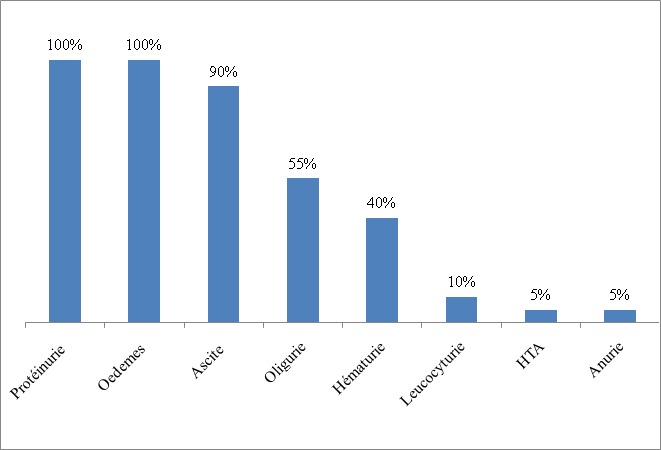
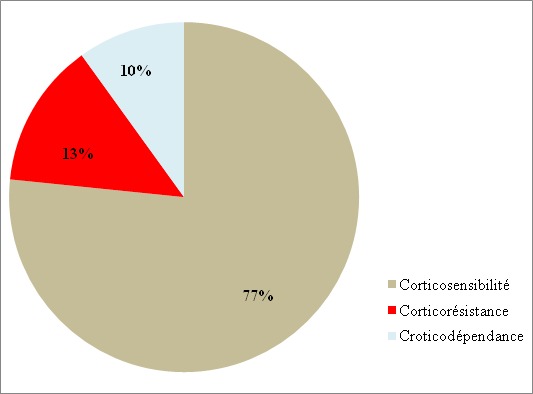
Forty cases of nephrosis were collected, that is to say a prevalence of 23% among patients with kidney disease treated in the Department of Pediatrics. The average age was 7.11 ± 3.14 years. 72.5% (n=29) of patients suffered from pure nephrotic syndrome. Lower limb edema was present in 100% of patients, oliguria in 55% (n=22) and high blood pressure (HBP) in 5% (n=2) of cases. Median proteinuria was 145,05 ± 85,54 mg/kg/24 hours. Median protidemia was 46,42 ±7.88 g/L and median albumin was 17.90 ± 7.15 g/L. Thirty nine patients were treated with prednisone-based corticosteroid therapy. Corticosensitivity was retained in 77% (n=30) patients and corticoresistance in 13% (n=5) of cases. The factor of poor response after corticosteroid therapy was initial proteinuria greater than 150 mg/kg/day (p = 0.024). Renal biopsy was performed in 18% (n=7) of patients which showed focal and segmental hyalinosis in 57.2% (n=4). Cyclophosphamide and azathioprine were associated with corticosteroids in 10% (n=4) of cases respectively. The overall remission rate was 89.8%. The evolution toward chronic renal failure was observed in three patients.
Nephrosis accounted for almost one quarter of all cases of kidney disease treated in our Department. It has high overall remission rate. The only factor contributing to poor response after corticosteroid therapy was high levels of initial proteinuria. Focal and segmental hyalinosis was the most frequently found lesion diagnosed by renal biopsy.
本研究旨在分析达喀尔一家儿科病房中儿童肾病的诊断、治疗及病情发展特征。
本研究在阿里斯蒂德·勒丹泰克医院儿科开展。我们进行了一项回顾性研究,研究时间段为2012年1月1日至2014年12月31日,为期3年。所有年龄在2至12岁的特发性肾病综合征患者均纳入本研究。
共收集到40例肾病病例,即在儿科接受治疗的肾病患者中患病率为23%。平均年龄为7.11±3.14岁。72.5%(n = 29)的患者患有单纯性肾病综合征。100%的患者出现下肢水肿,55%(n = 22)的患者出现少尿,5%(n = 2)的病例出现高血压(HBP)。蛋白尿中位数为145.05±85.54mg/kg/24小时。血浆蛋白中位数为46.42±7.88g/L,白蛋白中位数为17.90±7.15g/L。39例患者接受了以泼尼松为基础的皮质类固醇治疗。77%(n = 30)的患者保持皮质激素敏感性,13%(n = 5)的病例出现皮质激素抵抗。皮质类固醇治疗后反应不佳的因素是初始蛋白尿大于150mg/kg/天(p = 0.024)。18%(n = 7)的患者进行了肾活检,其中57.2%(n = 4)显示局灶节段性玻璃样变。分别有10%(n = 4)的病例将环磷酰胺和硫唑嘌呤与皮质类固醇联合使用。总体缓解率为89.8%。观察到3例患者病情发展为慢性肾衰竭。
肾病占我们科室治疗的所有肾病病例的近四分之一。其总体缓解率较高。皮质类固醇治疗后反应不佳的唯一因素是初始蛋白尿水平高。局灶节段性玻璃样变是肾活检诊断出的最常见病变。