NanoBiotechnology Laboratory, Australian Centre for Blood Diseases, Monash University, Melbourne, Australia.
VascularBiotechnology Laboratory, Baker Heart and Diabetes Institute, Melbourne, Australia.
Sci Rep. 2017 May 24;7(1):2346. doi: 10.1038/s41598-017-02498-2.
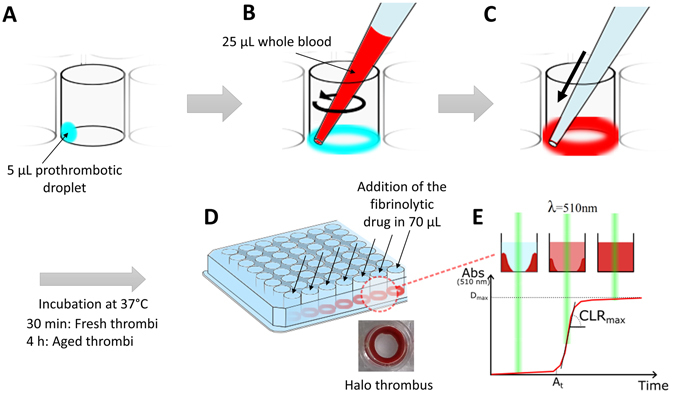
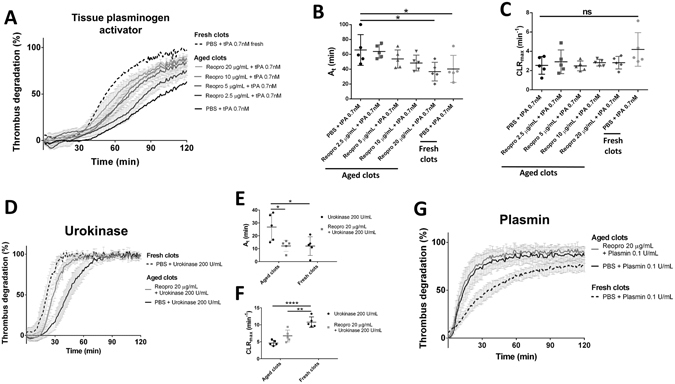
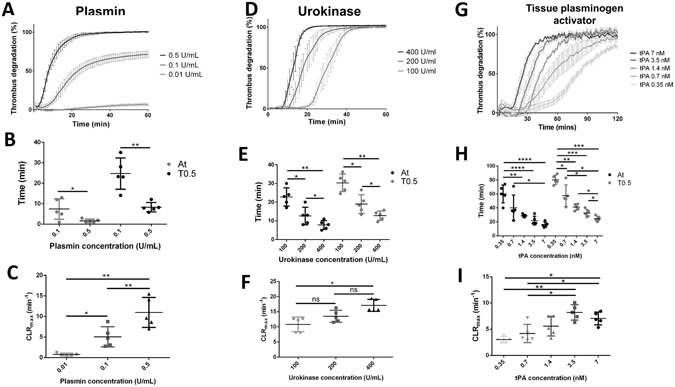
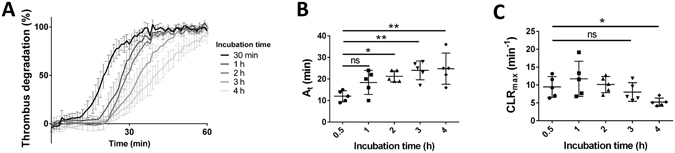
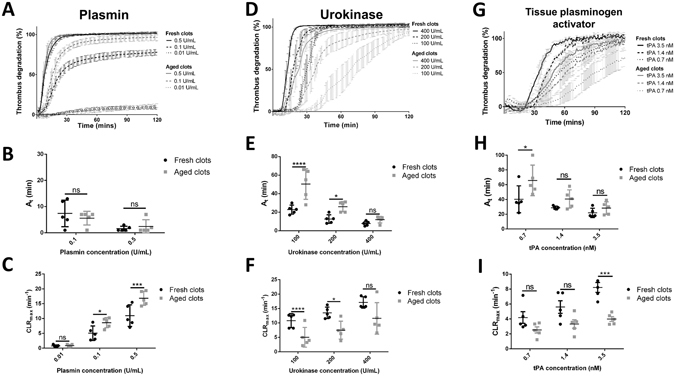
The objective of this work was to develop a high throughput assay for testing in vitro the thrombolytic activity using citrated whole blood samples, and to overcome the limitations of currently available techniques. We successfully developed a method that involves forming halo shaped, tissue factor induced, whole blood clots in 96 well plates, and then precisely measuring the thrombolysis process with a spectrophotometer plate reader. We here describe the implementation of this novel method, which we refer to as halo assay, and its validation with plasmin, urokinase and tissue plasminogen activator at different doses. The resulting data is a highly detailed thrombolysis profile, allowing comparison of different fibrinolytic agents. The time point analysis allows kinetic data to be collected and calculated to determine key parameters such as the activation time and the rate of fibrinolysis. We also assessed the capacity of the model to study the effect of clot maturation time on the fibrinolytic rate, an aspect of thrombosis rather unexplored with currently available methods, but of increasing importance in drug development. This novel thrombolysis assay could be an extremely useful research tool; to study the complex process of thrombolysis, and a valuable translational clinical tool; as a screening device to rapidly identify hypo- or hyper-fibrinolysis.
这项工作的目的是开发一种高通量测定法,以测试使用柠檬酸盐全血样本的体外溶栓活性,并克服当前可用技术的局限性。我们成功开发了一种方法,该方法涉及在 96 孔板中形成晕状、组织因子诱导的全血凝块,然后使用分光光度计板读数器精确测量溶栓过程。我们在这里描述了这种新方法的实施情况,我们称之为晕状测定法,并对不同剂量的纤溶酶、尿激酶和组织型纤溶酶原激活剂进行了验证。得到的数据是高度详细的溶栓谱,可以比较不同的纤维蛋白溶解剂。时间点分析可以收集和计算动力学数据,以确定关键参数,如激活时间和纤维蛋白溶解率。我们还评估了该模型研究血栓形成时间对纤维蛋白溶解率的影响的能力,这是当前可用方法尚未探索但在药物开发中越来越重要的血栓形成方面。这种新的溶栓测定法可以成为一种非常有用的研究工具;研究溶栓的复杂过程,以及一种有价值的转化临床工具;作为一种筛选装置,可快速识别低纤维蛋白溶解或高纤维蛋白溶解。