Montagna Elena, Dorostkar Mario M, Herms Jochen
Department for Translational Brain Research, German Center for Neurodegenerative Diseases (DZNE), Ludwig-Maximilian-University MunichMunich, Germany.
Center for Neuropathology and Prion Research, Ludwig-Maximilian-University MunichMunich, Germany.
Front Mol Neurosci. 2017 May 10;10:136. doi: 10.3389/fnmol.2017.00136. eCollection 2017.
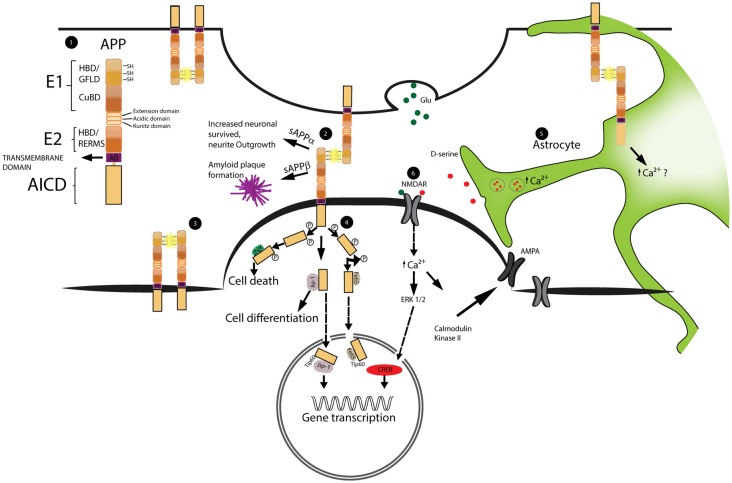
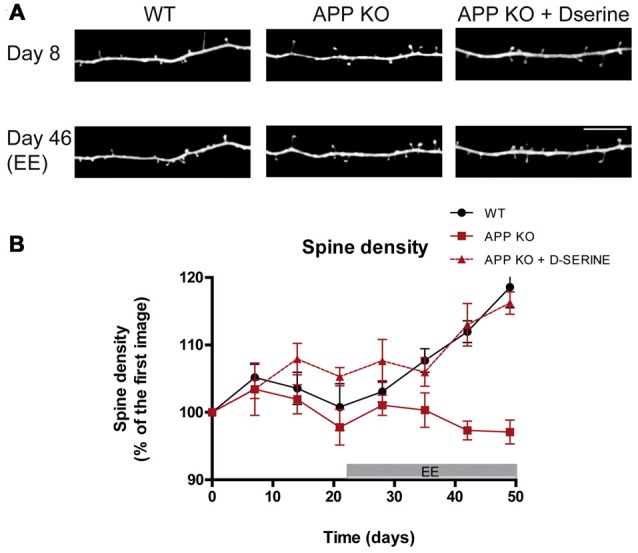
Amyloid precursor protein (APP) is a transmembrane protein highly expressed in neurons. The full-length protein has cell-adhesion and receptor-like properties, which play roles in synapse formation and stability. Furthermore, APP can be cleaved by several proteases into numerous fragments, many of which affect synaptic function and stability. This review article focuses on the mechanisms of APP in structural spine plasticity, which encompasses the morphological alterations at excitatory synapses. These occur as changes in the number and morphology of dendritic spines, which correspond to the postsynaptic compartment of excitatory synapses. Both overexpression and knockout (KO) of APP lead to impaired synaptic plasticity. Recent data also suggest a role of APP in the regulation of astrocytic D-serine homeostasis, which in turn regulates synaptic plasticity.
淀粉样前体蛋白(APP)是一种在神经元中高度表达的跨膜蛋白。全长蛋白具有细胞黏附及受体样特性,在突触形成和稳定性中发挥作用。此外,APP可被多种蛋白酶切割成众多片段,其中许多片段会影响突触功能和稳定性。这篇综述文章聚焦于APP在结构性脊柱可塑性中的机制,结构性脊柱可塑性涵盖兴奋性突触处的形态学改变。这些改变表现为树突棘数量和形态的变化,树突棘对应于兴奋性突触的突触后部分。APP的过表达和基因敲除(KO)均会导致突触可塑性受损。最新数据还表明APP在调节星形胶质细胞D-丝氨酸稳态中发挥作用,进而调节突触可塑性。