Kim Hee Sook, Lee Kun Sei, Eun Sang Jun, Choi Si Wan, Kim Dae Hyeok, Park Tae Ho, Yun Kyeong Ho, Yang Dong Heon, Hwang Seok Jae, Park Ki Soo, Kim Rock Bum
Division of Infectious Disease Surveillance, Korea Centers for Disease Control and Prevention, Cheongju, Korea.
Department of Public Health Science, Graduate School of Public Health and Institute of Health and Environment, Seoul National University, Seoul, Korea.
Yonsei Med J. 2017 Jul;58(4):710-719. doi: 10.3349/ymj.2017.58.4.710.
The aim of our study was to investigate gender differences in factors related to prehospital delay and identify whether the knowledge of acute myocardial infarction symptoms affects this delay in Korean patients with ST-elevation myocardial infarction (STEMI).
A total of 350 patients (286 men, 64 women) with confirmed STEMI were interviewed to investigate socio-demographics, history of disease, symptom onset time, and factors that contributed to delayed decision time in seeking treatment and hospital arrival time from symptom onset. Factors associated with prehospital delay were examined separately by gender using univariate and multivariate analyses.
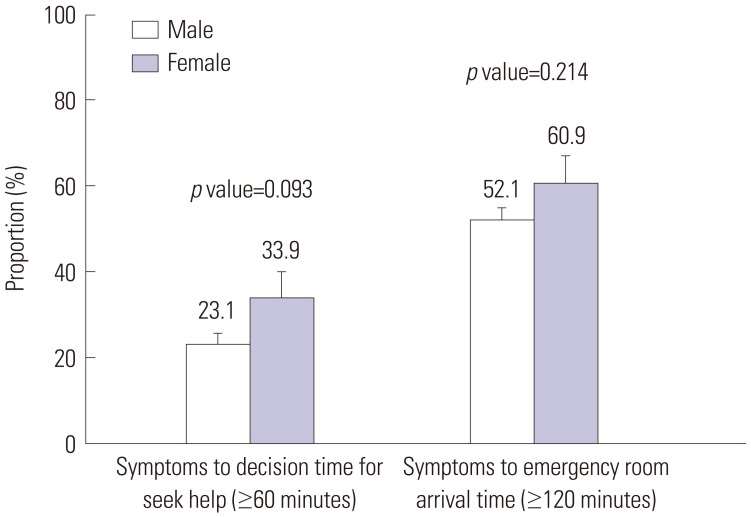
Female patients had higher proportions of ≥60-minute decision time and ≥120-minute arrival time compared to male patients (33.9% vs. 23.1%, 60.9% vs. 52.1%, respectively). However, the difference was not statistically significant (p=0.093 and 0.214, respectively). Previous cardiovascular disease (CVD) was associated with increased decision time in men, whereas, in women, lower educational status caused a greater delay in decision time. Factors associated with hospital arrival time excluding delayed decision time were referral from another hospital, previous CVD, and percutaneous coronary intervention in men, and referral from another hospital in women.
Gender differences exist in factors related to prehospital delay. Therefore, public education to reduce prehospital delay should be conducted according to gender with a focus on the pertinent factors.
我们研究的目的是调查与院前延误相关因素中的性别差异,并确定急性心肌梗死症状的知晓情况是否会影响韩国ST段抬高型心肌梗死(STEMI)患者的这种延误。
对350例确诊为STEMI的患者(286例男性,64例女性)进行访谈,以调查社会人口统计学、疾病史、症状发作时间,以及导致从症状发作到寻求治疗的决策时间延迟和到达医院时间延迟的因素。使用单变量和多变量分析按性别分别检查与院前延误相关的因素。
与男性患者相比,女性患者决策时间≥60分钟和到达时间≥120分钟的比例更高(分别为33.9%对23.1%,60.9%对52.1%)。然而,差异无统计学意义(分别为p=0.093和0.214)。既往心血管疾病(CVD)与男性决策时间增加有关,而在女性中,较低的教育水平导致决策时间延迟更长。排除决策时间延迟后,与到达医院时间相关的因素在男性中为来自另一家医院的转诊、既往CVD和经皮冠状动脉介入治疗,在女性中为来自另一家医院的转诊。
与院前延误相关的因素存在性别差异。因此,应根据性别针对相关因素开展减少院前延误的公众教育。