Albrecht Larissa, Stallard Robert F, Kalko Elisabeth K V
Institute of Experimental Ecology, University of Ulm, Ulm, Germany.
Smithsonian Tropical Research Institute, Balboa, Panama.
PLoS One. 2017 May 24;12(5):e0177060. doi: 10.1371/journal.pone.0177060. eCollection 2017.
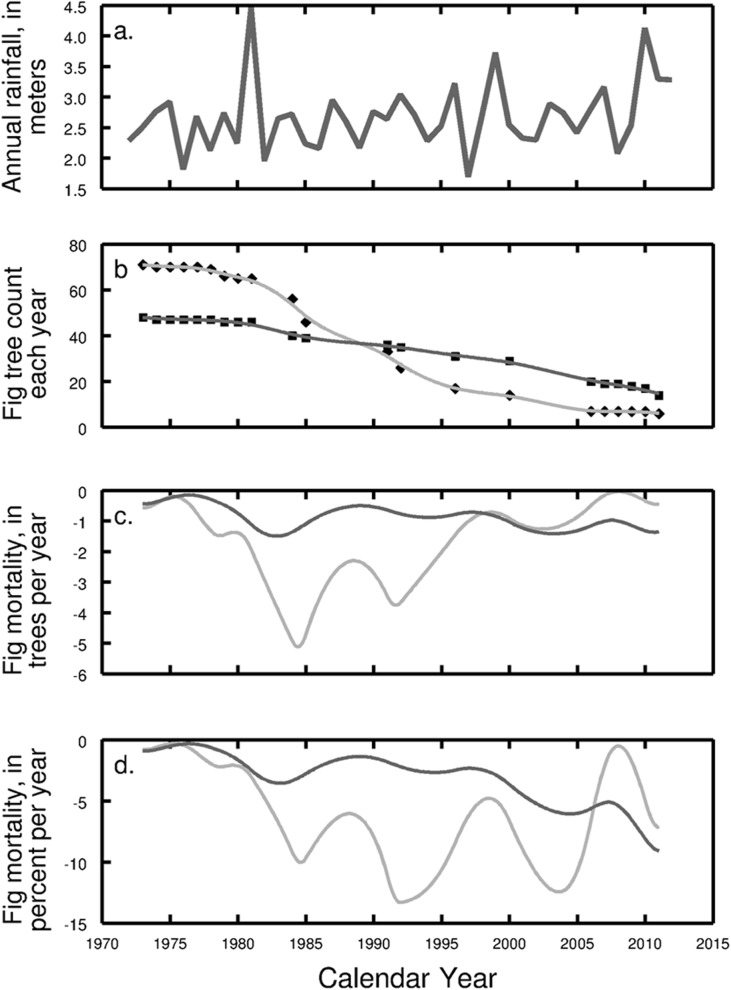
Figs (Ficus sp.) are often considered as keystone resources which strongly influence tropical forest ecosystems. We used long-term tree-census data to track the population dynamics of two abundant free-standing fig species, Ficus insipida and F. yoponensis, on Barro Colorado Island (BCI), a 15.6-km2 island in Lake Gatún, Panama. Vegetation cover on BCI consists of a mosaic of old growth (>400 years) and maturing (about 90-150 year old) secondary rainforest. Locations and conditions of fig trees have been mapped and monitored on BCI for more than 35 years (1973-2011), with a focus on the Lutz Catchment area (25 ha). The original distribution of the fig trees shortly after the construction of the Panama Canal was derived from an aerial photograph from 1927 and was compared with previous land use and forest status. The distribution of both fig species (~850 trees) is restricted to secondary forest. Of the original 119 trees observed in Lutz Catchment in 1973, >70% of F. insipida and >90% of F. yoponensis had died by 2011. Observations in other areas on BCI support the trend of declining free-standing figs. We interpret the decline of these figs on BCI as a natural process within a maturing tropical lowland forest. Senescence of the fig trees appears to have been accelerated by severe droughts such as the strong El Niño event in the year 1982/83. Because figs form such an important food resource for frugivores, this shift in resource availability is likely to have cascading effects on frugivore populations.
榕树(榕属植物)通常被视为对热带森林生态系统有强烈影响的关键资源。我们利用长期的树木普查数据,追踪了巴拿马加通湖一个面积为15.6平方公里的巴罗科罗拉多岛(BCI)上两种常见的独立生长的榕树物种——无味榕和尤庞榕的种群动态。BCI上的植被覆盖由古老生长(超过400年)和成熟(约90 - 150年树龄)的次生雨林组成的镶嵌体。榕树的位置和状况在BCI上已被绘制地图并监测了超过35年(1973 - 2011年),重点是卢茨集水区(25公顷)。巴拿马运河建成后不久榕树的原始分布源自1927年的一张航拍照片,并与先前的土地利用和森林状况进行了比较。两种榕树(约850棵树)的分布都局限于次生林。在1973年卢茨集水区观察到的最初119棵树中,到2011年,超过70%的无味榕和超过90%的尤庞榕已经死亡。在BCI其他区域的观察结果支持了独立生长的榕树数量下降的趋势。我们将BCI上这些榕树的减少解释为成熟热带低地森林中的一个自然过程。例如1982/83年强烈的厄尔尼诺事件等严重干旱似乎加速了榕树的衰老。由于榕树为食果动物形成了如此重要的食物资源,这种资源可用性的变化可能会对食果动物种群产生连锁反应。