Miszczyk Leszek, Namysł Kaletka Agnieszka, Napieralska Aleksandra, Woźniak Grzegorz, Stąpór Fudzińska Małgorzata, Głowacki Grzegorz, Tukiendorf Andrzej
Radiotherapy Department, M. Sklodowska-Curie Memorial Cancer Center and Institute of Oncology, Gliwice Branch, Poland. Email:
Asian Pac J Cancer Prev. 2017 Apr 1;18(4):1007-1013. doi: 10.22034/APJCP.2017.18.4.1007.
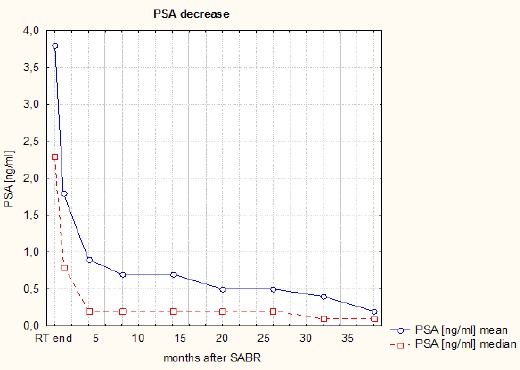
Objectives: To evaluate the tolerance and effectiveness of stereotactic ablative radiotherapy (SABR) applied in the treatment of low and intermediate risk (LR & IR) prostate cancer patients (PCP) and provide an evaluation of the level of risk group impact on treatment results. In addition, androgen deprivation therapy (ADT) usage and prostatic specific antigen (PSA) decline after SABR were assessed. Material and Methods: A total of 400 PCP (213 LR and 187 IR, including T2c) were irradiated with a CyberKnife using fd 7.25 Gy to TD 36.25 Gy. At the start of treatment, 60.3% of patients were undergoing ADT and this gradually decreased to 0% after 38 months. Follow-up was for a median of 15.0 months. Patients were monitored on SABR completion and 1, 4, 8 months later and then subsequently every 6 months. GI (Gastro-Intestinal) and GU (Genito-Urinary) acute and late adverse effects, PSA and ADT usage were evaluated. Results: Failure was noted in 9 patients (2.25%) (5 in LR and 4 in IR groups) - 4 relapses and 5 nodal metastases. No G3/4 late adverse effects (EORTC/RTOG) were observed. Some 0.5% of G3 GU and 0.3% of G3 GI acute reactions were noted respectively on the SABR completion day and one month later. The median of PSA declined 1.5 ng/ml during the first month and 0.6 ng/ml during the next three months. No impact of risk groups on treatment results was found. An impact of ADT on PSA decline was only confirmed for time point interactions. Conclusions: SABR for LR and IR PCP is a safe and effective treatment. The inclusion of T2c patients and the low percentage of IR patient failure permit us the assumption that this procedure could be utilized in the treatment of more advanced cases. The results do not allow clear definition of the impact of ADT on radioablation results in LR and IR+ T2c cases.
评估立体定向消融放疗(SABR)应用于低中危(LR & IR)前列腺癌患者(PCP)治疗的耐受性和有效性,并评估风险组水平对治疗结果的影响。此外,评估SABR后雄激素剥夺治疗(ADT)的使用情况和前列腺特异性抗原(PSA)的下降情况。材料与方法:总共400例PCP(213例LR和187例IR,包括T2c)使用射波刀接受fd 7.25 Gy至TD 36.25 Gy的照射。治疗开始时,60.3%的患者正在接受ADT,38个月后逐渐降至0%。中位随访时间为15.0个月。在SABR完成时、1、4、8个月后以及随后每6个月对患者进行监测。评估胃肠道(GI)和泌尿生殖系统(GU)的急性和晚期不良反应、PSA和ADT的使用情况。结果:9例患者(2.25%)出现失败(LR组5例,IR组4例)——4例复发和5例淋巴结转移。未观察到3/4级晚期不良反应(欧洲癌症研究与治疗组织/放射肿瘤学组标准)。在SABR完成当天和1个月后,分别观察到约0.5%的3级GU急性反应和0.3%的3级GI急性反应。PSA中位数在第一个月下降1.5 ng/ml,在接下来的三个月下降0.6 ng/ml。未发现风险组对治疗结果有影响。仅在时间点交互作用方面证实了ADT对PSA下降有影响。结论:SABR治疗LR和IR PCP是一种安全有效的治疗方法。纳入T2c患者以及IR患者低失败率使我们假设该方法可用于治疗更晚期病例。结果无法明确界定ADT对LR和IR + T2c病例放射消融结果的影响。