Voels Brent, Wang Liping, Sens Donald A, Garrett Scott H, Zhang Ke, Somji Seema
Department of Pathology, University of North Dakota, School of Medicine and Health Sciences, 1301 N. Columbia Road, Stop 9037, Grand Forks, ND, 58202, USA.
Departments of Science, Cankdeska Cikana Community College, 214 1st Avenue, Fort Totten, ND, 58335, USA.
BMC Cancer. 2017 May 25;17(1):369. doi: 10.1186/s12885-017-3355-9.
The 3rd isoform of the metallothionein (MT3) gene family has been shown to be overexpressed in most ductal breast cancers. A previous study has shown that the stable transfection of MCF-7 cells with the MT3 gene inhibits cell growth. The goal of the present study was to determine the role of the unique C-terminal and N-terminal sequences of MT3 on phenotypic properties and gene expression profiles of MCF-7 cells.
MCF-7 cells were transfected with various metallothionein gene constructs which contain the insertion or the removal of the unique MT3 C- and N-terminal domains. Global gene expression analysis was performed on the MCF-7 cells containing the various constructs and the expression of the unique C- and N- terminal domains of MT3 was correlated to phenotypic properties of the cells.
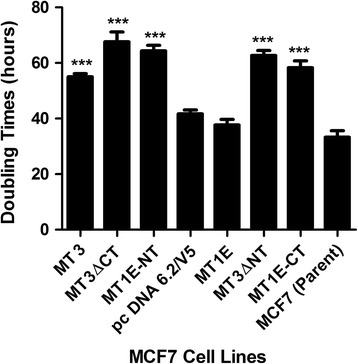
The results of the present study demonstrate that the C-terminal sequence of MT3, in the absence of the N-terminal sequence, induces dome formation in MCF-7 cells, which in cell cultures is the phenotypic manifestation of a cell's ability to perform vectorial active transport. Global gene expression analysis demonstrated that the increased expression of the GAGE gene family correlated with dome formation. Expression of the C-terminal domain induced GAGE gene expression, whereas the N-terminal domain inhibited GAGE gene expression and that the effect of the N-terminal domain inhibition was dominant over the C-terminal domain of MT3. Transfection with the metallothionein 1E gene increased the expression of GAGE genes. In addition, both the C- and the N-terminal sequences of the MT3 gene had growth inhibitory properties, which correlated to an increased expression of the interferon alpha-inducible protein 6.
Our study shows that the C-terminal domain of MT3 confers dome formation in MCF-7 cells and the presence of this domain induces expression of the GAGE family of genes. The differential effects of MT3 and metallothionein 1E on the expression of GAGE genes suggests unique roles of these genes in the development and progression of breast cancer. The finding that interferon alpha-inducible protein 6 expression is associated with the ability of MT3 to inhibit growth needs further investigation.
金属硫蛋白(MT3)基因家族的第3种异构体已被证明在大多数乳腺导管癌中过度表达。先前的一项研究表明,用MT3基因稳定转染MCF-7细胞可抑制细胞生长。本研究的目的是确定MT3独特的C末端和N末端序列对MCF-7细胞表型特性和基因表达谱的作用。
用各种金属硫蛋白基因构建体转染MCF-7细胞,这些构建体包含独特的MT3 C末端和N末端结构域的插入或缺失。对含有各种构建体的MCF-7细胞进行全局基因表达分析,并将MT3独特的C末端和N末端结构域的表达与细胞的表型特性相关联。
本研究结果表明,在没有N末端序列的情况下,MT3的C末端序列可诱导MCF-7细胞形成穹顶,在细胞培养中这是细胞进行矢量主动转运能力的表型表现。全局基因表达分析表明,GAGE基因家族表达的增加与穹顶形成相关。C末端结构域的表达诱导GAGE基因表达,而N末端结构域抑制GAGE基因表达,并且N末端结构域抑制的作用比MT3的C末端结构域占主导。用金属硫蛋白1E基因转染可增加GAGE基因的表达。此外,MT3基因的C末端和N末端序列均具有生长抑制特性,这与干扰素α诱导蛋白6表达的增加相关。
我们的研究表明,MT3的C末端结构域赋予MCF-7细胞穹顶形成能力,并且该结构域的存在诱导GAGE基因家族的表达。MT3和金属硫蛋白1E对GAGE基因表达的不同作用表明这些基因在乳腺癌发生发展中的独特作用。干扰素α诱导蛋白6表达与MT3抑制生长能力相关这一发现需要进一步研究。