Lasch Florian, Weber Kristina, Chao Mwe Mwe, Koch Armin
Department of Biostatistics, Hannover Medical School, Carl-Neuberg Strasse 1, 30165, Hannover, Germany.
Department of Pediatric Hematology Oncology, Hannover Medical School, Hannover, Germany.
Orphanet J Rare Dis. 2017 May 25;12(1):102. doi: 10.1186/s13023-017-0655-8.
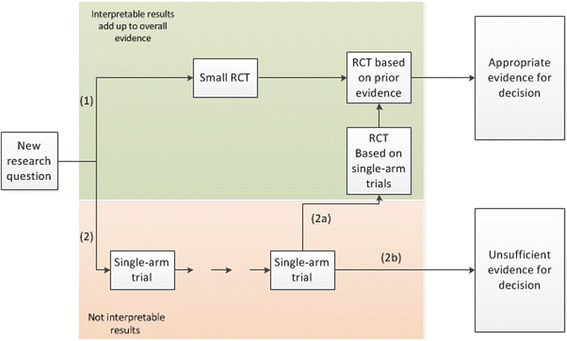
In planning a clinical trial for demonstrating the efficacy of pioglitazone to resolve leukoplakia and erythroplakia in Fanconi anemia patients we had to discuss the need for a randomized controlled trial particularly under sample-size restrictions as very promising results were available from a single-arm clinical trial. Unfortunately, at a later stage, we had to suffer from the fact that single-arm clinical trials may sometimes mislead. When revisiting our planning at a later stage of a grant application, results of a randomized controlled trial had become available which were less impressive, but may still be of clinical interest. However, these results were perceived as disappointing in the light of previously raised hopes based on the results of the single-arm trial. We highlight some major problems when research is based on single-arm trials compared to randomized controlled trials. After debunking common arguments for the conduct of single-arm trials in rare disease we conclude that particularly in rare disease research should be based on randomized building blocks simply because more robust evidence is generated. The plea for single-arm trials should be substituted by a plea for cooperation of all stakeholders to provide best evidence for decision making under sample-size restrictions.
在规划一项临床试验以证明吡格列酮对范可尼贫血患者白斑和红斑的疗效时,我们不得不讨论随机对照试验的必要性,尤其是在样本量受限的情况下,因为一项单臂临床试验已得出非常有前景的结果。不幸的是,在后期,我们不得不承受单臂临床试验有时可能会产生误导这一事实。在资助申请的后期重新审视我们的规划时,一项随机对照试验的结果已经出炉,这些结果不那么令人印象深刻,但可能仍具有临床意义。然而,鉴于基于单臂试验结果先前产生的希望,这些结果被认为令人失望。我们强调了与随机对照试验相比,基于单臂试验进行研究时的一些主要问题。在揭穿了罕见病中单臂试验开展的常见论据后,我们得出结论,特别是在罕见病研究中,应该基于随机分组,仅仅是因为这样能产生更有力的证据。对单臂试验的呼吁应该被所有利益相关者合作的呼吁所取代,以便在样本量受限的情况下为决策提供最佳证据。