Department of Adult ICU, University Hospital Erasmus MC Rotterdam, 's-Gravendijkwal 230 3015 CE, Rotterdam, the Netherlands.
Department of Surgery, Upstate Medical University, 750 E Adams St, Syracuse, NY, 13210, USA.
Purinergic Signal. 2017 Sep;13(3):363-386. doi: 10.1007/s11302-017-9564-5. Epub 2017 May 26.
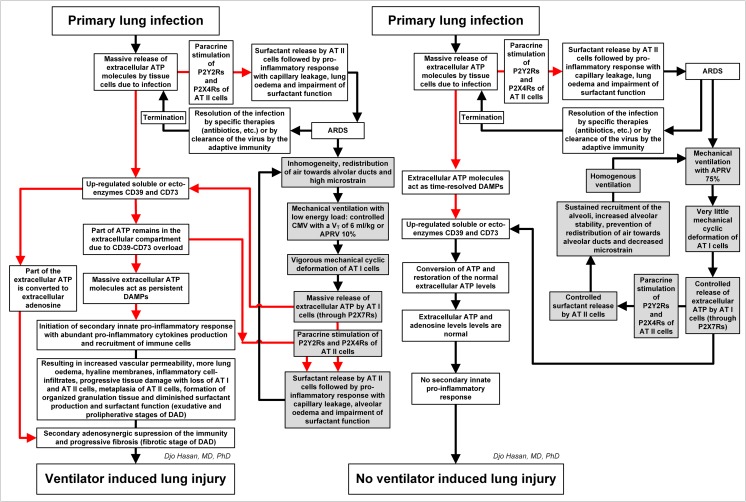
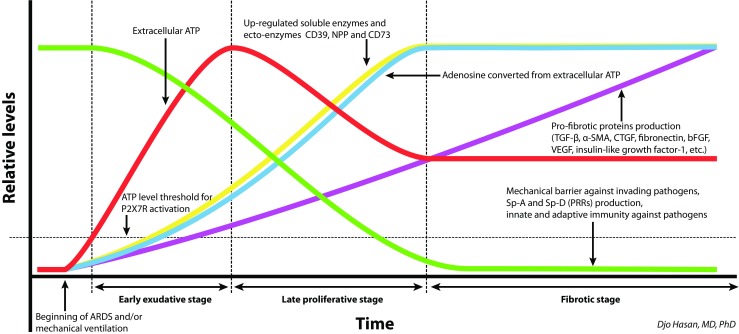
Severe pulmonary infection or vigorous cyclic deformation of the alveolar epithelial type I (AT I) cells by mechanical ventilation leads to massive extracellular ATP release. High levels of extracellular ATP saturate the ATP hydrolysis enzymes CD39 and CD73 resulting in persistent high ATP levels despite the conversion to adenosine. Above a certain level, extracellular ATP molecules act as danger-associated molecular patterns (DAMPs) and activate the pro-inflammatory response of the innate immunity through purinergic receptors on the surface of the immune cells. This results in lung tissue inflammation, capillary leakage, interstitial and alveolar oedema and lung injury reducing the production of surfactant by the damaged AT II cells and deactivating the surfactant function by the concomitant extravasated serum proteins through capillary leakage followed by a substantial increase in alveolar surface tension and alveolar collapse. The resulting inhomogeneous ventilation of the lungs is an important mechanism in the development of ventilation-induced lung injury. The high levels of extracellular ATP and the upregulation of ecto-enzymes and soluble enzymes that hydrolyse ATP to adenosine (CD39 and CD73) increase the extracellular adenosine levels that inhibit the innate and adaptive immune responses rendering the host susceptible to infection by invading microorganisms. Moreover, high levels of extracellular adenosine increase the expression, the production and the activation of pro-fibrotic proteins (such as TGF-β, α-SMA, etc.) followed by the establishment of lung fibrosis.
严重的肺部感染或机械通气引起的肺泡上皮 I 型 (AT I) 细胞剧烈的周期性变形会导致大量细胞外 ATP 释放。高水平的细胞外 ATP 会使 ATP 水解酶 CD39 和 CD73 饱和,尽管转化为腺苷,但仍会持续保持高 ATP 水平。在一定水平以上,细胞外 ATP 分子作为危险相关分子模式 (DAMPs),通过免疫细胞表面的嘌呤能受体激活先天免疫的促炎反应。这会导致肺部组织炎症、毛细血管渗漏、间质和肺泡水肿以及肺损伤,减少受损 AT II 细胞产生的表面活性剂,并通过毛细血管渗漏使伴随的渗出血清蛋白失活表面活性剂功能,随后肺泡表面张力和肺泡塌陷显著增加。由此导致的肺部不均匀通气是通气诱导性肺损伤发展的重要机制。高水平的细胞外 ATP 和细胞外酶和可将 ATP 水解为腺苷的可溶性酶(CD39 和 CD73)的上调增加了细胞外腺苷水平,抑制了先天和适应性免疫反应,使宿主容易受到入侵微生物的感染。此外,高水平的细胞外腺苷增加了促纤维化蛋白(如 TGF-β、α-SMA 等)的表达、产生和激活,随后建立了肺纤维化。