Ashraf Kharaz Yalda, Zamboulis Danae, Sanders Karen, Comerford Eithne, Clegg Peter, Peffers Mandy
Department of Musculoskeletal Biology, Institute of Ageing and Chronic Disease, University of Liverpool, Liverpool, UK.
The MRC-Arthritis Research UK Centre for Integrated research into Musculoskeletal Ageing (CIMA), Liverpool, UK.
Proteomics. 2017 Jul;17(13-14). doi: 10.1002/pmic.201700018. Epub 2017 Jun 22.
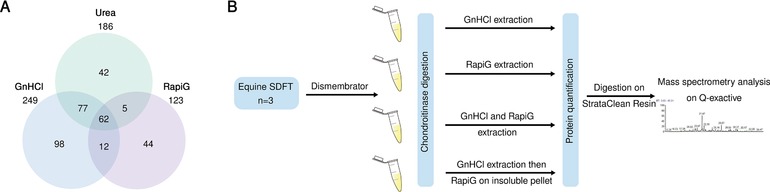
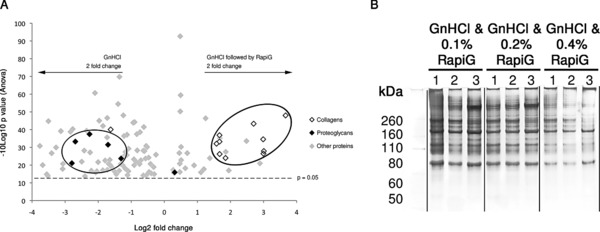
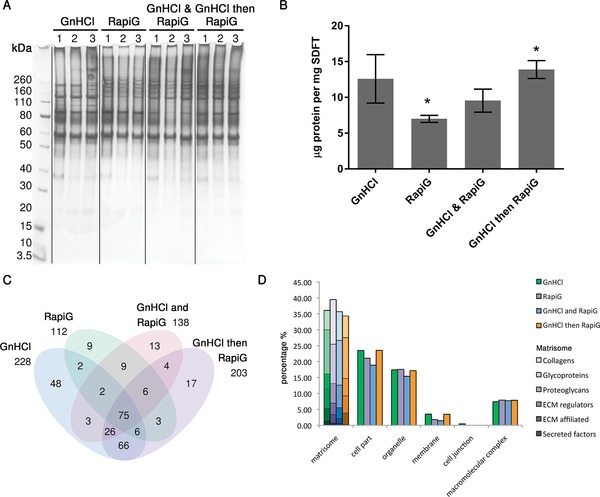
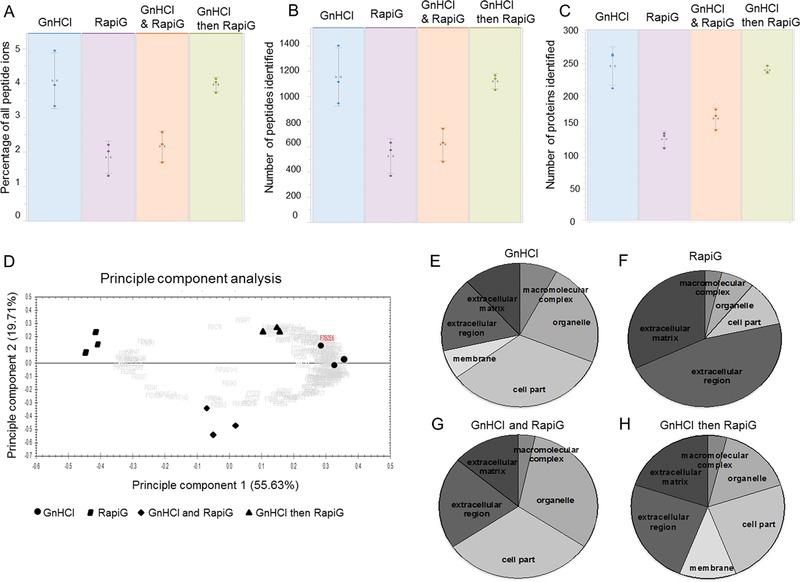
Exploring the tendon proteome is a challenging but important task for understanding the mechanisms of physiological/pathological processes during ageing and disease and for the development of new treatments. Several extraction methods have been utilised for tendon mass spectrometry, however different extraction methods have not been simultaneously compared. In the present study we compared protein extraction in tendon with two chaotropic agents, guanidine hydrochloride (GnHCl) and urea, a detergent, RapiGest™, and their combinations for shotgun mass spectrometry. An initial proteomic analysis was performed following urea, GnHCl, and RapiGest™ extraction of equine superficial digital flexor tendon (SDFT) tissue. Subsequently, another proteomic analysis was performed following extraction with GnHCl, Rapigest™, and their combinations. Between the two chaotropic agents, GnHCl extracted more proteins, whilst a greater number of proteins were solely identified after Rapigest™ extraction. Protein extraction with a combination of GnHCl followed by RapiGest™ on the insoluble pellet demonstrated, after label-free quantification, increased abundance of identified collagen proteins and low sample to sample variability. In contrast, GnHCl extraction on its own showed increased abundance of identified proteoglycans and cellular proteins. Therefore, the selection of protein extraction method for tendon tissue for mass spectrometry analysis should reflect the focus of the study.
探索肌腱蛋白质组对于理解衰老和疾病过程中生理/病理机制以及开发新疗法而言是一项具有挑战性但又很重要的任务。已有多种提取方法用于肌腱质谱分析,然而不同的提取方法尚未同时进行比较。在本研究中,我们比较了两种离液剂盐酸胍(GnHCl)和尿素、一种去污剂RapiGest™及其组合用于肌腱鸟枪法质谱分析时的蛋白质提取情况。在用尿素、GnHCl和RapiGest™提取马浅屈肌腱(SDFT)组织后进行了初步蛋白质组分析。随后,在用GnHCl、RapiGest™及其组合提取后又进行了另一项蛋白质组分析。在这两种离液剂中,GnHCl提取出的蛋白质更多,而仅在RapiGest™提取后鉴定出的蛋白质数量更多。对不溶性沉淀先后用GnHCl和RapiGest™组合提取蛋白质,经无标记定量分析表明,鉴定出的胶原蛋白丰度增加,且样品间变异性低。相比之下,单独使用GnHCl提取则显示鉴定出蛋白聚糖和细胞蛋白的丰度增加。因此,用于肌腱组织质谱分析的蛋白质提取方法的选择应反映研究重点。