Stripecke Renata
Regenerative Immune Therapies Applied, Excellence Cluster Rebirth, Department of Hematology, Hemostasis, Oncology and Stem Cell Transplantation, Hannover Medical School, OE6862, Carl-Neuberg-Strasse 1, 30625 Hannover, Germany.
Biomedicines. 2014 Aug 21;2(3):229-246. doi: 10.3390/biomedicines2030229.
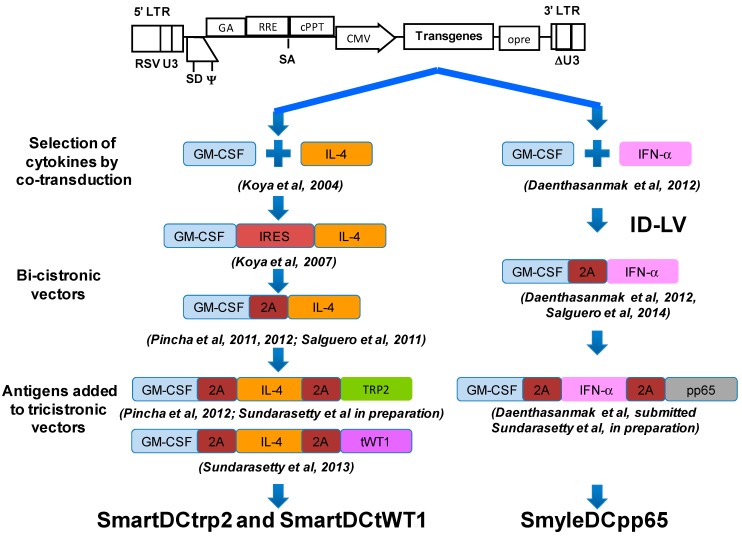
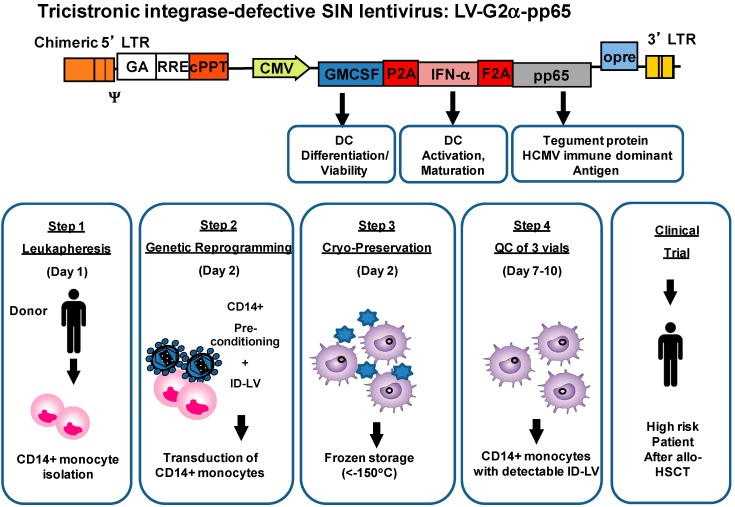
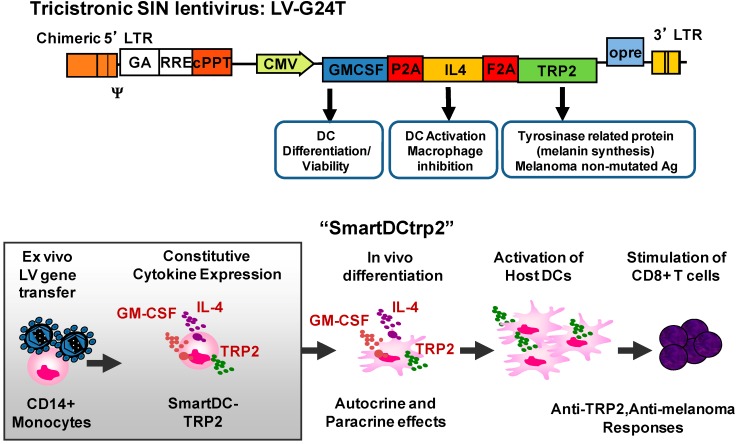
Conventional dendritic cells (cDC) are differentiated professional antigen presenting cells capable of potently stimulating naïve T cells and with vast potential for immunotherapeutic applications. The manufacture of clinical-grade cDC is relatively complex and requires several days for completion. Clinical trials showed poor trafficking of cDC from subcutaneous injection sites to lymph nodes (LN), where DC can optimally stimulate naïve lymphocytes for long-lasting memory responses. We demonstrated in mouse and human systems that a single overnight lentiviral (LV) gene transfer into DC precursors for production of combination of cytokines and antigens was capable to induce autonomous self-differentiation of antigen-loaded DC and . These highly viable induced DC (iDC) effectively migrated from the injected skin to LN, where they effectively activated antigen-specific effector memory T cells. Two iDC modalities were validated in relevant animal models and are now in clinical development: Self-differentiated Myeloid-derived Antigen-presenting-cells Reactive against Tumors co-expressing GM-CSF/IL-4/TRP2 for melanoma immunotherapy in the autologous setting (SmartDCtrp2), and Self-differentiated Myeloid-derived Lentivirus-induced against human cytomegalovirus as an allogeneic matched adoptive cell after stem cell transplantation (SmyleDCpp65). The lentiviral vector design and packaging methodology has "evolved" continuously in order to simplify and optimize function and biosafety of and genetic reprogramming of iDC. Here, we address the challenges seeking for new creations of genetically programmed iDC and integrase-defective LV vaccines for immune regeneration.
传统树突状细胞(cDC)是分化的专职抗原呈递细胞,能够有效刺激初始T细胞,在免疫治疗应用方面具有巨大潜力。临床级cDC的制备相对复杂,需要数天才能完成。临床试验表明,cDC从皮下注射部位向淋巴结(LN)的迁移较差,而在淋巴结中,DC能够最佳地刺激初始淋巴细胞以产生持久的记忆反应。我们在小鼠和人类系统中证明,通过向DC前体细胞进行单次过夜慢病毒(LV)基因转移以产生细胞因子和抗原的组合,能够诱导负载抗原的DC自主自我分化。这些高活力的诱导DC(iDC)有效地从注射的皮肤迁移至LN,在那里它们有效地激活了抗原特异性效应记忆T细胞。两种iDC模式已在相关动物模型中得到验证,目前正处于临床开发阶段:在自体环境中用于黑色素瘤免疫治疗的共表达GM-CSF/IL-4/TRP2的自分化髓系来源的肿瘤反应性抗原呈递细胞(SmartDCtrp2),以及作为干细胞移植后同种异体匹配过继性细胞用于抗人巨细胞病毒的自分化髓系来源的慢病毒诱导细胞(SmyleDCpp65)。慢病毒载体设计和包装方法不断“进化”,以简化和优化iDC的功能及生物安全性以及iDC的基因重编程。在此,我们探讨了在基因编程iDC和整合酶缺陷型LV疫苗的新创制方面寻求免疫再生所面临的挑战。