Lee Mi Jung, Park Jung Tak, Han Seung Hyeok, Kim Yong-Lim, Kim Yon Su, Yang Chul Woo, Kim Nam-Ho, Kang Shin-Wook, Kim Hyung Jong, Yoo Tae-Hyun
Department of Internal Medicine, CHA Bundang Medical Center, CHA University, Seongnam, Korea.
Department of Internal Medicine, Yonsei University College of Medicine, Seoul, Korea.
PLoS One. 2017 May 26;12(5):e0177499. doi: 10.1371/journal.pone.0177499. eCollection 2017.
The atherogenic index of plasma (AIP), which is the logarithmic ratio of triglyceride (TG) to high-density lipoprotein cholesterol (HDL-C), had a linear relationship with clinical outcomes in the general population. However, the association of each lipid profile, TG and HDL-C, with survival was not straightforward in dialysis patients. This non-linear association led us to further investigate the prognostic impact of the AIP in these patients.
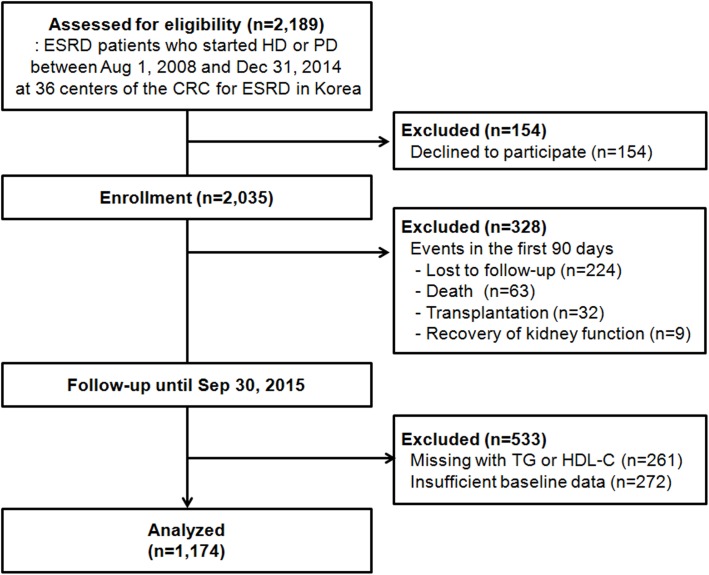
From a nationwide prospective cohort, 1,174 incident dialysis patients were included. Patients were categorized into quintiles according to the AIP. An independent association of the AIP with all-cause and cardiovascular mortality was determined.
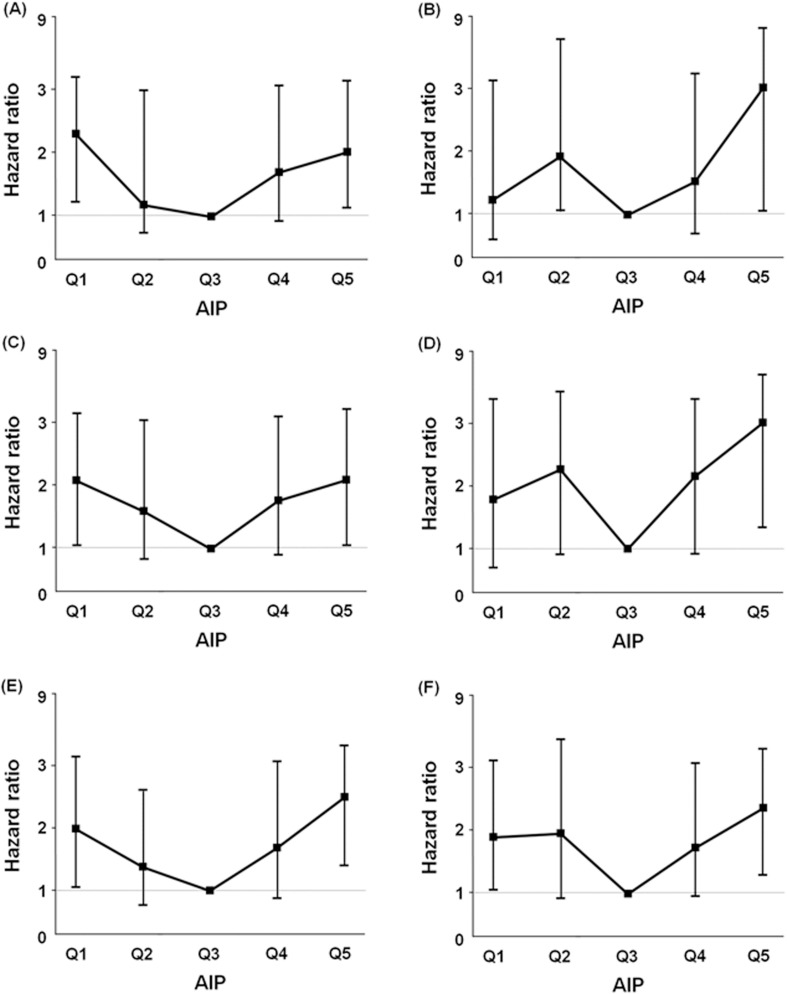
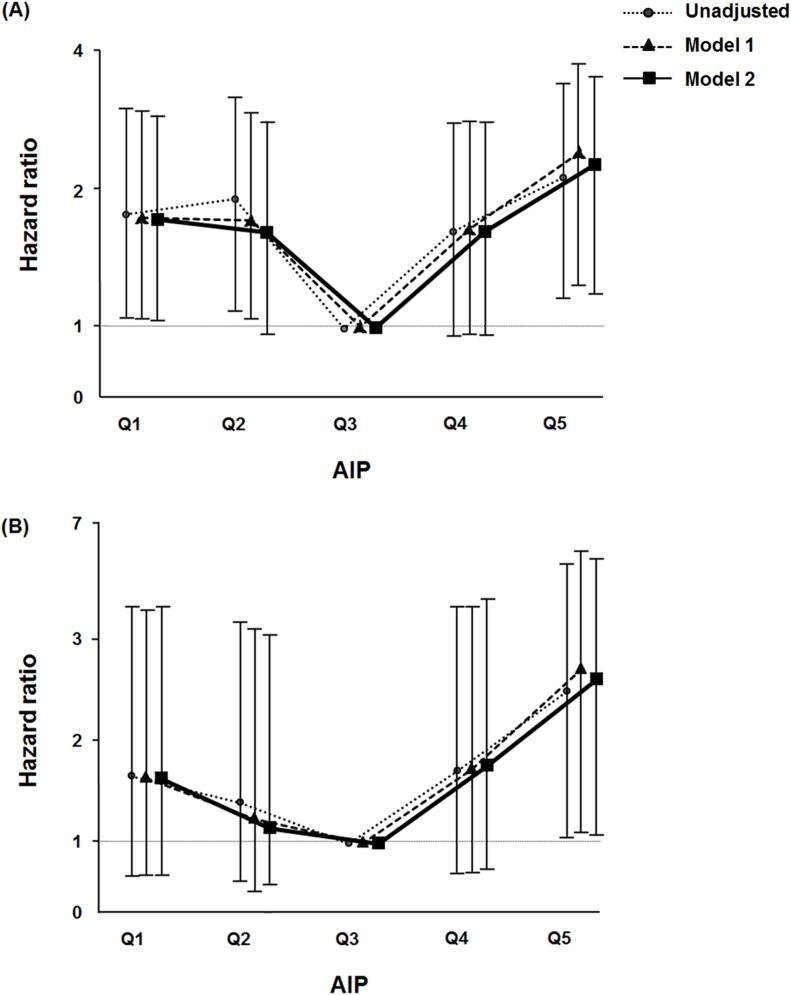
During a mean follow-up duration of 33.2 months, 170 patients (14.5%) died, and cardiovascular death was observed in 55 patients (4.7%). Multivariate Cox analyses revealed that the lowest (quintile 1, hazard ratio [HR] = 1.76, 95% confidence interval [CI] = 1.02-3.03) and the highest (quintile 5, HR = 2.15, 95% CI = 1.26-3.65) AIP groups were significantly associated with higher all-cause mortality compared to patients in quintile 3 (reference group). In terms of cardiovascular mortality, only the highest AIP group (quintile 5, HR = 2.59, 95% CI = 1.06-6.34) was significantly associated with increased risk of mortality. Sensitivity analyses showed that a U-shaped association between the AIP and all-cause mortality remained significant in non-diabetic and underweight to normal body mass index patients.
Both the highest and the lowest AIP groups were independently associated with all-cause mortality, showing a U-shaped association. It suggested further studies are needed to identify targets and subgroups that can benefit from intervention of the AIP in incident dialysis patients.
血浆致动脉粥样硬化指数(AIP)是甘油三酯(TG)与高密度脂蛋白胆固醇(HDL-C)的对数比值,在普通人群中与临床结局呈线性关系。然而,在透析患者中,每种血脂指标(TG和HDL-C)与生存率的关联并不简单。这种非线性关联促使我们进一步研究AIP对这些患者的预后影响。
从一项全国性前瞻性队列研究中纳入了1174例新发病透析患者。根据AIP将患者分为五等份。确定AIP与全因死亡率和心血管死亡率的独立关联。
在平均33.2个月的随访期间,170例患者(14.5%)死亡,55例患者(4.7%)发生心血管死亡。多变量Cox分析显示,与第3五分位组(参照组)患者相比,最低(第1五分位组,风险比[HR]=1.76,95%置信区间[CI]=1.02-3.03)和最高(第5五分位组,HR=2.15,95%CI=1.26-3.65)AIP组与更高的全因死亡率显著相关。就心血管死亡率而言,只有最高AIP组(第5五分位组,HR=2.59,95%CI=1.06-6.34)与死亡风险增加显著相关。敏感性分析表明,在非糖尿病且体重指数正常至超重的患者中,AIP与全因死亡率之间的U型关联仍然显著。
最高和最低AIP组均与全因死亡率独立相关,呈U型关联。这表明需要进一步研究以确定可从新发病透析患者的AIP干预中获益的目标和亚组。