Wang Xiaoxing, Cui Yanyan, Zhang Yan, Shi Ke, Yan Yaqun, Jian Fuchun, Zhang Longxian, Wang Rongjun, Ning Changshen
College of Animal Science and Veterinary Medicine, Henan Agricultural University, Zhengzhou, 450002, People's Republic of China.
BMC Vet Res. 2017 May 26;13(1):142. doi: 10.1186/s12917-017-1062-z.
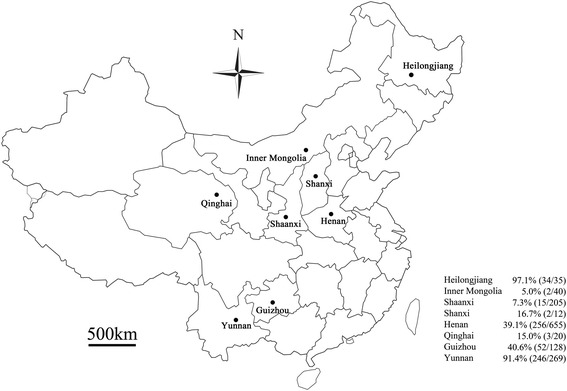
Hemotropic mycoplasmas (hemoplasmas) are emerging zoonotic pathogens with a worldwide distribution that can cause mild to severe hemolytic anemia, icterus, ill-thrift, infertility, and poor weight gain. However, understanding of the molecular epidemiology of hemoplasmas (Mycoplasma ovis and 'Candidatus Mycoplasma haemovis') is limited in sheep and goats, and the hemoplasma strain/species/variant 'Candidatus M. haemovis' was poorly studied throughout the world and had never been detected in China until now. Thus, the aim of the present study was to determine the molecular prevalence of hemoplasmas, including M. ovis and 'Candidatus M. haemovis' in sheep and goats from seven provinces and one autonomous region of China.
A total of 1364 blood samples were collected from sheep and goats in seven provinces and one autonomous region of China. All blood samples were tested for hemoplasmas (M. ovis and 'Candidatus M. haemovis') by nested PCR amplification based on 16S rRNA gene. Positive specimens underwent nucleotide sequencing and phylogenetic analysis.
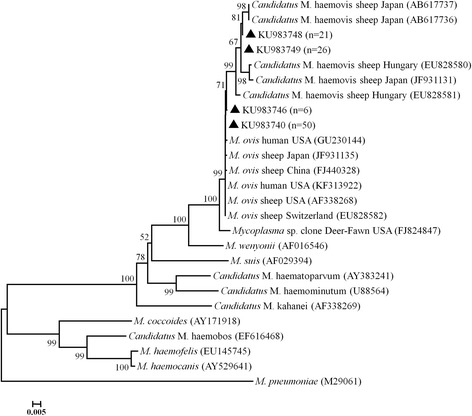
Overall, 610 specimens (44.7%, 610/1364) were shown to be hemoplasmas (M. ovis and 'Candidatus M. haemovis') -positive by nested PCR amplification based on 16S rRNA gene. The prevalence in goats was 44.1% (379/860), and 45.8% (231/504) in sheep, while that in grazing small ruminants was 54.4% (396/728) and 33.6% (214/636) in house feeding small ruminants. Sequencing of the nearly complete 16S rRNA gene was successful for the 103 randomly selected positive specimens from different farms in different sampling sites of China. Among them, analysis of the 16S rRNA gene sequences identified M. ovis (n = 56) and 'Candidatus M. haemovis' (n = 47). Two (KU983740 and KU983746) of the four novel genotypes obtained in this study were closely related to M. ovis, while the other two genotypes (KU983748 and KU983749) had high identity with 'Candidatus M. haemovis'. Remarkably, the genotype (KU983740) of M. ovis in sheep and goats in this study fell in a clade with two human hemoplasmas from USA (KF313922 and GU230144) and shared 99.8%-99.9% with them.
In this study, 'Candidatus M. haemovis' was first detected in Chinese sheep and goats and hemoplasmas (M. ovis and 'Candidatus M. haemovis') are highly prevalent, and widely distributed in China.
血支原体(血原虫)是新出现的人畜共患病原体,在全球范围内均有分布,可引起从轻度到重度的溶血性贫血、黄疸、生长迟缓、不育以及体重增加缓慢。然而,关于绵羊和山羊血支原体(绵羊支原体和“嗜血性支原体暂定种”)的分子流行病学了解有限,并且血支原体菌株/种/变种“嗜血性支原体暂定种”在全球范围内研究较少,在中国此前从未被检测到。因此,本研究的目的是确定中国七个省和一个自治区绵羊和山羊中血支原体(包括绵羊支原体和“嗜血性支原体暂定种”)的分子流行情况。
从中国七个省和一个自治区的绵羊和山羊中总共采集了1364份血样。所有血样均通过基于16S rRNA基因的巢式PCR扩增检测血支原体(绵羊支原体和“嗜血性支原体暂定种”)。对阳性标本进行核苷酸测序和系统发育分析。
总体而言,基于16S rRNA基因的巢式PCR扩增显示,610份标本(44.7%,610/1364)为血支原体(绵羊支原体和“嗜血性支原体暂定种”)阳性。山羊的患病率为44.1%(379/860),绵羊为45.8%(231/504),而放牧小反刍动物的患病率为54.4%(396/728),舍饲小反刍动物为33.6%(214/636)。对从中国不同采样地点不同养殖场随机选取的103份阳性标本成功进行了近乎完整的16S rRNA基因测序。其中,16S rRNA基因序列分析鉴定出绵羊支原体(n = 56)和“嗜血性支原体暂定种”(n = 47)。本研究中获得的四个新基因型中的两个(KU983740和KU983746)与绵羊支原体密切相关,而另外两个基因型(KU983748和KU983749)与“嗜血性支原体暂定种”具有高度同源性。值得注意的是,本研究中绵羊和山羊的绵羊支原体基因型(KU983740)与来自美国的两个人血支原体(KF313922和GU230144)处于同一进化枝,与它们的同源性为99.8% - 99.9%。
在本研究中,首次在中国绵羊和山羊中检测到“嗜血性支原体暂定种”,并且血支原体(绵羊支原体和“嗜血性支原体暂定种”)在中国高度流行且分布广泛。