
CPB2 Ala147Thr而非Thr325Ile变异对静脉血栓形成风险的性别特异性影响:一项综合荟萃分析。
Sex-specific effect of CPB2 Ala147Thr but not Thr325Ile variants on the risk of venous thrombosis: A comprehensive meta-analysis.
作者信息
Zwingerman Nora, Medina-Rivera Alejandra, Kassam Irfahan, Wilson Michael D, Morange Pierre-Emmanuel, Trégouët David-Alexandre, Gagnon France
机构信息
Division of Epidemiology, Dalla Lana School of Public Health, University of Toronto, Toronto, Canada.
Genetics and Genome Biology Program, SickKids Research Institute, Toronto, Canada.
出版信息
PLoS One. 2017 May 26;12(5):e0177768. doi: 10.1371/journal.pone.0177768. eCollection 2017.
BACKGROUND
Thrombin activatable fibrinolysis inhibitor (TAFI), encoded by the Carboxypeptidase B2 gene (CPB2), is an inhibitor of fibrinolysis and plays a role in the pathogenesis of venous thrombosis. Experimental findings support a functional role of genetic variants in CPB2, while epidemiological studies have been unable to confirm associations with risk of venous thrombosis. Sex-specific effects could underlie the observed inconsistent associations between CPB2 genetic variants and venous thrombosis.
METHODS
A comprehensive literature search was conducted for associations between Ala147Thr and Thr325Ile variants with venous thrombosis. Authors were contacted to provide sex-specific genotype counts from their studies. Combined and sex-specific random effects meta-analyses were used to estimate a pooled effect estimate for primary and secondary genetic models.
RESULTS
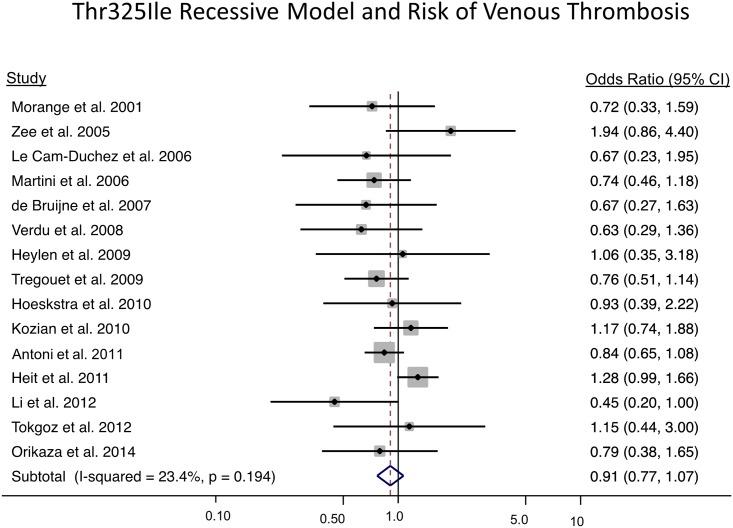
A total of 17 studies met the inclusion criteria. A sex-specific meta-analysis applying a dominant model supported a protective effect of Ala147Thr on venous thrombosis in females (OR = 0.81, 95%CI: 0.68,0.97; p = 0.018), but not in males (OR = 1.06, 95%CI:0.96-1.16; p = 0.263). The Thr325Ile did not show a sex-specific effect but showed variation in allele frequencies by geographic region. A subgroup analysis of studies in European countries showed decreased risk, with a recessive model (OR = 0.83, 95%CI:0.71-0.97, p = 0.021) for venous thrombosis.
CONCLUSIONS
A comprehensive literature review, including unpublished data, provided greater statistical power for the analyses and decreased the likelihood of publication bias influencing the results. Sex-specific analyses explained apparent discrepancies across genetic studies of Ala147Thr and venous thrombosis. While, careful selection of genetic models based on population genetics, evolutionary and biological knowledge can increase power by decreasing the need to adjust for testing multiple models.
背景
凝血酶激活的纤维蛋白溶解抑制剂(TAFI)由羧肽酶B2基因(CPB2)编码,是一种纤维蛋白溶解抑制剂,在静脉血栓形成的发病机制中起作用。实验结果支持CPB2基因变异的功能作用,而流行病学研究未能证实与静脉血栓形成风险的关联。性别特异性效应可能是CPB2基因变异与静脉血栓形成之间观察到的不一致关联的基础。
方法
对Ala147Thr和Thr325Ile变异与静脉血栓形成之间的关联进行了全面的文献检索。联系作者以提供其研究中的性别特异性基因型计数。采用合并和性别特异性随机效应荟萃分析来估计主要和次要遗传模型的合并效应估计值。
结果
共有17项研究符合纳入标准。应用显性模型进行的性别特异性荟萃分析支持Ala147Thr对女性静脉血栓形成有保护作用(OR = 0.81,95%CI:0.68,0.97;p = 0.018),但对男性无保护作用(OR = 1.06, 95%CI:0.96 - 1.16;p = 0.263)Thr325Ile未显示性别特异性效应,但等位基因频率因地理区域而异。对欧洲国家研究的亚组分析显示静脉血栓形成风险降低,采用隐性模型(OR = 0.83, 95%CI:0.71 - 0.97,p = 0.021)。
结论
包括未发表数据在内的全面文献综述为分析提供了更大的统计效力,并降低了发表偏倚影响结果的可能性。性别特异性分析解释了Ala147Thr与静脉血栓形成的基因研究之间明显的差异。同时,基于群体遗传学、进化和生物学知识仔细选择遗传模型,可以通过减少对多个模型进行检验调整来提高效力。


 Zotero 插件