Biederman Lori, Mortensen Brent, Fay Philip, Hagenah Nicole, Knops Johannes, La Pierre Kimberly, Laungani Ramesh, Lind Eric, McCulley Rebecca, Power Sally, Seabloom Eric, Tognetti Pedro
Department of Ecology, Evolution and Organismal Biology, Iowa State University, Ames, Iowa, United States of America.
USDA-ARS Grassland Soil and Water Research Lab, United States Department of Agriculture-Agricultural Research Service, Temple, Texas, United States of America.
PLoS One. 2017 May 26;12(5):e0178440. doi: 10.1371/journal.pone.0178440. eCollection 2017.
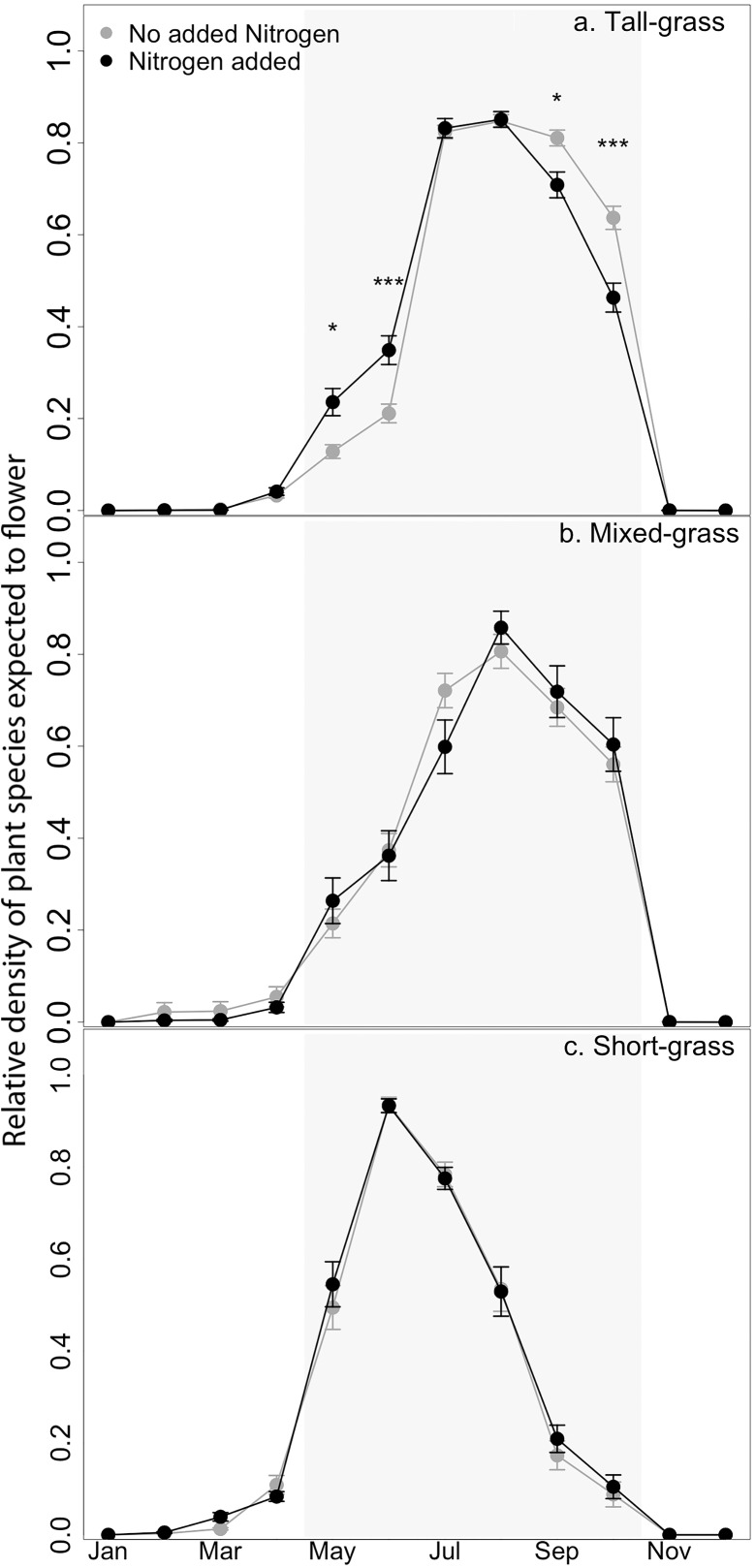
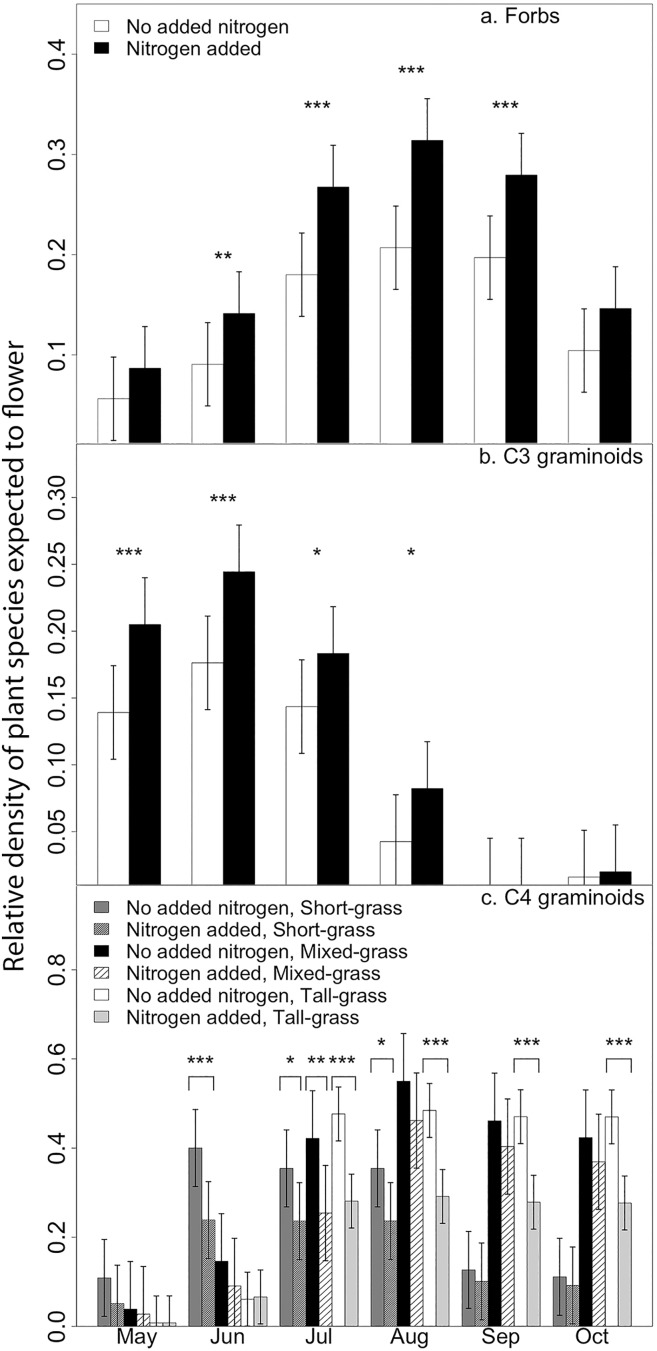
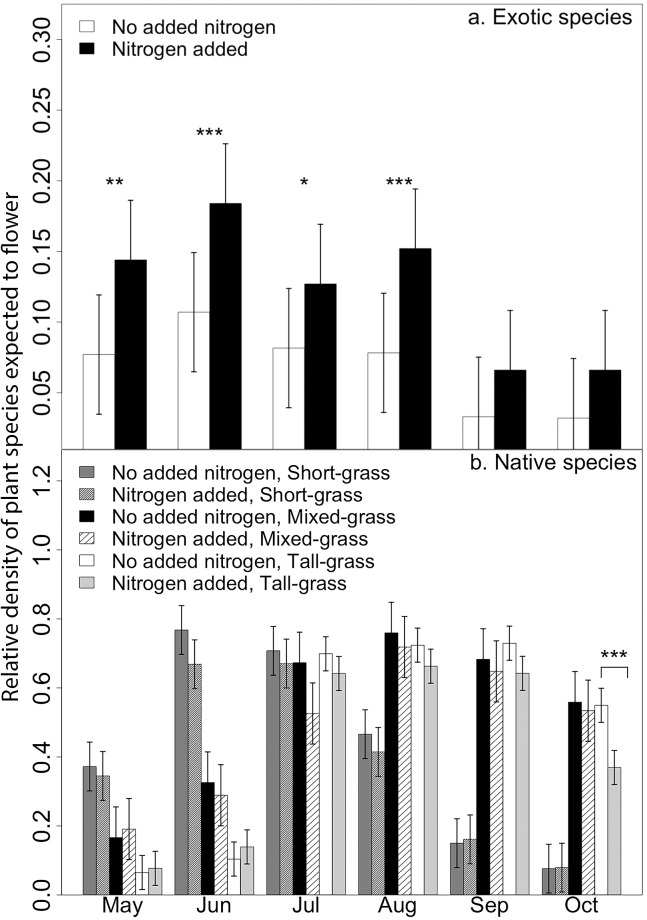
The distribution of flowering across the growing season is governed by each species' evolutionary history and climatic variability. However, global change factors, such as eutrophication and invasion, can alter plant community composition and thus change the distribution of flowering across the growing season. We examined three ecoregions (tall-, mixed, and short-grass prairie) across the U.S. Central Plains to determine how nutrient (nitrogen (N), phosphorus, and potassium (+micronutrient)) addition alters the temporal patterns of plant flowering traits. We calculated total community flowering potential (FP) by distributing peak-season plant cover values across the growing season, allocating each species' cover to only those months in which it typically flowers. We also generated separate FP profiles for exotic and native species and functional group. We compared the ability of the added nutrients to shift the distribution of these FP profiles (total and sub-groups) across the growing season. In all ecoregions, N increased the relative cover of both exotic species and C3 graminoids that flower in May through August. The cover of C4 graminoids decreased with added N, but the response varied by ecoregion and month. However, these functional changes only aggregated to shift the entire community's FP profile in the tall-grass prairie, where the relative cover of plants expected to flower in May and June increased and those that flower in September and October decreased with added N. The relatively low native cover in May and June may leave this ecoregion vulnerable to disturbance-induced invasion by exotic species that occupy this temporal niche. There was no change in the FP profile of the mixed and short-grass prairies with N addition as increased abundance of exotic species and C3 graminoids replaced other species that flower at the same time. In these communities a disturbance other than nutrient addition may be required to disrupt phenological patterns.
整个生长季节开花的分布受每个物种的进化历史和气候变异性的支配。然而,诸如富营养化和入侵等全球变化因素会改变植物群落组成,从而改变整个生长季节开花的分布。我们研究了美国中部平原的三个生态区(高草、混合草和矮草草原),以确定添加养分(氮(N)、磷和钾(+微量营养素))如何改变植物开花性状的时间模式。我们通过将旺季植物覆盖值分布在整个生长季节来计算总群落开花潜力(FP),将每个物种的覆盖仅分配到其通常开花的月份。我们还为外来物种和本地物种以及功能组生成了单独的FP概况。我们比较了添加的养分使这些FP概况(总和子组)在整个生长季节的分布发生变化的能力。在所有生态区,氮增加了五月至八月开花的外来物种和C3禾本科植物的相对覆盖率。随着氮的添加,C4禾本科植物的覆盖率下降,但响应因生态区和月份而异。然而,这些功能变化仅在高草草原上汇总,从而改变了整个群落的FP概况,在高草草原上,预计五月和六月开花的植物的相对覆盖率增加,而九月和十月开花的植物的相对覆盖率随着氮的添加而下降。五月和六月相对较低的本地覆盖率可能使该生态区容易受到占据这一时期生态位的外来物种干扰引发的入侵。添加氮后,混合草和矮草草原的FP概况没有变化,因为外来物种和C3禾本科植物丰度的增加取代了同时开花的其他物种。在这些群落中,可能需要除添加养分以外的干扰来破坏物候模式。