Wang Yimei, Zou Zhouping, Jin Jifu, Teng Jie, Xu Jiarui, Shen Bo, Jiang Wuhua, Zhuang Yamin, Liu Lan, Luo Zhe, Wang Chunsheng, Ding Xiaoqiang
Departments of Nephrology, Zhongshan Hospital, Shanghai Medical College, Fudan University, No 180 Fenglin Rd, Shanghai, China.
Department of critical care medicine, Fudan University, No 180 Fenglin Rd, Shanghai, China.
BMC Nephrol. 2017 May 30;18(1):177. doi: 10.1186/s12882-017-0592-8.
Acute kidney injury (AKI) following cardiac surgery is common and associated with poor patient outcomes. Early risk assessment for development of AKI remains a challenge. The combination of urinary tissue inhibitor of metalloproteinase 2 (TIMP-2) and insulin-like growth factor binding protein 7 (IGFBP7) has been shown to be an excellent predictor of AKI following cardiac surgery, but reported studies are for predominately non-Asian populations.
Adult patients were prospectively enrolled at Zhongshan hospital in Shanghai, China. The primary analysis was prediction of AKI and stage 2-3 AKI by [TIMP-2][IGFBP7] measured 4 h after postoperative ICU admission assessed using receiver operating characteristic curve (ROC) analysis. Kinetics of [TIMP-2][IGFBP7] following ICU admission were also examined.
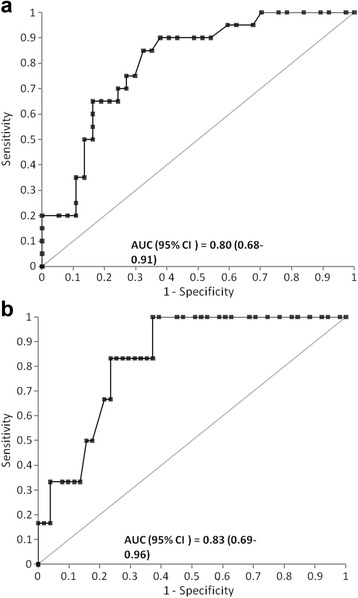
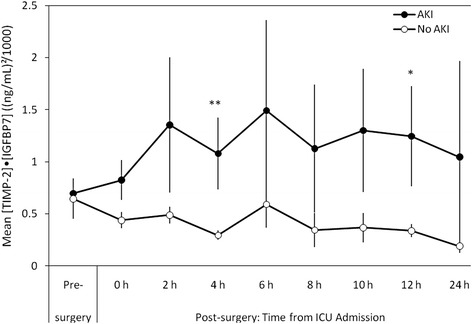
We prospectively enrolled 57 cardiac surgery patients, of which 20 (35%) developed AKI and 6 (11%) developed stage 2-3 AKI. The area under the ROC curve (AUC) of [TIMP-2][IGFBP7] at 4 h after ICU admission was 0.80 (95% confidence interval (CI): 0.68-0.91) for development of AKI and 0.83 (95% CI: 0.69-0.96) for development of stage 2-3 AKI. Urinary [TIMP-2][IGFBP7] values at 4 h after ICU admission were significantly (P < 0.001) higher in patients who developed AKI than in patients who did not develop AKI (mean (standard error) of 1.08 (0.34) (ng/mL)/1000 and 0.29 (0.05) (ng/mL)/1000, respectively). The time-profile of [TIMP-2]*[IGFBP7] suggests the markers started to elevate by the time of ICU admission in patients who developed AKI and either decreased or remained flat in patients without AKI.
The combination of urinary TIMP-2 and IGFBP7 4 h after postoperative ICU admission identifies patients at risk for developing AKI, not just stage 2-3 AKI following cardiac surgery.
心脏手术后急性肾损伤(AKI)很常见,且与患者预后不良相关。对AKI发生进行早期风险评估仍然是一项挑战。尿金属蛋白酶组织抑制剂2(TIMP-2)和胰岛素样生长因子结合蛋白7(IGFBP7)的联合检测已被证明是心脏手术后AKI的优秀预测指标,但已报道的研究主要针对非亚洲人群。
在中国上海中山医院前瞻性纳入成年患者。主要分析是通过术后入住重症监护病房(ICU)4小时后测得的[TIMP-2]×[IGFBP7],采用受试者操作特征曲线(ROC)分析预测AKI及2-3期AKI。还研究了入住ICU后[TIMP-2]×[IGFBP7]的变化情况。
我们前瞻性纳入了57例心脏手术患者,其中20例(35%)发生AKI,6例(11%)发生2-3期AKI。入住ICU 4小时后,[TIMP-2]×[IGFBP7]预测AKI发生的ROC曲线下面积(AUC)为0.80(95%置信区间(CI):0.68-0.91),预测2-3期AKI发生的AUC为0.83(95%CI:0.69-0.96)。入住ICU 4小时后发生AKI的患者尿中[TIMP-2]×[IGFBP7]值显著高于未发生AKI的患者(P<0.001)(分别为1.08(0.34)(ng/mL)/1000和0.29(0.05)(ng/mL)/1000)。[TIMP-2]×[IGFBP7]的时间变化曲线表明,发生AKI的患者在入住ICU时这些标志物就开始升高,而未发生AKI的患者则下降或保持平稳。
术后入住ICU 4小时后尿中TIMP-2和IGFBP7的联合检测可识别有发生AKI风险的患者,而不仅仅是心脏手术后有发生2-3期AKI风险的患者。