School of Respiratory Therapy, College of Medicine, Taipei Medical University, Taipei, Taiwan.
Department of Medicinal Chemistry, College of Pharmacy, Taipei Medical University, Taipei, Taiwan.
BMC Pharmacol Toxicol. 2017 May 30;18(1):39. doi: 10.1186/s40360-017-0146-5.
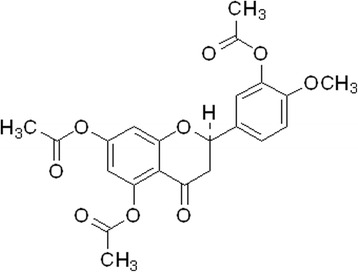
We recently reported that hesperetin-5,7,3'-O-triacetate (HTA) dually inhibited phosphodiesterase (PDE)3/4 with a therapeutic ratio of 20.8. The application and development of PDE4 inhibitors for treating asthma or COPD are limited by their side effects, such as nausea, vomiting and gastric hypersecretion. PDE4 inhibitors were reported to reverse xylazine/ketamine-induced anesthesia in rats and triggered vomiting in ferrets. Thus the reversing effect of HTA on xylazine/ketamine-induced anesthesia in mice was studied to assess emetic effect of HTA. The aim of this study was to prove the therapeutic effect of HTA without vomiting effect at an effective dose for treating COPD.
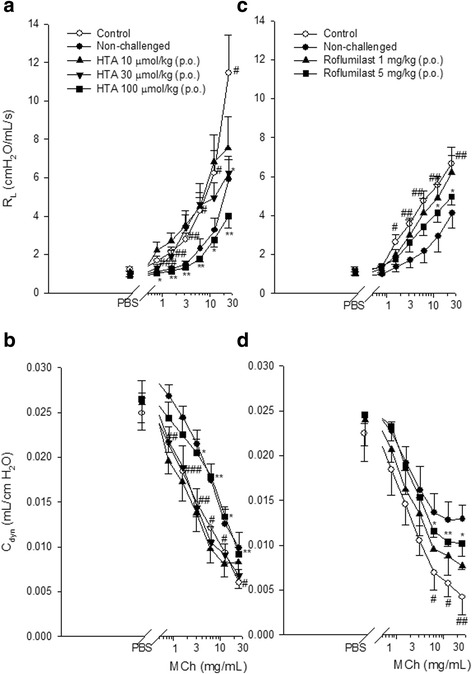
Ten female BALB/c mice in each group were sensitized by ovalbumin (OVA) on days 0 and 14. On day 21, these mice were emphasized the sensitization by Freund's complete adjuvant. Mice were challenged by 1% OVA nebulization on days 28, 29, and 30. Airway hyperresponsiveness (AHR) was assessed on day 32 in each group, using the FlexiVent system to determine airway resistance (R) and lung dynamic compliance (C) in anesthetized ovalbumin (OVA)-sensitized and challenged mice. Each group was orally administered HTA (10 ~ 100 μmol/kg), roflumilast (1 and 5 mg/kg) or vehicles (controls) 2 h before and 6 and 24 h after OVA provocation. For comparison, sham-treated mice were challenged with saline instead of 1% OVA. The ability to reverse xylazine/ketamine-induced anesthesia by HTA or roflumilast for 3 h was determined in normal mice. We used roflumilast, a selective PDE4 inhibitor and bronchodilator for severe COPD approved by the US Food and Drug Administration, as a reference drug.
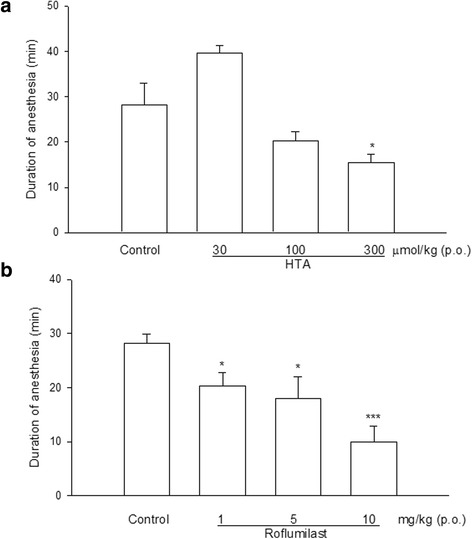
In the results, HTA (100 μmol/kg, p.o.) or roflumilast (5 mg/kg, p.o.) significantly suppressed all R values of MCh at 0.78 ~ 25 mg/mL and enhanced C values of MCh at 3.125 ~ 25 mg/mL compared to OVA-sensitized and -challenged control mice. Orally administered 1, 3 or 10 mg/kg roflumilast, but not 30 or 100 μmol/kg HTA, significantly reversed xylazine/ketamine-induced anesthesia.
In contrast to roflumilast, HTA may ameliorate COPD but induce few side effects of nausea, vomiting and gastric hypersecretion at an effective dose for treating COPD, because HTA did not reverse xylazine/ketamine-induced anesthesia in mice.
我们最近报道,橙皮素-5,7,3'-O-三乙酸酯(HTA)双重抑制磷酸二酯酶(PDE)3/4,治疗比值为 20.8。PDE4 抑制剂在治疗哮喘或 COPD 方面的应用和发展受到其副作用的限制,如恶心、呕吐和胃酸分泌过多。据报道,PDE4 抑制剂可逆转沙利度胺/氯胺酮诱导的大鼠麻醉,并引发雪貂呕吐。因此,研究了 HTA 对沙利度胺/氯胺酮诱导的麻醉在小鼠中的逆转作用,以评估 HTA 的呕吐作用。本研究旨在证明 HTA 在有效治疗 COPD 的剂量下没有呕吐作用的治疗效果。
每组 10 只雌性 BALB/c 小鼠,分别于第 0 天和第 14 天用卵清蛋白(OVA)致敏。第 21 天,这些小鼠用完全弗氏佐剂加强致敏。第 28、29 和 30 天,用 1%OVA 雾化对小鼠进行攻击。在每组中,使用 FlexiVent 系统在麻醉的卵清蛋白(OVA)致敏和攻击的小鼠中测定气道阻力(R)和肺动态顺应性(C),以评估气道高反应性(AHR)。在 OVA 激发前 2 小时和激发后 6 小时和 24 小时,每组分别给予 HTA(10 至 100μmol/kg)、罗氟司特(1 和 5mg/kg)或载体(对照)。为了比较,假处理的小鼠用生理盐水代替 1%OVA 进行攻击。在正常小鼠中,通过 HTA 或罗氟司特(3 小时)确定逆转沙利度胺/氯胺酮诱导的麻醉的能力。我们使用罗氟司特,一种美国食品和药物管理局批准的用于治疗严重 COPD 的选择性 PDE4 抑制剂和支气管扩张剂,作为参考药物。
HTA(100μmol/kg,po)或罗氟司特(5mg/kg,po)显著抑制了 OVA 致敏和攻击的小鼠对 MCh 的所有 R 值(0.78 至 25mg/mL),并增强了 MCh 的 C 值(3.125 至 25mg/mL)。与 OVA 致敏和攻击的对照小鼠相比。罗氟司特 1、3 或 10mg/kg,但不是 HTA 30 或 100μmol/kg,可显著逆转沙利度胺/氯胺酮诱导的麻醉。
与罗氟司特相比,HTA 可能改善 COPD,但在有效治疗 COPD 的剂量下引起恶心、呕吐和胃酸分泌过多等副作用较少,因为 HTA 未在小鼠中逆转沙利度胺/氯胺酮诱导的麻醉。