Lee Richard, Huelsen Alexander, Saad Nivene, Hodgkinson Peter, Hourigan Luke F
Department of Gastroenterology and Hepatology, Princess Alexandra Hospital, Woolloongabba, Queensland, Australia.
School of Medicine, University of Queensland, St Lucia, Queensland, Australia.
Case Rep Gastroenterol. 2017 Apr 28;11(1):241-249. doi: 10.1159/000468515. eCollection 2017 Jan-Apr.
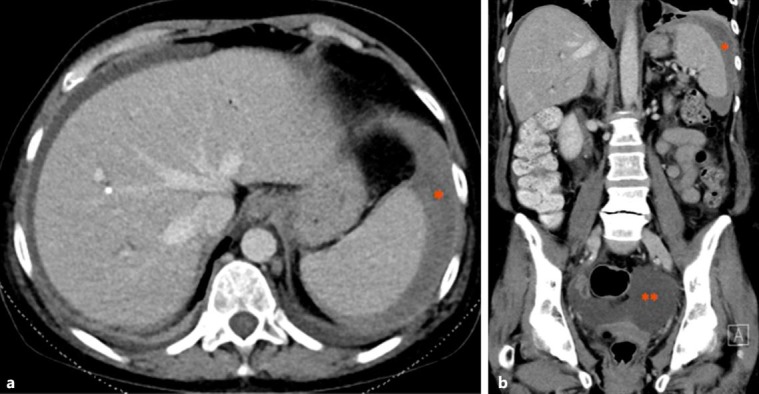
Splenic injury following endoscopy is a rare but potentially fatal complication. While this has been found to occur more frequently after colonoscopy, splenic injury following endoscopic retrograde cholangiopancreatography (ERCP) remains highly uncommon since its first reported case in 1989. Indeed, there have been only 19 such cases reported in the English, German, and Spanish literature collectively over the past 27 years. We report on a 59-year-old woman who developed a peri-splenic haematoma diagnosed on abdominal computed tomography the day following ERCP and stenting for Mirizzi syndrome. The patient was treated conservatively and made a full recovery. We reviewed all cases of post-ERCP splenic injuries reported to date and discuss the published opinions on the likely mechanism of injury, predisposing factors, presenting features, investigation, and treatment options. Ultimately, patient outcome relies on clinical suspicion of this rare complication following ERCP.
内镜检查后发生脾损伤是一种罕见但可能致命的并发症。虽然已发现这种情况在结肠镜检查后更频繁地发生,但自1989年首次报告病例以来,内镜逆行胰胆管造影术(ERCP)后发生脾损伤仍然极为罕见。事实上,在过去27年中,英文、德文和西班牙文文献总共仅报告了19例此类病例。我们报告了一名59岁女性,她在因Mirizzi综合征接受ERCP和支架置入术后第二天,经腹部计算机断层扫描诊断为脾周血肿。该患者接受了保守治疗并完全康复。我们回顾了迄今为止报告的所有ERCP后脾损伤病例,并讨论了关于可能的损伤机制、易感因素、表现特征、检查及治疗选择的已发表观点。最终,患者的预后取决于对ERCP后这种罕见并发症的临床怀疑。